


The Queen of the Pesos: The 1905-S Straight Serif, Part 3 of My Obsession

Back in September 2021, at the tail end of a very long blog, we made a bold claim. We called the 1905-S Straight Serif the new Queen of the Pesos. Then, with the confidence of someone who had just crowned a coin on his own blog, we promised to return in three years to see whether the crown still fit.
That was five years ago. Life happened. Other obsessions happened. But the promise stayed, and so did the question.
So here we are. Part 1, back in November 2020, was about the eyes: how to tell a true Straight Serif from its twin. Part 2, in September 2021, covered the numbers and the money, and that’s where the Queen idea was born. Part 3 is the verdict.
This time, we didn’t rely on hunches or Facebook chatter. We went back to the census reports, auction records, and price guides and let them do the talking. Spoiler: they had a lot to say.
First, a Refresher: What Makes a Straight Serif
Every 1905-S peso came from the same mint in the same year, with a mintage of 6,056,000 coins. A single punch splits them into two.
On the Straight Serif, the upper serif of the “1” in the date is straight. That makes the top of the numeral look like a small triangle. On the more common Curved Serif, that same serif is distinctly curved. The catalogs call our coin Allen-16.06a, FS-301, and PCGS gives it its own number, #90387. Greysheet notes that the straight style became the normal punch for the 1906 pesos, which makes the 1905-S Straight Serif a kind of preview of the year to come.
Simple enough on paper. On a worn coin, under bad light, in a Facebook group at midnight? Not so simple. That’s why Part 1 existed. We kept seeing the same question pop up: Is this straight or curved?
So we did what any sane collector would do. We bought the coins, six of them, three of each variety, and stared at them under macro until they gave up their secrets. We found nine points where the two varieties part ways, all on the eagle side of the coin. Only one of them, the serif itself, is the catalog standard. The other eight are our own observations, and they work best together.
We won’t repeat all nine here. The full walkthrough, with close-up photos of every point, lives in Part 1: 1905s Straight Serif vs. Curved Serif: The Diagnostics. Never read it? Now’s a good time. Tired of reading? Watch the video instead. Yes, we produced a video to make sure more people understand that we discovered these diagnostics.
A Small Side Note on Borrowed Photos
Some of you may remember this. A few of the photos from Part 1 took a little trip without us. They turned up in a book, lifted from the blog without anyone asking permission. The reaction, when we pointed it out after launching our video a couple of weeks ago, was quick. Actually very quick. A phone call at midnight, to air his side, I suppose. Then messages with photos of the pages from the book where our name appears in the book. And yes, our name is in there, as “his friend” who shared the findings with him. The blog, the post, and the photos as a source? Not so much. For a seasoned author with several co-authored books, we expected the basics: ask first, then credit the source properly, right beside the image. Photograph, title, website, link. A friend’s name in passing is a mention. It is not a citation.
So, for the record, here is the proper one. The photos come from the Part 1 post on NineteenKopongKopong, November 14, 2020. Anyone is welcome to use them. Just ask first.
Lesson learned. Watermarks are cheaper than friendships. Anyway, back to the Queen.
Why does any of this matter to a Queen? Because attribution drives the census. A Straight Serif in an old holder that just says “1905-S” doesn’t get counted as a Straight Serif. It’s hiding in plain sight. Keep that in mind. It comes back later.
Before we crown anything, it’s only fair to show you how we compiled the numbers. Here’s the short version.
PCGS. We read the PCGS Population Report for the Peso (1903–1945) directly, as of July 9, 2026. Mint State counts include the base and plus grades from MS60 to MS70. Circulated counts are simply the total minus the Mint State count.
NGC. The NGC Census stubbornly refused to load in our research tools, so we went old school. We took screenshots of the live census pages on September 24, 2026, for the 1905-S, 1906-S, 1911-S, and 1912-S varieties. Then we transcribed them grade by grade and checked each line against its total. The 2022 comparison figures come from a July 2022 NGC Registry forum post that quoted the census at the time.
ANACS. Its population report sits behind a member login, and collectors report that it leaves out details-graded coins. We couldn’t pull a single count for any USA-PHIL peso.
Auction prices. The PCGS CoinFacts and Auction Prices Realized pages for #90387 provided the record sale. We tracked down Heritage and Stack’s Bowers lots through search because both hide realized prices or block automated access. We filled in wholesale bids and value ranges in Greysheet.
The baselines. For “then” versus “now,” we used the PCGS article “A Collector’s Guide to U.S. Philippine Coins Part II” (July 2018) for the Mint State counts and a 2019 Heritage lot description for the variety totals.
The math. Rankings sort the 13 business-strike pesos from 1903 to 1912 by population. The Straight Serif’s share is its count divided by the combined total of both 1905-S varieties. Any calculated or inferred values are labeled accordingly.
One ground rule applies to every number below: population reports count grading events, not coins. A coin sent back for a better grade, or transferred from one grader to another, can be counted more than once. Keep a pinch of salt handy.
You’ll notice that most of this story leans on PCGS. That’s intentional.
For the USA-PHIL pesos, PCGS is where the serious action is. It’s where the registry sets are built, and most collectors of this series live and die by its census. PCGS also treats the Straight Serif as its own coin (#90387) and makes it a required slot in its One Peso and Complete Basic registry sets, not just the “all varieties” set. The basic set. If you want to finish, you need one.
NGC works differently. It treats the serif as a label for a single date, so any coin sent in without that request lands in the plain “1905-S” line, regardless of its serif. Straight Serifs can hide there.
Then there are the crossovers. When a valuable coin moves from NGC or ANACS to PCGS and the old holder’s tag isn’t returned, the coin is counted at the old grader and again at PCGS. PCGS’s 2018 guide describes exactly this for the 1906-S. Of four NGC Mint State 1906-S pesos, the author had crossed two to PCGS without returning the tags and knew of a third.
Our rule is simple. PCGS is the reference census. NGC and ANACS are supporting witnesses. When we add their numbers, we treat the total as a ceiling, not a head count.
Now for the fun part.
Line up all 13 business-strike pesos from 1903 to 1912 by PCGS population, and the picture is hard to argue with.

The 1906-S sits alone at the top with 56 coins graded. That’s the King, and nobody is contesting that throne. Right behind it is the Straight Serif at 114, then the 1912-S at 124 and the 1911-S at 158. After that, the field opens up quickly. The Curved Serif has 307. The common dates range from about 450 to over 900.
Second of thirteen. Not a bad seat.
Here’s a bit of history that still makes us smile. In July 2018, PCGS called the 1906-S and 1912-S “the King and Queen of the Mint State Peso Series.” The Queen title reflected Mint State scarcity.
At the time, PCGS had graded 12 Mint State 1912-S pesos. And the Straight Serif? Six. Fewer than the Queen. Even one fewer than the King. It simply wasn’t invited to the ball. It was a variety, not a date, and in 2018, that was enough to keep it out of the conversation.
So we ran the same test eight years later.

Today, PCGS counts 15 Mint State Straight Serifs, compared with 8 for the 1906-S, 24 for the 1912-S, and 33 for the 1911-S. Among the key dates, only two still have fewer than 20 coins in Mint State. The King and the Straight Serif.
And the top end is capped. No Straight Serif is above MS64. None. The 1912-S reaches MS66, and the 1911-S reaches MS67.

Look at it another way. For every ten Straight Serifs PCGS has graded, only about 1.3 are Mint State. That’s the lowest ratio of the key dates, just under the 1906-S. About 87% of the Straight Serifs at PCGS are circulated. These coins worked for a living.

A small footnote from the September 23 update: PCGS now shows 117 Straight Serifs, 16 of them in Mint State. One more MS62 walked in the door. The ranking doesn’t move.
Whenever a population doubles, the first question any collector should ask is: did somebody just dump a hoard on the market?
The Straight Serif’s PCGS count did double, from 56 in 2019 to 114 in 2026. Its Mint State count grew 2.5 times since 2018. But the Curved Serif grew almost exactly as fast, 2.3 times, and the 1912-S doubled too.
The telling number is the share. In 2019, Straight Serifs were 29% of all attributed 1905-S pesos at PCGS. Today they’re 27%. About one in four, then and now.

If a hoard had surfaced, that share would have jumped. It didn’t. What we’re seeing is more submissions and better attribution across the board. Which, if we may say so, is partly the point of Parts 1 and 2.
One more thought from that share. If about 27% of the 6,056,000 coins struck were Straight Serifs, the variety’s original mintage would be roughly 1.6 million. That’s our estimate, not a Mint record. Heritage made the same “about one-fourth” inference in 2019. And on that basis, the Straight Serif survived at about the same rate as the Curved Serif. Its rarity comes from being a smaller slice of the mintage, not from heavier melting. Greysheet reports that as many as 90% of the 1905-S pesos were melted by 1911, when silver rose above face value. Both varieties went into that same fire.
Same Auction, Same Grade: The Price Ladder
Population tells you how many. Price tells you how badly people want one. And for this part of the story, the market handed us an almost perfect experiment.
In August 2024, at Heritage’s ANA Signature sale, two lots apart, a PCGS MS63 1906-S from the Byron Milstead Collection sold for $156,000. That’s the 1906-S auction record. Two lots earlier, a PCGS MS63 Straight Serif from the Mahal Collection sold for $45,600, the record for the variety.
Same sale. Same week. Same grade. Same grading service.
The best PCGS MS63 1912-S result we could find? $14,100.

Hold the grade equal, and the three coins fall into a clean ladder. The King is about 3.4 times the Straight Serif. The Straight Serif is about 3.2 times the 1912-S. And that order matches the PCGS census exactly: 56, 114, 124 in all grades, and 8, 15, 24 in Mint State.
Now, about fairness. That 1912-S MS63 result is from 2017, seven years before the other two, and prices across the series have risen since then. So treat the ratio as a signal, not a precise measurement. But here’s a newer data point that points the same way. In August 2022, a PCGS MS64 1912-S sold at Stack’s Bowers for $24,000. It was a full grade higher than our Queen’s record coin and brought barely half.
What about the 1912-S’s $90,000 record? That was an MS66, sold in August 2024. It’s a real record, but it lives in gem grades that neither the King nor the Straight Serif has ever reached. You can’t compare a coin to a grade it doesn’t exist in.
And just to show how far this little coin has come:

In 2018, a raw Straight Serif could be had for Php 10,000 to 15,000, about $200 to $300. By 2021 it was Php 30,000 to 40,000, about $600 to $800. In 2024, a PCGS MS63 hammered at $45,600.
A crown shouldn’t depend on one witness. So we checked NGC and tried ANACS.
At NGC, as of September 24, 2026, the Straight Serif has 44 entries. The 1906-S has 88. The 1912-S has 138. The 1911-S has 141. On NGC’s census, the Straight Serif is the scarcest of the four, even scarcer than the King.
Don’t get too excited. That’s mostly an attribution effect, plus crossovers. NGC’s 1906-S line is heavy with details-graded coins, at least 67% of it. Many of its best 1906-S coins have moved to PCGS. And NGC holds 308 plain “1905-S” pesos with no variety on the label. At PCGS’s 27% share, that could mean up to about 80 more Straight Serifs. The real number is probably lower, because suspected Straight Serifs are exactly the coins owners pay to attribute.
That same habit explains another oddity. NGC lists nearly three times as many Straight Serifs as Curved Serifs, 44 against 15. At PCGS it’s the reverse. Nobody pays extra for a Curved Serif attribution.
In Mint State, NGC shows 5 Straight Serifs, 4 for the 1906-S and 12 for the 1912-S. NGC’s finest Straight Serif is MS62, one grade above its finest 1906-S. And the NGC Straight Serif line grew fastest of the four since 2022, up 76%, from 25 to 44. Most of the new entries are details-graded coins. A variety that collectors have only recently started attributing.
Put the two graders together, and the order holds.
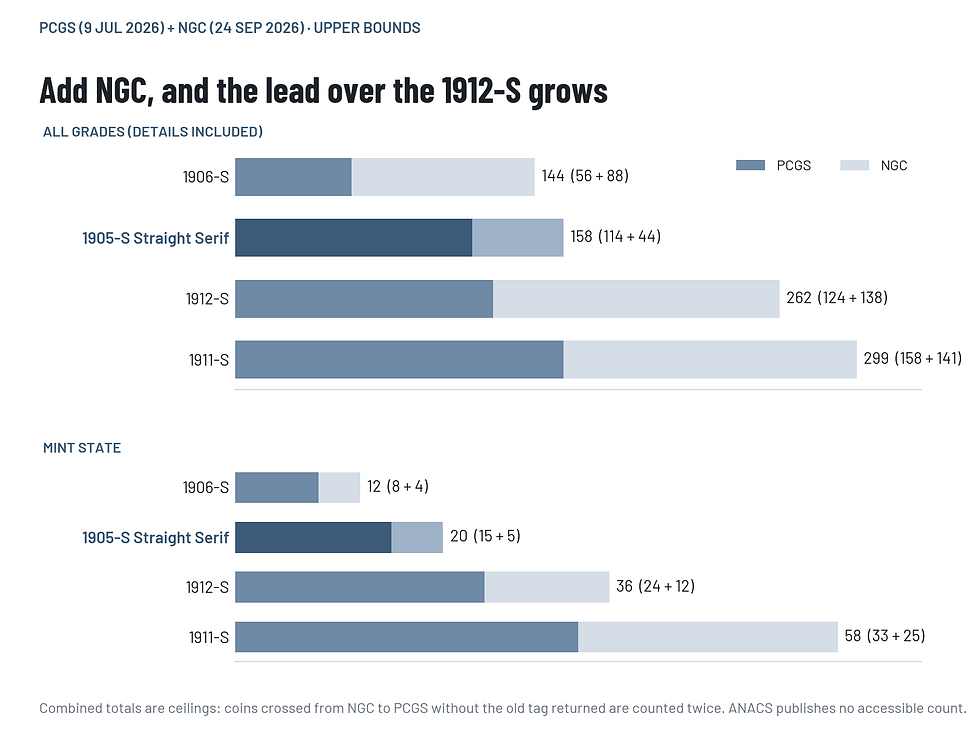
Combined, the Straight Serif has 158 entries against 144 for the 1906-S, 262 for the 1912-S, and 299 for the 1911-S. In Mint State: 20, against 12, 36, and 58. At PCGS alone, the Straight Serif leads the 1912-S by only 10 coins. Add NGC, and that gap grows to 104.
As for ANACS, we found no Straight Serif in an ANACS holder. Only a few 1906-S pieces turned up, including an old-holder MS61 that PCGS noted in 2018. But one find made us grin. A collector post from 2010, citing all three grading services, named the 1905-S Straight Serif as possibly “the next rarest” after the 1906-S.
Sixteen years ago, somebody already saw it coming.
The Queen’s Test
Here is everything on one page. The Straight Serif against the 1912-S, the Queen of 2018, measured, measure by measure.

On every population count we could document, the Straight Serif is scarcer than the 1912-S. By 8% at PCGS in all grades. By 38% at PCGS in Mint State. By 40% combined, and by as much as 68% at NGC. At the same grade, it has brought about three times the best 1912-S result found.
The only row the 1912-S wins is the top grade. It exists as a gem. The Straight Serif doesn’t. But that doesn’t really support the 1912-S claim to remain Queen. Remember “mint-state scarcity.”
Let’s lay it out plainly.
By PCGS population, the Straight Serif ranks second of the 13 business-strike pesos, behind only the 1906-S. That holds in all grades (114) and in Mint State (15).
Mint State is where it’s thinnest. Only the 1906-S and the Straight Serif have fewer than 20 Mint State coins at PCGS. None is finer than MS64, and about 87% of PCGS coins are circulated.
The growth is steady, not a flood. The PCGS count has doubled since 2019, but so did the Curved Serifs. The share is held at 27 to 29%. No sign of a hoard.
At the same grade, the market ranks it second. In PCGS MS63: $156,000 for the 1906-S, $45,600 for the Straight Serif, $14,100 for the best 1912-S found.
NGC agrees on the 1912-S comparison. 44 NGC entries against 138. Five Mint State coins against 12.
Combined census totals are ceilings. Because of crossovers, the true number of distinct Straight Serifs lies somewhere between 114 and 158, and in Mint State between 15 and 20. The PCGS figures are the ones to quote.
ANACS adds nothing measurable. No Straight Serif is documented in an ANACS holder.
Finally, our conclusions…
In 2018, the 1912-S earned the Queen title on Mint State scarcity. We applied the very same test in 2026, with the very same census, and the Straight Serif passes it more convincingly than the 1912-S does. It’s scarcer in all grades. It’s scarcer in Mint State. It’s scarcer at NGC. And at the same grade, the market now pays roughly three times more for it.
So, on the evidence, yes. The 1905-S Straight Serif ranks directly beneath the 1906-S and above the 1912-S. After 5-6 years of speculation, we can safely conclude that the 1905-S Straight Serif is indeed the Queen of the USA-PHIL Pesos.
But a good argument shows its weak spots too, so here are ours.
It’s a die variety, not a separate date. Its rank depends on graders attributing it, and some collectors build date sets without varieties at all. If a large batch of unattributed 1905-S coins were suddenly attributed, the numbers could shift. At PCGS, the lead over the 1912-S in all grades is only 10 coins. It is nowhere near the King, in population or in price. And the 1912-S keeps a far deeper high end, with gems the Straight Serif will probably never have.
A Queen, then. Not a pretender to the throne.
And what about the “undervalued” label from Part 2 of our blog? At the top grades, the market has caught up. $45,600 is no bargain. If there’s still value left on the table, it’s in the circulated grades, where most of these coins live and where the price evidence is thinnest.
A Word to Fellow Collectors
If there’s one practical lesson here, it’s this: because attribution drives the population, the diagnostics are your real protection.
Before you buy a raw 1905-S, check the serif of the “1.” Then check the eagle. Use the nine points from Part 1 together, not just one. And if a holder simply says “1905-S,” look again. A Queen may be inside, waiting to be recognized.
We’ll run these numbers again in 2029. This time, we promise, three years will actually mean three years.
Until then, happy hunting.
Where everything has a past… and some even have a future.
Sources
Lichauco, Sandy. “1905s Straight Serif vs. Curved Serif: The Diagnostics.” NineteenKopongKopong, 14 Nov 2020.
Lichauco, Sandy. “The Undervalued 1905s Straight Serif: Part 2 of My Obsession.” NineteenKopongKopong, 19 Sep 2021.
Lichauco, Sandy. “USPI 1905-S One Peso Curved (Allen-16.06) vs. Straight Serif (Allen-16.06a): A Visual Comparison.” Academia.edu, 2020.
PCGS. Population Report: Peso (1903–1945). Updated 9 Jul 2026 and 23 Sep 2026.
PCGS. “A Collector’s Guide to U.S. Philippine Coins Part II: Mint State Pesos.” PCGS News, 9 Jul 2018.
PCGS. CoinFacts and Auction Prices Realized, #90387.
NGC. NGC Census, 1905-S, 1906-S, 1911-S and 1912-S USA-PHIL Peso varieties.
NGC Collectors Chat Boards. “U.S. / Philippine Peso Set.” Jul 2022.
Heritage Auctions. ANA Signature #1376, lots 4482, 4484 and 4488 (Aug 2024); #1298, lot 4401 (Aug 2019); #1258, lot 4266 (Aug 2017).
Stack’s Bowers Galleries. Philippines Peso 1912-S, PCGS MS-64 (Aug 2022).
CDN Greysheet. 1905-S Straight Serif (GSID 26005), 1906-S (GSID 26007) and 1912-S (GSID 26012) listings.
Collectors Universe Forums. “US-PI Collectors, is this a genuine 1906-S Peso?” 12 Mar 2010.


Comments