


The Sister's Book: Inside the 1909 Tagalog Noli Me Tángere
Updated: Oct 23
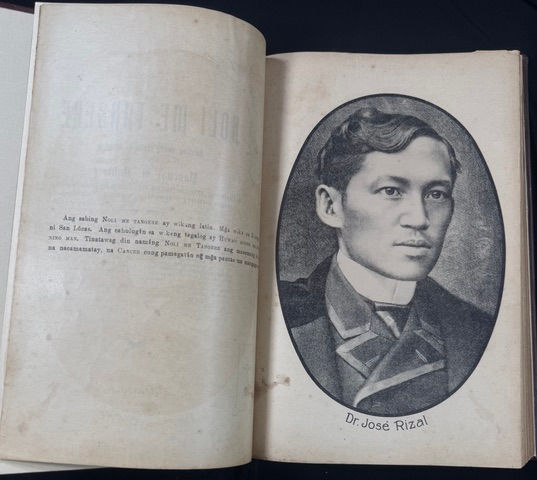
There are two ways to own a piece of the Noli Me Tángere story. One costs eight figures, comes wrapped in Japanese paper, and belongs to a rarefied circle of buyers who track Rizaliana the way other people track blue-chip stocks. The other costs a fraction of that. It sat forgotten in bookstore bodegas for decades, and it carries something those million-peso copies simply don't: the actual handwriting of Rizal's own family, deciding — on their own initiative, with their own money — that his most famous novel belonged to every Filipino, not just the ones who could afford to read Spanish.

That second book is what we want to talk about here. Pascual H. Poblete translated the 1909 Tagalog version of the Noli, and Saturnina Rizal, Jose Rizal's eldest sister, published it. By every scholarly account we could dig up, it's the first time the novel existed in the language of the people it was actually written about. And the more we sat with that fact, the more we realized something: this book doesn't belong in the same conversation as the Berlin first edition. Not a lesser conversation. Just a different one entirely. Everyone who sat through the mandatory Rizal course remembers the broad strokes. Noli Me Tángere, written in Spanish, printed in Berlin in 1887 with borrowed money, banned within the year, used as evidence to justify a firing squad in 1896. What almost never makes the syllabus is what happened to the book after Rizal was gone, and the person who did the most to bring it back to Filipino hands wasn't a government commission, and it wasn't a publishing house either. It was his sister – “Neneng.”
Saturnina "Neneng" Rizal was the eldest of the eleven Rizal-Mercado children, old enough to
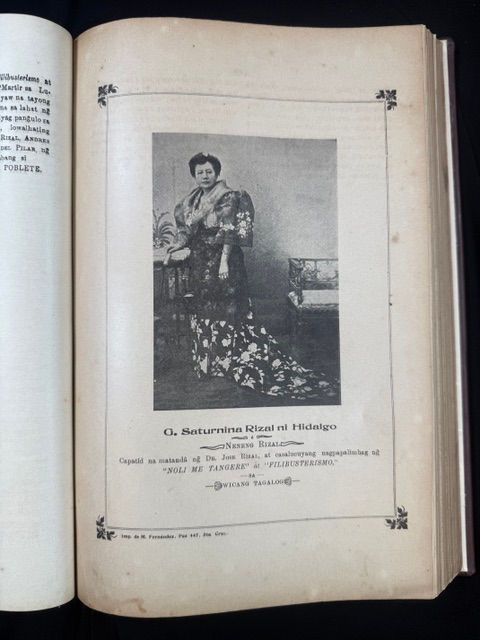
remember her brother before Europe, before the ilustrado circuit, before any of it. She ran her own shop in Sta. Cruz, Manila—the kind of hands-on commercial instinct she'd picked up from their mother, Teodora Alonso, who managed the family's business affairs long before "entrepreneur" was a word anyone used for a woman of that era. In 1909, thirteen years after her brother's execution, Saturnina commissioned a Tagalog translation of the Noli and published it herself. Her name sits on the title page not as a dedication, and not as some sponsor's footnote, but as “Ipinalimbag” ni Neneng Rizal — published by Neneng Rizal. The imprint is precise about it, too: Limbagan ni M. Fernandez, Paz 447, Sta. Cruz, Manila; 531 pages.
That word, publisher rather than patron, is the whole ballgame for us. Plenty of Rizal-adjacent objects exist because someone in the family happened to own them, inherited them, or once got photographed standing near them. This one is different. It exists because a Rizal sibling sat down and made an editorial and commercial decision, full stop: my brother's book needs to exist in Tagalog, and I am the one who is going to make that happen.
Saturnina didn't hand this off to just anyone. She went to Pascual H. Poblete, who by 1909 was one of the most credentialed figures in Filipino letters — and, depending on which colonial government you asked, one of the more dangerous names in the country. Poblete co-founded

Diariong Tagalog in 1882 with Marcelo H. del Pilar, the first bilingual newspaper in the Philippines, with Poblete editing the Tagalog section while del Pilar ran the Spanish side. He moved through the reformist and revolutionary press throughout the Katipunan years, went into exile in Spain, helped found the Philippine Independent Church, and organized some of the country's earliest labor and political movements when he finally came home. In 1901, Poblete first floated the idea of a Rizal monument on the Luneta—an idea that helped set in motion what eventually became Act No. 243 and, later, the actual monument. Under the Americans, they arrested him over his play Pag-ibig sa Tinubuang Lupa, which they deemed too seditious for the stage. Today, though, he's remembered simply as the first person to translate Rizal's Noli Me Tángere into Tagalog. Everything else tends to fall away.
So this one book carries two people's worth of history bound into a single spine. The sister who decided it needed to exist, and the revolutionary journalist she trusted to make it sing in the vernacular. As a bonus, Poblete's own biography of Rizal is bound into the same volume, which means a complete copy isn't just a translated novel. It's a translated novel plus an early, first-hand-adjacent account of the man's life, written by someone who lived through the era he described.
The 1909 Noli wasn't printed and shelved in one clean run. Like many ambitious Philippine publishing projects of the era, it went out by subscription. Poblete's translation was released in 16 installments, sold weekly, until the full 531-page text finally reached subscribers. Buyers then had to bind those accumulated pages themselves, usually at their own expense, using whatever binder was convenient and affordable.
We believe this detail matters enormously for anyone evaluating a copy today, and here's why. It means there was never a single, uniform "first printing" the way we think of a modern press run. Instead, there was a scattering of loose gatherings that individual owners eventually turned into books, some quickly, some over months. It also means survival was never guaranteed, and never even. Incomplete subscriptions, missing installments, amateur home binding, water damage, insect damage — all of it has thinned the surviving population unevenly, book by book, decade by decade. A complete copy, full 531 pages with Poblete's Rizal biography intact, has simply had more chances to go wrong than a book from a conventional single print run, and it survived anyway, and that's key to collecting old stuff: "survivability." The ability to survive intact over decades- there is value to that.
"First Tagalog Noli" gets thrown around loosely in listings and social posts, so before we repeated it ourselves, we wanted to know whether the historical record actually backs it up. Short answer: it does. The most rigorous account we found is Anna Melinda Testa-De Ocampo's "The Afterlives of the Noli me Tángere," published in Philippine Studies out of Ateneo de Manila University. It reconstructs the novel's entire translation history, starting right after 1887 and working forward. Her bibliography lists a string of pre-1909 reprints and abridged editions out of Spain — Valencia and Madrid in 1902 and 1903, Barcelona in 1902 and 1903, Manila (though printed in Spain) in 1908 — but here's the thing: every single one of them is in Spanish. Some carry the descriptive label novela tagala, "Tagalog novel," which refers to the book's subject and setting, not the language it's written in, and has apparently confused more than one collector over the years. The University of Michigan Library's Worcester Philippine History Collection confirms the same pattern independently. Their earliest Noli holdings are a 1899 Chofré y Compañía edition out of Manila and a 1909 Casa Maucci edition out of Barcelona — both Spanish, no exceptions.
Testa-De Ocampo states it plainly: across the entire American colonial period, only three Tagalog or Filipino-language editions of the Noli were ever produced, against twelve in Spanish, one in Japanese, and four more spread across other Philippine languages. Poblete's 1909 translation was the first of those three, ahead of Patricio Mariano's later, more widely used school translation, and ahead of Pedro Gatmaitan's 1926 version too. Wikipedia's own entry on Poblete lands on the same conclusion from a completely different angle, calling him plainly "the first translator of the Bible and José Rizal's novel Noli Me Tangere into the Tagalog language." An academic literature review and a general reference, arriving at the same fact by two entirely different roads. As far as we can tell, "first Tagalog Noli" isn't marketing language here. It checks out.
Here's where it gets personal for us. The 1909 Tagalog Noli is the first time the novel existed in the language of the people it was written about. But it wasn't the first time it existed in any language besides Rizal's own Spanish, and sitting with that earlier "first" sharpened, for us, exactly what makes Saturnina and Poblete's book so different.
We've written about that earlier translation before. Au Pays des Moines, "In the Country of the Monks," published in Paris in 1899 by P.-V. Stock, translated by Henri Lucas and Ramon Sempau. It's the actual first translation of the Noli into any language, full stop. And we found it almost by

accident. A friend pointed us to a copy sitting quietly on a European auction site with no bids, and it took me a moment, flipping through the photos, before "Dr. Jose Rizal" on the title page made the air shift. That book now lives on a shelf in Makati, which still feels a little unreal to type out loud. Its backstory is one of the wilder things we've come across in this hobby, and we mean that. One of its translators, Ramon Sempau, was a Spanish anarchist who'd attempted to assassinate a Civil Guard lieutenant notorious for torturing prisoners after a bombing in Barcelona in 1896. The attempt failed, and Sempau was imprisoned at Montjuïc Castle, where — of all people — he met Isabelo de los Reyes, the Filipino patriot and labor organizer held there during the Revolution. That meeting is what set the French translation in motion. Sempau reportedly began the work in his cell, recognizing in Rizal a fellow political martyr. Even the retitling wasn't incidental: calling it Au Pays des Moines deliberately foregrounded Rizal's critique of the friars, aimed squarely at a European audience whose sympathy the Filipino cause badly needed during the Philippine-American War.
Put the two translations side by side, and the contrast actually tells you something real about who each one was for. The French edition existed to carry Rizal's argument outward, into Parisian intellectual circles, into P.-V. Stock's own "Bibliothèque Sociologique" alongside serious European social criticism—aimed at winning European sympathy, not reaching Filipino readers. Rizal apparently considered writing his second novel directly in French if the Noli failed to find an audience in Spanish, since French was still the dominant language of international letters. Poblete's translation, ten years later, runs in the exact opposite direction. It exists to carry the novel inward, back to the very people it was about and who'd been shut out of reading it in the original. One translation was propaganda aimed at Europe. The other was restitution aimed at home.
And that inward-facing intent is exactly what separates Saturnina's 1909 project from every earlier translation, French included. It's the only early edition initiated and financed by a member of Rizal's own family, explicitly to reach ordinary Filipino readers rather than a foreign or elite audience.
If Rizaliana collecting in this country has one dominant public voice, it's Ambeth R. Ocampo—historian, former chair of the National Historical Commission of the Philippines, and longtime writer behind the Inquirer's "Looking Back" column. He's spent over four decades personally buying, selling, and writing about exactly this category of material, so much so that his columns function almost like an informal price index for Philippine rare books.
In his 2023 column "Bibliomania," Ocampo recalls building his own Filipiniana collection in the early 1980s as a college student on an allowance, hunting through Makati bookshops like Erehwon and Alemars, and — tellingly — through the bodega of the prewar Libreria Martinez, tucked behind a girlie bar off the Welcome Rotonda on Quezon Boulevard, where rare Philippine books of exactly this era and type could once be had for next to nothing. He's candid about what that undervaluation cost him personally. A first-edition El Filibusterismo he'd picked up in Marikina for P200, later sold for P8,000, that he now figures would fetch at least a million pesos at auction today. This pattern runs across several of his columns: Philippine antiquarian books were treated as disposable for most of the twentieth century, and the market only recently caught up to what scholars already knew.
On the value side of Rizaliana specifically, Ocampo has tracked the top of the market closely enough to give the rest of us a real sense of scale. In a 2014 column, he noted a first-edition Spanish Noli, Berlin 1887, hammering at Salcedo Auctions for P6 million, or roughly P7 million after premium and tax — a Philippine book auction record at the time. A P5 million sale followed

the next year, then P3.2 million the year after that, showing that even top-tier first editions swing significantly on condition and provenance rather than climbing in a straight line. The record broke again in 2025, when a first-edition Noli inscribed by Rizal himself to his friend Trinidad H. Pardo de Tavera sold at León Gallery for P22.8 million, the highest price ever paid for a Philippine book at that time, before its younger sister, the El Filibusterismo, was sold a couple of months later for P25M, driven almost entirely by the author's own handwriting on the flyleaf.
That top tier, the Spanish first editions, especially the signed ones, occupies a completely different universe of value than the Poblete Tagalog translation. It's worth being honest about why. Those are the novel's actual first editions, printed under Rizal's direct instruction in a run of roughly 2,000 copies, most of which were seized, censored, or destroyed outright. The Poblete Tagalog isn't that book. It's a derivative translation, produced 22 years after the original and 13 years after Rizal's death. But derivative doesn't mean minor, not by a long shot. It's the first edition of a genuinely distinct, independently significant object — the first time Rizal's own countrymen, not the Spanish-reading gentry but ordinary Tagalog speakers, could read the Noli in their own language, at the direct initiative of Rizal's own sister. Collectors and historians treat these as separate, parallel categories of Rizaliana, not points on the same price curve. So we believe the 1909 book's value case has to be argued on its own terms, rather than borrowed from its far more famous Spanish predecessor.
Unlike the Spanish first editions, which surface at the major houses with some regularity and make headlines every time, the Poblete Tagalog translation has a much thinner public auction record, and we believe that thinness is itself a data point about scarcity.
The clearest documented sale we could find is Salcedo Auctions, Lot 215, The Ilustrado Home, held November 15, 2014, where a copy was cataloged explicitly as "Jose Rizal: Noli Me Tangere (First Tagalog translation by Pascual H. Poblete, 1909)," estimated at ₱80,000 to ₱90,000.
A decade later, a private listing on Carousell offered a "heavily used" copy — still complete, still with the Poblete biography intact — asking ₱120,000, and explicitly pitched to Rizaliana collectors, citing Ambeth Ocampo's own research on the subscription publishing model as part of its provenance story. Whether or not that specific ask ever closed at full price, it tracks with the broader trend Ocampo has documented across this whole category: material that was genuinely disposable a generation ago has climbed steadily, as scholars, then dealers, then the wider collecting public caught up to what it actually is.
That's roughly a 33 to 50 percent increase over ten years, on a book that, by both listings' own description, wasn't even in top condition. Which tells me plainly where a genuinely complete, well-preserved copy ought to sit today.
Strip away the auction-house language, and we believe four things compound to make this specific book worth chasing.
Firstness. Verified independently by academic bibliography and general reference sources alike — this is the first time the Noli existed in Tagalog, full stop, plus it is also considered the first illustrated published edition.
Family provenance as publisher, not subject. Saturnina Rizal isn't a footnote sponsor, and she isn't a name attached after the fact. She's the publisher of record. Her decision to fund and release this translation is itself a documented historical act, a Rizal family member choosing, on her own initiative, to widen her brother's readership across the exact language line that had kept most Filipinos out of his own novel.
Translator pedigree. Poblete is a significant historical figure entirely apart from this book. Newspaper pioneer, Rizal-monument advocate, playwright arrested for sedition. His biography of Rizal, bound into the same volume, adds a whole second layer of historical content to the object.
Survivorship. The subscription-and-self-bind production model means completeness — full 531 pages, biography section intact — is genuinely rare rather than a formality. Condition varies unusually widely between surviving copies of a single edition, more than you'd expect.
If you're looking at a copy of this book and trying to work out what it's actually worth to you, the questions that matter most, in order, are these. Is it complete — 531 pages plus the Poblete biography section? Is the binding original to the subscription era, or a later rebind? What shape is the paper in — foxing, insect damage, water staining? And does it carry any provenance beyond the book itself, a bookplate, an inscription, a documented chain of ownership?
In our opinion, none of those questions has a wrong answer that disqualifies a copy from being worth owning. A later rebind with a complete, clean text block is still a legitimate, desirable copy of a genuinely rare book. It just sits at a different point on the value scale than one in its original subscription binding. What would give us pause, personally, is incompleteness. Missing installments or a truncated text undercut the entire reason to chase this edition in the first place, since the whole point is the complete, first-ever Tagalog rendering of the novel, biography and all.
The Berlin 1887 first edition is Rizal's book. The 1909 Poblete translation, published by Saturnina Rizal, is the book his own family decided the rest of the country deserved to read. One belongs to the history of Philippine literature. The other belongs to the history of those who fought, quietly and deliberately, thirteen years after a firing squad at Bagumbayan, to make sure literature actually reached the people it was written for.
And soon, a copy of it will change hands again. This particular Tagalog Noli will be auctioned as Lot No. 1, the opening lot on the very first day, when the Bayanihan Collectors Club, in cooperation with the Ortigas Foundation Library, presents Pamana Cabinet on September 26. Moreton Auctions powers the auction. Its placement on the docket feels fitting. A sale built around the memory of things Filipinos made, kept, and passed down opens with the one book on the table that a Filipino family made sure the rest of us could actually read.
(All images in the Gallery courtesy of the Ortigas Foundation Library and Pamana Auction of the Bayanihan Collectors Club)
Sources:
Mojares, Resil B. Origins and Rise of the Filipino Novel. Quezon City: University of the Philippines Press, 1983. Cited in Testa-De Ocampo, "The Afterlives of the Noli me Tángere."
Ocampo, Ambeth R. "Bibliomania." Philippine Daily Inquirer, August 23, 2023.
Ocampo, Ambeth R. "Much ado over a P27-M book." Philippine Daily Inquirer, February 18, 2026.
Ocampo, Ambeth R. "Personal shopper to the corrupt." Philippine Daily Inquirer, September 5, 2025.
Ocampo, Ambeth R. "Rare books—what finally decides their worth." Philippine Daily Inquirer, June 14, 2017.
Ocampo, Ambeth R. "Sour grapes." Philippine Daily Inquirer, October 1, 2014.
Pascual Poblete: https://en.wikipedia.org/wiki/Pascual_H._Poblete
Rare: First Tagalog Translation of Noli Me Tangere by Pascual Poblete (Published by Saturnina Rizal in 1909)." Carousell listing. Accessed 2026. https://www.carousell.ph/p/rare-first-tagalog-translation-of-noli-me-tangere-by-pascual-poblete-published-by-saturnina-rizal-in-1909-1312683610/.
Rizal, José. Au Pays des Moines (Noli Me Tangere). Translated by Henri Lucas and Ramon Sempau. Paris: P.-V. Stock, 1899.
Lichauco, Sandy. "Rediscovering the 1899 French Translation of the Noli Me Tangere." NineteenKopongKopong, May 17, 2026. https://www.nineteenkopongkopong.com/post/rediscovering-the-1899-french-translation-of-the-noli-me-tangere.
Salcedo Auctions. "Jose Rizal: Noli Me Tangere (First Tagalog Translation by Pascual H. Poblete, 1909)." Lot 215, The Ilustrado Home, November 15, 2014.
Testa-De Ocampo, Anna Melinda. "The Afterlives of the Noli me Tángere." Philippine Studies 59, no. 4 (2011): 495–527.
University of Michigan Library. "Translation and Memory: The Literary Worlds of the Spanish Philippines." Rizal's Noli and Fili online exhibit. https://apps.lib.umich.edu/online-exhibits/exhibits/show/translation-memory/rizals-noli-and-fili.
Wikipedia, s.v. "Pascual H. Poblete." Accessed 2026. https://en.wikipedia.org/wiki/Pascual_H._Poblete.


Comments