


INVESTING IN RIZAL
Updated: 7 days ago
A study examined forty-three lots, thirty-two published prices, and one lesson about what the national hero is really worth at auction to attempt to answer the question: Is Rizal a good investment?
(Updated October 3, 2026. After this post went up three days ago, Ambeth Ocampo wrote to us about the Boustead copy of the Noli. Its ₱500,000 sale in 2004 is now part of the count, and every figure below reflects it.)
(Updated again October 4, 2026. In the spirit of completeness, which is something we love to do, we’ve added two more Rizal items we had forgotten, both auctioned off at León Gallery in June 2026: his flute and his dinner set. Both land in the top twenty, and every figure below reflects them.)
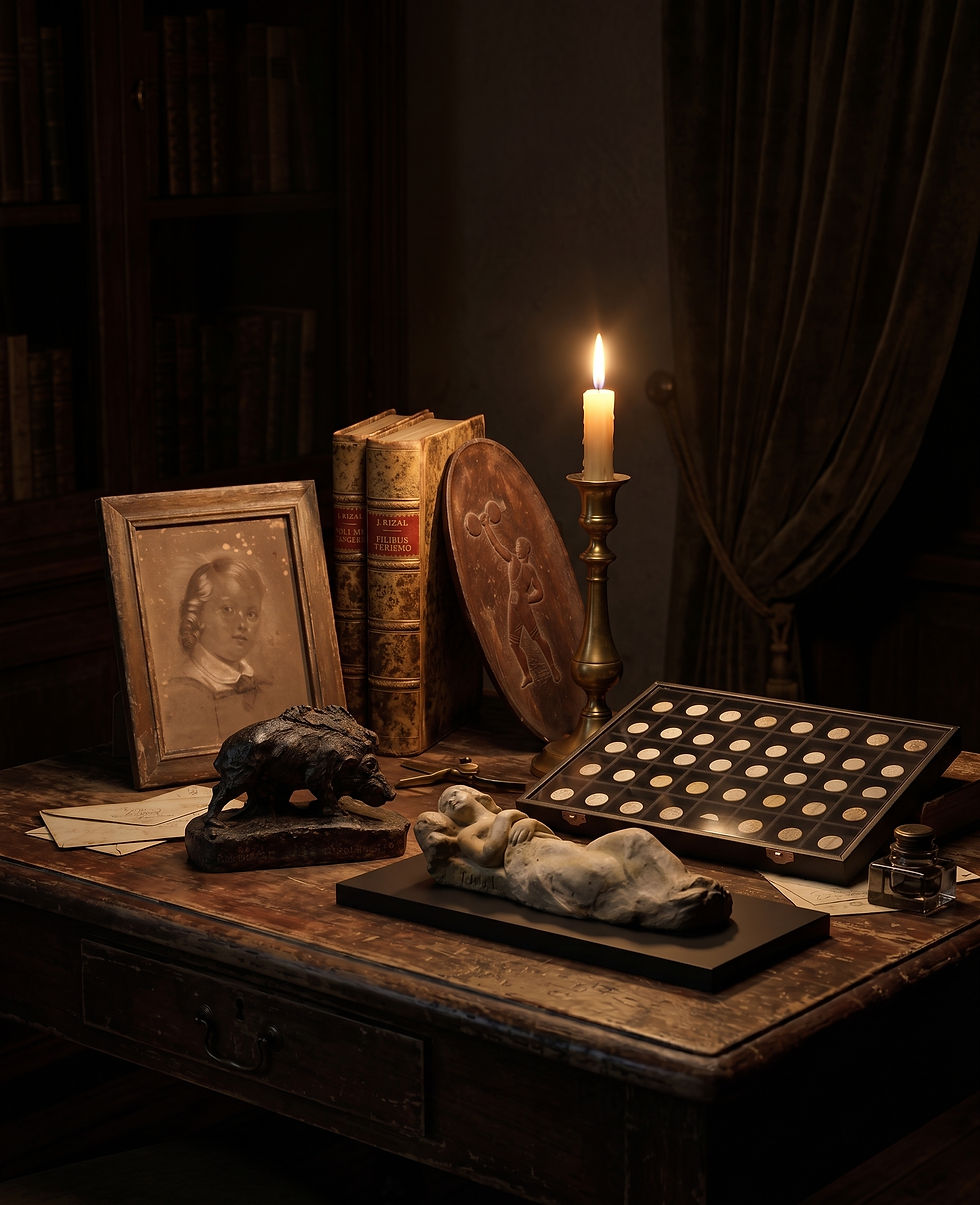
In college, a young Ambeth Ocampo bought a mint first edition of El Filibusterismo for ₱500. A year later, he sold it for ₱7,000. He made fourteen times his money in twelve months. Any fund manager would frame that and hang it in the lobby. Then February 2026 happened. A first-edition Fili went under the hammer in Makati and sold for more than ₱25 million. Granted, that one had Rizal's handwriting in it. Still.
He has written about his own sale, with some feeling, ever since.
So let’s ask the question every collector asks quietly, and no historian likes to hear out loud. Is Rizal a good investment?
We went looking for the answer the only way we trust: by getting down on our knees and counting. We traced every piece of Rizal we could to an auction block between 2004 and September 2026. First editions and translations. Sculpture, drawings, letters, a chess set, a flute, his own fork and spoon. Even the furniture of the man who paid for the Noli. Forty-three lots in all. Thirty-two with a price anyone admits to. ₱193.2 million changing hands in public.

The short answer is yes. The long answer is more interesting and might save you a few million pesos.
First, the lay of the land. This is not a Sotheby’s story. Every documented auction sale of a Rizal book since 2014 has occurred in Makati, at one of two houses, León Gallery and Salcedo Auctions. Searches of Sotheby’s, Christie’s, and Bonhams yield many paintings titled Noli me tangere and Gospel scenes, but not a single Rizal book. Invaluable lists 29 past Rizal lots. Every one is from León Gallery. Every one is in the Philippines. Hold that thought. We will come back to León.
Twenty years sounds like a long track record for an art market, but the Philippine saleroom is actually younger than the window we measured. Salcedo Auctions opened in 2010, and León Gallery began holding auctions in 2013. Before their arrival, formal art auctions in Manila had lapsed completely after The Auction House at the Manila Garden Hotel closed. Because there was simply nowhere to sell a Noli during the early years of our sweep, the book only reached the auction block in five of those twenty years.
The top of this market is front-page news, while the bottom is invisible.
This historical gap created a lopsided, erratic market once tracking began. In total, a massive four orders of magnitude separate the cheapest lot—₱5,750 for eight 20th-century books about Rizal—from the most expensive, a pencil-length plaster sculpture that fetched ₱31.24 million. Wealth in this market remains heavily top-heavy, with the top five lots accounting for 61 percent of the market's total value. Furthermore, stability is still developing; while the median lot sits at ₱2.19 million, eleven of the forty-three lots never published a result, nearly all of them under the ₱2 million mark.
Then came the droughts. Ten years without a first-edition Noli at auction, from 2004 to 2014; Salcedo’s own 2014 catalog called it the first offering in a decade. Then, after a February 2019 offering, came six more years of nothing. Those six years swallowed the pandemic, the lockdowns, and the whole saleroom’s awkward move to online bidding. In 2020 and 2021, not one Rizal lot in our records produced a published price.
And then the dam broke. Three first editions in twelve months: September 2025, December 2025, and September 2026.

Follow the money, and the pattern is starker. Of the ₱193.2 million disclosed in this record, about ₱124 million, or 64 percent, has been spent since January 2024. The five years from 2019 to 2023 together account for barely ₱12 million. The Rizal market didn’t grow steadily for twenty years. It idled for most of that time, then sprinted.

Is that pent-up supply finally reaching the block, or are sellers answering the headlines? The public record can’t tell us yet. What it does tell us is that nearly every benchmark a buyer relies on today was set within the last three years. This market isn’t mature. It is new, and it is loud.
The top twenty

A note before we start. When a buyer’s premium is on record, the figure below reflects what the buyer actually paid, not the hammer price. Only one of the twenty, No. 19, never had a result published; it is marked and ranked at the house’s own estimate.
1. Josephine Sleeping — ₱31,241,600
León Gallery, The Kingly Treasures Auction, 30 November 2024
See it: Philstar
Rizal's portrait of Josephine Bracken, asleep, her form traced beneath a sheet. Plaster of Paris, signed “Rizal,” made in Dapitan between mid-1895 and mid-1896, months before Bagumbayan. It measures 24 centimeters long and 6 centimeters high. Do the math, and the buyer paid about ₱1.3 million per centimeter.
Ten bidders opened at ₱7 million. The National Museum dropped out early, then exercised its legal right of first refusal and matched the winning bid, a first for Philippine art. León’s director called it Rizal’s Mona Lisa. Rarity: Ocampo counts only about 43 surviving Rizal sculptures; many others were lost in the Second World War, and this one passed down directly from his sister Narcisa. It went on display at the National Museum of Fine Arts on Rizal Day 2024. It will never be sold again.
2. El Filibusterismo, first edition, inscribed to Pardo de Tavera — about ₱25.3 million
León Gallery, The Asian Cultural Council Auction, 14 February 2026
See it: The Diarist
Ghent, 1891. Inscribed in Rizal’s hand: “A mi querido amigo el doctor T. H. Pardo de Tavera,” signed and dated Gante, 16 September 1891. Estimated at ₱5 million to ₱6.5 million, it opened at ₱5 million and hammered at ₱21 million. With premium and VAT, it became the most expensive book ever sold in the Philippines.
The Fili is the scarcer novel. Fewer pages, a smaller print run, and a reported shipment of some 800 copies to Hong Kong that was lost, confiscated, or destroyed. León’s director called this “most likely the last signed and dedicated copy in private hands.” Scarcity beat fame. The Noli is the better-known book. The Fili is the harder to find.
3. Noli Me Tángere, first edition, inscribed to Pardo de Tavera — ₱22,830,000
León Gallery, The Magnificent September Auction, 13 September 2025
See it: Asia News Network
Berlin, 1887. Inscribed by Rizal “to the distinguished Filipinista, Don T. H. Pardo de Tavera,” one of the first recipients of the book, and still bearing Pardo de Tavera’s own ex-libris and pencil notes. The estimate was ₱4 million to ₱5.2 million. It opened at ₱10 million, already double the top of that range, and was hammered down at ₱19 million.
Rizal had some 2,000 copies printed. Ocampo counts only three signed copies at auction over twenty-five years. It held the Philippine book record for five months until its younger sibling at number two took it away.
4. The Noli and the Fili, first editions, as one lot — ₱20,427,200
León Gallery, The Kingly Treasures Auction, 6 December 2025, lot 83
See it: PhilSTAR Life.
A matched pair. Berlin, 1887, and Ghent, 1891, bound alike in hand-painted speckled Moroccan leather with the initials “AGM,” from a private collection in Madrid. No inscription. The estimate was ₱6 million to ₱7.8 million; it sold for about 2.6 times the top of the estimate.
Here is what makes this one interesting. Since 2017, unsigned Nolis sold separately have fetched ₱1.75 million to ₱3.2 million. Together, in a matching binding, the pair has sold for several times what the two would likely have fetched separately. It is not a clean price for either book. It is a clear lesson in completeness.
5. The Filipino — ₱17,500,000
León Gallery, The Spectacular Mid-Year Auction, 9 June 2018
See it: Garage Magazine
An oval bas-relief carved in Dapitan: a shirtless young man in knee-length breeches, one hand on his hip, the other raising a dumbbell. Untitled by Rizal; León christened it The Filipino, a wooden riposte to Spanish claims that Filipinos were idle. The resemblance to Rizal himself is hard to miss.
León believed it was perhaps the only wooden work Rizal ever made. It descended through Narcisa’s family and was last seen publicly in the 1962 Pictorial Album on Rizal. Estimated at ₱5 million to ₱6.5 million, it sold a year before the law allowing the National Museum to match private bids, so it went to a private collection. Sayang, from the museum’s point of view.
6. Jabali (Wild Boar) — ₱16,400,000
León Gallery, The Spectacular Mid-Year Auction, 11 June 2016
The first artwork by Rizal ever offered at public auction. A small plaster wild boar, made in Dapitan around 1894. Rizal wrote home about boars raiding at night and shooting so many that he grew tired of pork. He kept one of them in plaster.
Like Josephine and The Filipino, it came straight down from Narcisa. The estimate was ₱3.8 million to ₱4.94 million. It earned more than three times that amount and, for two years, held the record for anything Rizal made.
7. Ivory and bone chess pieces — ₱7,810,400
León Gallery, The Magnificent September Auction, 12 September 2026
See it: The Diarist
Thirty-two pieces, hand-painted by Rizal during his Dapitan exile around 1893, in European and African-inspired designs. Rizal was a serious player. In 1886, in Wilhelmsfeld, he played chess with his host, Pastor Karl Ullmer, at a table where he is said to have finished the Noli.
Estimated at ₱4 million to ₱5.2 million. The National Museum again exercised its right of first refusal, and the set is now in public hands. No other Rizal chess set has surfaced in this record.
8. Noli Me Tángere, first edition, from Narcisa’s descendants — ₱7,000,008
Salcedo Auctions, The Connoisseur Collection, 20 September 2014, lot 363
See it: Invaluable, lot 363
The sale that woke the market. An unsigned Berlin first edition from a descendant of Narcisa Rizal-Lopez, estimated at ₱300,000 to ₱350,000. Ocampo publicly advised bidders not to go past ₱500,000. His ceiling had a precedent: the last first edition sold at auction, the Boustead copy in 2004, had made exactly that.
It hammered at ₱6 million, roughly seventeen times the high estimate, and with premium and VAT, the buyer paid ₱7,000,008. At the time, it was the highest price ever paid for a Philippine book. Salcedo’s catalog noted that it was the first time in a decade a first-edition Noli had been offered at auction. Ocampo’s column on the result was titled “Sour grapes.” We will leave that there.
9. Máximo Viola’s armchair and side chair — over ₱6,000,000
León Gallery, The Asian Cultural Council Art Auction, March 2018
Not Rizal’s at all, and that is the point. Máximo Viola was the friend who financed the printing of the Noli in Berlin. An armchair and a side chair, both of narra and rattan and carved for him by the workshop of Isabelo Tampinco, with bamboo arms, areca-palm legs, and anahaw leaves, sold separately and together, fetched over ₱6 million. The armchair alone fetched ₱3.5 million.
This is the Rizal effect at one remove: furniture that never held Rizal, from a house he never lived in, priced like masterworks because the owner once lent him money.
10. Mi Retiro, in Rizal’s hand — ₱5,407,200
León Gallery, The Kingly Treasures Auction, 2 December 2023, lot 171
See it: The Diarist
The poem Rizal wrote in Dapitan about his exile, a companion piece to Mi Último Adiós. He originally gave it to his mother, Teodora Alonso. This is a second copy, written out and signed by Rizal on two leaves of graph paper, four pages in all, with its envelope addressed “Para Sr. Dr. Pardo, Calle Centeno, No. 7.”
Same recipient as numbers two and three. It sold for more than double its ₱2.6 million high estimate and remains the highest price on this record for any item written in Rizal’s hand that is not a book.
11. Máximo Viola’s carved bed — ₱4,672,000
León Gallery, The Spectacular Mid-Year Auction, 10 June 2017
See it: LiveAuctioneers sale catalog
Carved by Isabelo Tampinco, the great ecclesiastical sculptor, for Viola in 1909, thirteen years after Rizal’s death. Adjacent to Rizaliana again. It sold at the same auction as an unsigned first edition of Noli and outsold the book by about ₱1.5 million.
Read that twice. At the same sale, on the same afternoon, the bed of the man who paid for the novel fetched more than the novel did.
12. Elevation of the façade of Rizal’s academy — ₱3,364,480
León Gallery, The Magnificent September Auction, 13 September 2025, lot 71
See it: The Diarist
Rizal the architect. A pen-and-ink elevation of the school he dreamed of founding, drawn in Hong Kong in 1892 with metric measurements and signed “J. Rizal 16 de Marzo.” It measures 58 by 44 centimeters and depicts a building that was never built. It came to auction from his sister Narcisa's family.
Estimated at ₱1 million to ₱1.3 million, it sold for about 2.6 times the high end. Rizal drawings almost never come to market, and this one is a plan for the future rather than a picture of the past.
13. Noli Me Tángere, first edition, Madrid collection — ₱3,200,000
León Gallery, The Spectacular Mid-Year Auction, 10 June 2017, lot 74
Unsigned, from a private collection in Madrid. Opening bid ₱2 million, estimate ₱2 million to ₱2.6 million. Ocampo reported the result as ₱3.2 million without specifying whether that was the hammer or total.
Keep this number in mind. It is less than half of what the 2014 copy earned three years earlier. We will come back to it.
14. Rizal’s flute, “Nach Meyer” — ₱3,124,160
León Gallery, The Spectacular Mid-Year Auction, 13 June 2026, lot 90
See it: The Diarist (link: https://www.thediarist.ph/rare-rizaliania-artifacts-historic-ph-documents-highlight-independence-auction/)
A rosewood flute with nickel bands and keys, in three sections, made “nach Meyer,” in the style of the German maker Heinrich Friedrich Meyer, around the 1880s. It still sits in its original cardboard box from Ed. A. Keller & Company, with a homemade cloth sleeve worn thin from use. It came from the family of Dr. Leoncio Lopez-Rizal, Narcisa’s son. Same cupboard as the chess set.
Rizal was no natural musician. He persevered anyway, learning the flute, then piano, voice, and composition. No estimate or press report of the result surfaced; León’s own lot page records it as sold for ₱3,124,160. That puts it a whisker behind the Madrid Noli at No. 13 and ahead of the first edition right below it. The market paid more for the instrument he practiced on than for a copy of the novel that made him famous.
15. Noli Me Tángere, first edition, with Rodríguez’s pamphlet — ₱2,803,200
Salcedo Auctions, The Well-Appointed Life, 12 September 2026, lot 37
See it: Manila Bulletin.
Last month. A first edition sold together with Fr. José Rodríguez’s Cuestiones de Sumo Interés, the Augustinian friar’s polemic written to discredit the novel. The book and the pamphlet written to damn it, in one lot.
The irony runs deeper. Rodríguez’s 1888 tract ¡Caiñgat Cayo!, part of the same campaign, was printed at the orphanage press in Guadalupe, San Pedro Macati, and sold for a cuarta per copy. One hundred thirty-eight years later, his work and Rizal’s changed hands together in Makati for ₱2.8 million. The copy’s condition and provenance were not disclosed. Only one Berlin first edition on record has sold for less: the de los Santos copy of 2019, No. 20 on this list.
16. El Filibusterismo, first edition, with later editions of both novels — ₱2,219,200
León Gallery, The Magnificent September Auction, 14 September 2019, lot 108
A leather-bound first edition from the F. Meyer-Van Loo press in Ghent, described by the house as in excellent condition, offered together with second editions of both the Noli and the Fili, from a Spanish collection. No inscription recorded. No press report covered the result; it survives only on León’s own lot page.
It is the closest this record has to a plain-copy baseline for the Fili. Compare it with number two. Same book, same printer, same year. Even with two extra volumes, this lot sold for less than a tenth of the inscribed copy. The difference is a dedication and a name.
17. José Rizal’s dinner set, fork and spoon — ₱2,162,880
León Gallery, The Spectacular Mid-Year Auction, 13 June 2026, lot 91
See it: PhilSTAR Life (link: https://philstarlife.com/news-and-views/296228-spoon-and-fork-once-owned-by-jose-rizal-up-for-auction)
A dinner fork and a spoon in German silver, each engraved “J.R.,” from the 1880s. The spoon is hallmarked F.M. & Cie. Pacfong, the fork F.K. Superior. Same provenance as the flute: Narcisa, then her son Dr. Leoncio Lopez-Rizal.
Why would a man carry his own cutlery? According to the pre-sale coverage, his family feared he would be poisoned over the Noli. Bidding opened at ₱1 million, and the set sold for ₱2,162,880, more than twice that. Two pieces of everyday tableware, priced within a whisker of the first-edition Fili at No. 16. The story did the selling.
18. La Niña Mestiza — ₱2,042,720
León Gallery, The Asian Cultural Council Auction, 14 February 2026, lot 106
A crayon portrait of a fair-haired mestiza girl wearing a white collar and black bow, drawn around 1876–1877, when Rizal was about fifteen and studying at the Ateneo. It was reproduced in the 1961 centennial Pictorial Album and came from Asuncion Lopez Bantug, Narcisa’s granddaughter. Narcisa again.
Estimated at ₱800,000 to ₱1.04 million, it sold for about twice the high end. A teenager’s drawing, and the market treated it like a signature.
19. El Filibusterismo, first edition, Morales bookplate — estimate ₱1.8–2 million
Salcedo Auctions, The Well-Appointed Life, 19 September 2015, lot 383 — result never published
The first Fili ever offered at auction, bearing Isidro R. Morales's bookplate. Salcedo estimated it at ₱1.8 million to ₱2 million. No house or press report ever published a hammer price. One blogger recalled it selling for “approximately ₱2 million,” but that is a visitor’s memory, not a saleroom figure. It ranks here based on its estimate.
20. Noli Me Tángere, first edition, from Epifanio de los Santos’s library — ₱1,752,000
León Gallery, The Asian Cultural Council Art Auction, 23 February 2019, lot 72
See it: León Gallery, lot 72
If you drive EDSA, you already know the provenance. This copy belonged to Epifanio de los Santos, a historian and director of the National Library. It surfaced alongside Aguinaldo’s handwritten confession to ordering Bonifacio’s execution and Gregoria de Jesus’s autobiography.
The preview set the floor at ₱1.5 million. No newspaper reported the result, but León’s own page for lot 72 lists it as sold for ₱1,752,000. The house cataloged it as dated 1886, the same slip Ocampo corrected in 2014, and noted the printed dedication “A Mi Patria.” It is the lowest published price on this record for a Berlin first edition. A first edition from the library of the man EDSA is named after sold for a quarter of what a plain copy with no famous owner fetched five years earlier.
Just outside the twenty
The June 2026 lots pushed two old friends out of the top twenty. They still belong in the story.
21. The Ullmer sketchbook, with two pages by Rizal — ₱1,635,200
León Gallery, The Asian Cultural Council Auction, 18 February 2017, lot 155
See it: ABS-CBN
In the spring of 1886, Rizal lodged with Pastor Karl Ullmer and his family in Wilhelmsfeld, near Heidelberg, while he worked on the Noli. This sketchbook contains about forty drawings by Ullmer and two sketches by Rizal, portraits of the pastor and his wife, signed and dated 1886. Ullmer’s grandsons had already given the Philippine government a signed first edition of Noli in 1961; they later found the sketchbook among their grandfather’s things.
León's director called it the first time in living memory that Rizal’s work had come to auction. It cleared its low estimate of ₱1.4 million, not by much. Two sketches by Rizal in someone else’s sketchbook: the market paid for both.
22. Letter to María Rizal, Dapitan — ₱1,168,000
León Gallery, The Asian Cultural Council Art Auction, 5 March 2022, lot 77
See it: The Diarist
Two sheets of graph paper, written on three sides in Tagalog, dated Dapitan, 28 August 1895, and signed. María was the sister just ahead of him in the family line and among those closest to him. His letters to her read like any brother’s from far away: supply lists for rice and soap, advice about her marriage, news of “Miss B.,” and prescriptions for his nephew.
Estimated at ₱1 million to ₱1.3 million. It landed near the middle. A letter to his mother, Teodora Alonso, sold for the same ₱1,168,000 at the same sale. For the price of one unsigned Noli, you could have had two letters and change.
The book costs ₱3 million. The sentence costs ₱20 million.
Rizal’s most famous artifacts are his books, which drive the headlines. Our master list traces 25 Rizal book lots since 2004: first editions, translations, reprints, and other works he wrote or annotated. Only 13 have a published price. Together, those thirteen total about ₱87 million.
The first editions carry almost all of it. Ten lots featuring a Berlin Noli or a Ghent Fili have reached the block, and only three in twenty-two years have carried an inscription in Rizal’s hand: the Boustead Noli in 2004 and the two Pardo de Tavera copies in 2025 and 2026. Those last two books alone account for ₱48 million. That is more than half of every peso ever publicly spent on a Rizal book.
Now set the signed copies beside the plain ones. The inscribed Noli made ₱22.83 million. Plain Nolis have made ₱7.0 million, ₱3.2 million, ₱1.75 million, and ₱2.8 million. Compared with the 2014 high-water mark, the inscription tripled the price. Compared with the plain copies sold since, it multiplied the price seven to thirteen times. The inscribed Fili made more than ten times the 2019 plain-copy Fili lot. Same book, same printer, same year. The difference is a sentence and a name.
For some families, that is wonderful news. Rizal gave books to friends. The friends kept them, and their grandchildren stored them in cabinets. The market has already paid out to Narcisa’s descendants, the heirs of María Rizal Cruz, Viola’s family, and Pastor Ullmer’s grandsons in Germany, who chose to sell in the Philippines because the buyers are there. Somewhere, in some lola’s aparador, another inscribed copy almost certainly exists. When it surfaces, it will change a family’s life.
It is also an invitation. When a sentence in Rizal’s hand adds ₱20 million, the arithmetic tempts people to supply the sentence. Our other hobby has seen this movie. Numismatists have learned the hard way about altered dates, tool marks, medals that were created, and countermarks added to otherwise honest coins, and serious buyers now expect independent grading before they pay serious money. Rizaliana has no such referee. No catalog raisonné of his work exists, and no independent body authenticates his handwriting. The market runs on provenance, auction-house scholarship, and a handful of historians.
The record already shows why that matters, and the man who knows the story best set it straight. After this post went up, Ambeth Ocampo messaged us privately about the Boustead Noli. The consignor bought it on eBay from Edinburgh for less than US$100. In 2004, it went under the hammer at the Philippine Numismatic and Antiquarian Society’s 75th-anniversary auction and sold for ₱500,000. Roughly a hundredfold return.
So why only ₱500,000 for a Noli in Rizal’s own hand, when plain copies have since made several times that? Look at how he signed it. The dedication reads “A M. Boustead / Dedica / El Autor”: to Madame Boustead, Nellie’s mother, from “the author.” No name. No trademark flourish. In Ocampo’s words, “those who examined it were not excited.” The PNAS catalog added to the confusion, dating the book to 1886 and misreading the dedication as an “adieu” to Nellie; Ocampo corrected both. In a market with no auction house and few collectors, an inscription nobody could recognize as Rizal’s earned almost no premium. Now look at the Pardo de Tavera copies: the recipient’s ex-libris, his name stamped on the title page, and his own pencil notes. That is what a clean chain looks like. An inscription with no chain behind it is just ink.
So, fellow collectors: buy the chain before you buy the signature. Ask, in writing, who owned the book, generation by generation. Ask for a comparison with dated Rizal letters in public collections. And if a “new” inscription appears in a book that sold plain a few years earlier, walk away.

Beyond the books
Books make the headlines, but they don’t hold the record. Sculpture does. Here is how the objects climbed the ranks, one record at a time.
June 2016 — Jabali, ₱16.4 million. The first artwork by Rizal ever offered at public auction opened at ₱3.8 million. It set the bar for everything that followed.
Source: Inquirer Lifestyle, 30 May 2016
February 2017 — the Ullmer sketchbook, ₱1,635,200. The first Rizal drawings on paper at auction in living memory, discovered by Pastor Ullmer’s grandsons among their grandfather’s belongings.
Source: ABS-CBN, 16 Feb 2017
December 2017 — four letters to María, over ₱10 million. The first Rizal letters ever sold at public auction, consigned by the heirs of María Rizal Cruz, each opening at ₱1 million. The same sale sent Viola’s three-seater Tampinco settee to ₱5.84 million. Neither result made it into our market file; both belong there.
June 2018 — The Filipino, ₱17.5 million. A new ceiling, contested by more than three collectors on the floor and on the phone.
Source: Philstar, 18 Jun 2018
December 2023 — Mi Retiro, ₱5,407,200. Twice its high estimate and still the highest published single-lot price for Rizal’s handwriting outside a book.
Source: The Diarist
November 2024 — Josephine Sleeping, ₱31,241,600. Ten bidders, a ₱7 million opening, nearly double the previous record for any Rizal work, and the National Museum's first use of its right of first refusal.
Source: Philstar, 2 Dec 2024
September 2025 — the academy’s elevation, ₱3,364,480. About 2.6 times its high estimate, for a building Rizal never got to build.
Source: The Diarist
February 2026 — La Niña Mestiza, ₱2,042,720. A schoolboy’s crayon drawing sold for twice its high estimate.
June 2026 — the flute, ₱3,124,160, and the dinner set, ₱2,162,880. Rizal’s personal effects, both from Dr. Leoncio Lopez-Rizal’s family, sold the same afternoon. A fork and spoon cleared their ₱1 million opening more than twice over.
Source: The Diarist, June 2026 results (link: https://www.thediarist.ph/filipina-artists-shine-in-leon-gallerys-independence-day-auction/)
September 2026 — the chess set, ₱7,810,400, and the martyrdom photograph, ₱841,120. The National Museum acquired the chess set. Manuel Arias y Rodriguez’s photograph of Rizal’s execution at the Luneta set León’s record for the most expensive Philippine photograph, selling for more than eight times its starting price.
Source: The Diarist, Sept 2026 results
Follow the provenance
Read the provenance lines on these lots, and one pattern jumps out. The supply doesn’t come from collectors trading with each other. It comes from families opening cupboards. Narcisa’s line alone yielded Josephine, The Filipino, Jabali, La Niña Mestiza, the academy elevation, the 2014 Noli, and, through her son Dr. Leoncio Lopez-Rizal's family collection, the chess set, the flute, and the dinner set. María Rizal Cruz's heirs yielded the letters. Viola’s heirs yielded his furniture. Pardo de Tavera’s library supplied the two most expensive books; the Ullmer family, the sketchbook. The other stream runs from Spain. Two first-edition Nolis came from private collections in Madrid, and the 2019 Fili lot came from what León called an illustrious Spanish collection. Books that had sat in Europe for well over a century are now coming home, one auction at a time.
Two things follow. Provenance isn’t a footnote in this market; the family name does much of the selling. And when a family’s cupboard is empty, it stays that way. Every piece that goes from a family to a museum is one fewer piece that will ever come to market again.
Step back and count everything. Of forty-three lots and listings on our record, thirty-two carry a published price, together worth about ₱193.2 million. Add the December 2017 letters and the Viola settee, which our file missed, and the disclosed total passes ₱200 million. Sculpture alone accounts for ₱65 million, a third of the total. The two inscribed first editions add another ₱48 million. Nothing else Rizal made, wrote, or owned has cleared ₱8 million per lot. And eleven lots never published a result, so the true total is higher by an amount no one outside the auction houses knows.
León Gallery: the Rizal Market Maker
Two houses, one city. It sounds like a rivalry. It isn’t.
León Gallery is the clear winner among the auction houses selling Rizal in the Philippines, and it isn’t close. Of the forty-three lots on our record, León offered thirty-six, or 84 percent. Salcedo Auctions offered five, 12 percent. The 2004 PNAS sale and a single Carousell listing account for the rest. Follow the money and the gap becomes a canyon. León’s twenty-seven published results total ₱182.4 million, 94 percent of every peso disclosed for Rizal at auction. Salcedo’s three come to ₱10.2 million, about 5 percent. León holds nine of the ten highest prices on this list; the only exception is Salcedo’s 2014 Noli at No. 8, at ₱3.4 million.
The first editions are the only contest still open. Of the seven Berlin Nolis with a public price, León sold four, Salcedo two, and PNAS one. Beyond the books, there is no contest. Every sculpture, drawing, letter, and personal effect on our record, from Josephine Sleeping to a fork and spoon, went through León’s saleroom.
So which is it? Is León simply the house closest to Rizal, or merely the most resourceful at convincing his things out of family cupboards and onto the block? The provenance lines suggest both. Narcisa’s line, the richest seam on this record, sent every piece but the 2014 Noli to León. Pardo de Tavera’s library, María’s heirs, Viola’s family, and Pastor Ullmer’s grandsons all went there too. That makes sense. A family with a Rizal heirloom calls the house that set the last record, and the last record was almost always set at León.
One caveat, in fairness. Salcedo keeps no online results archive, and two of its five Rizal lots never published a price, so its share is probably understated. Even if both had sold at their estimates, Salcedo’s total would rise by only about ₱2 million.
In a market this thin, whoever brings the goods sets the prices, the calendar, and most of the catalog scholarship buyers rely on. That is what a market maker does. León Gallery is the Rizal Market Maker.

The National Museum: the new market mover
If León makes this market, the National Museum is now the one moving it. Until 2019, the National Museum lacked legal authority to purchase at auction. As a result, Jabali and The Filipino were acquired from private collections. Then came Republic Act No. 11333, the National Museum of the Philippines Act, signed on 26 April 2019. Section 8 of the same law, fittingly, dedicates the National Museum Complex to Rizal.
Section 23 is the one collectors should read. It authorizes the museum to buy at public auction, including online, one item at a time, with each purchase approved by a board resolution. For each item, the board sets a price ceiling in advance, based on its judgment of fair market value. The museum can then bid in the room like anyone else, or wait: within seven days of the sale, it can match the highest bid by written notice. That is the right of first refusal. It pays the full invoice, including premium and taxes. If an auction house violates the right in a way that costs the museum the item, it faces a fine equal to the highest bid, plus court costs.
Read the law: Republic Act No. 11333, full text (Lawphil)
According to our records, the museum has used it twice for Rizal items (There was the case of the Gold dagger from Mindanao, but that's another story). It opened the bidding on Josephine Sleeping at ₱7 million, dropped out, then matched ₱31,241,600. In September 2026, it matched ₱7,810,400 for the chess set. That is about ₱39 million of public money, roughly one peso in every five ever disclosed for Rizal at auction. Quietly, the National Museum has become the single biggest buyer in this market.
Can it move the market? It already does, in two directions. It takes the best pieces out of circulation for good, tightening supply for everyone else. And because its ceiling is secret, a private bidder who wants the piece must beat a number he cannot see. Far from dampening prices, that can push them up. Josephine opened at ₱7 million and finished past ₱31 million, with the museum’s interest known to the room. The chess set sold for about 1.5 times its high estimate.
A common worry is that an auction house could scare off bidders by announcing the museum’s interest before the sale. It can’t avoid making that announcement. Section 23 requires the museum’s interest to be disclosed to the auction house, which must then disclose it to everyone registered to bid. The risk lies in how that disclosure is made. A notice that sounds like a foregone conclusion tells serious bidders not to bother. A notice that simply states the law and reminds the room that the museum can only match up to a ceiling it set in advance keeps them in. Add the seven-day wait, during which the winning bidder doesn’t know whether he owns what he just paid for, and the houses have every reason to explain the rules early and plainly. Done well, the museum moves markets. Done badly, it becomes a market chiller.
What the ledger tells us
Step back from the twenty, and a few patterns come into focus.
The record only moves up. ₱16.4 million for Jabali in 2016. ₱17.5 million for The Filipino in 2018. ₱31.24 million for Josephine in 2024. The ceiling has more than quadrupled since 2014, and since 2016, every new record has been a sculpture. The three Dapitan sculptures and the two inscribed first editions occupy the entire top decade of the chart. Nothing else Rizal made or owned has cleared ₱8 million.
Exile was his most valuable period. Josephine, The Filipino, Jabali, the chess set, and Mi Retiro all come from Dapitan. Half of the top ten. Spain sent him to the edge of the map to keep him quiet. He spent four years creating the most expensive objects of his life.
Two families supply the top. Nine of the twenty come from Narcisa Rizal’s line: Josephine, The Filipino, Jabali, the chess set, the 2014 Noli, the academy elevation, the flute, the dinner set, and La Niña Mestiza. Three come from Trinidad Pardo de Tavera: the inscribed Noli, the inscribed Fili, and Mi Retiro. Twelve of the top twenty come from two cupboards.
The signature is worth about six times the book’s value. Inscribed first editions trade for tens of millions. Plain ones trade for the low millions. As Ocampo put it, when an autographed copy comes along, the price goes up even more. The one exception proves the rule: the Boustead copy, signed only “El Autor,” made ₱500,000.
If this were a sales pitch, we’d stop here. But it isn’t, so we won’t.
Look at the plain, unsigned Noli. ₱7.0 million in 2014. ₱3.2 million in 2017. ₱1.75 million in 2019. ₱2.8 million this month. In dollars, the decline is steeper still: roughly $157,000, $64,000, $33,700, then $44,600, because the peso has slid from about ₱44.5 to the dollar to ₱62.90 over the same years. These are different copies in different condition, and the 2017 figure may be a hammer rather than a total. This month’s copy clawed back some ground on 2019, but it still sold for 60 percent less than the 2014 copy. The direction is hard to argue with.

Then there are the letters. In December 2017, León sold four letters from Rizal to María for over ₱10 million in total, the first Rizal letters ever offered at public auction. In March 2022, letters to María were back on León’s block; the one with a published result sold for ₱1,168,000. The Hong Kong letter quoted in 2017 and the one quoted in 2022 share the same passages. If these are the same letters, as the text suggests, whoever bought in 2017 got back well under half.
Which brings us to the quiet problem with “the record only moves up.” Almost nothing on this list has ever been resold. A record that is never tested is easy to keep. The genuine buy-and-sell pairs are few: Ocampo’s ₱500 Fili and the Boustead Noli, bought on eBay from Edinburgh for under $100 and sold at the 2004 PNAS auction for ₱500,000, as Ocampo has now confirmed to us. Both are spectacular, and both come from an era when nobody else was looking.
One more trap. Philippine coverage jumps between hammer prices and premium-inclusive totals without specifying which, so one book can list three prices. The inscribed Noli has been reported at ₱19 million, ₱22.83 million, and ₱25.3 million. Before comparing two numbers, ask which one you are looking at.
What every Filipino should know about the Rizal market.
1. It is a Filipino market. Two houses, one city, no sales abroad. We found no record of Sotheby’s, Christie’s, or Bonhams ever selling a Rizal book. And it is, overwhelmingly, León’s market: 84 percent of the lots and 94 percent of the money.
2. It is new, and most of the funds are recent. Sixty-four percent of the disclosed total has been spent since 2024.
3. Handwriting and provenance set the price. The name alone doesn’t. Plain first-edition Nolis fell from ₱7.0 million in 2014 to as low as ₱1.75 million in 2019, while inscribed copies sold for more than ₱20 million.
4. Almost nothing has been resold. “The record only moves up” has never really been tested, and the one likely resale on record, the letters to María, sold for less.
5. A quarter of the market is dark. Of forty-three lots, eleven have no published price, most of them below ₱2 million. What we see is the top.
6. Always ask which price. Hammer and total are swapped freely. The inscribed Fili has been reported at ₱21 million, about ₱25.3 million, ₱25,536,000, and ₱27,333,600. Same book, same afternoon.
7. The state is at the table. Under RA 11333, the National Museum can match any winning bid within seven days, up to a ceiling it sets privately.
8. Authentication is the weak link. No catalog raisonné, no authenticating body, and a ₱20 million incentive to forge a dedication. Buy the chain, not the signature.
9. The auctions are good for history, too. Ocampo has noted that high prices draw manuscripts out of hiding and that the letters offered in 2022 were scanned and posted online, where any historian can now read them. Not everyone agrees; some would rather every piece go straight to a public collection. It is a fair debate, and it isn’t going away.
And one last observation, from the man himself. In a June 1888 letter, Rizal noted that the burning of the Noli had made it scarce, that friends would pay any price, and that booksellers were charging as much as 50 pesos per copy. The entire print run had cost ₱300, about fifteen centavos per book. He never saw a penny of the profit. Rizal was the first to notice that his books were a good investment. He was also the first not to cash in.
Source: Philstar, 8 Sep 2025
So, is Rizal a good investment?
Yes. With conditions.
The Rizal premium is real, and it is enormous. It is also selective. The market pays for what cannot be replaced: his hand, his chisel, his exile, and a provenance you can trace back to Narcisa’s cupboard or Pardo de Tavera’s desk. It even pays, remarkably, for a friend's furniture and for his own fork and spoon. What it hasn't rewarded lately is simply owning a Rizal thing.
The name opens the door. The handwriting sets the price.
And if you do buy, buy the story. The pieces that climbed were the ones with the best stories, and the story is the only part of the purchase that never depreciates. We collect pens, medals, postcards, and pesos here, not portfolios, so please take none of this as investment advice. Take it as forty-three lots, speaking for themselves.
Where everything has a past… and some even have a future.
Sources
Republic Act No. 11333, National Museum of the Philippines Act, approved 26 April 2019 (Sections 8, 22, 23). https://lawphil.net/statutes/repacts/ra2019/ra_11333_2019.html
"Sour grapes,” 1 October 2014 — the 2014 Noli, the 2004 PNAS copy, his own ₱500 Fili. https://opinion.inquirer.net/78924/sour-grapes-2
“Rare books — what finally decides their worth,” 14 June 2017 — the ₱500,000 sale of the Boustead Noli and its “El Autor” signature. https://opinion.inquirer.net/104760/rare-books-finally-decides-worth
Ambeth R. Ocampo, private message to NineteenKopongKopong, 2026 — the Boustead Noli, bought on eBay from Edinburgh and sold at the PNAS auction for ₱500,000.
"Pieces of the National Hero,” November 2017 — the letters to María. https://opinion.inquirer.net/?p=108955
"Priceless, not only as collectibles,” 16 February 2018 — the letters’ record result. https://opinion.inquirer.net/?p=111067
"Rizal on the block,” 2022 — the letters re-offered; scans put online. https://opinion.inquirer.net/150522/rizal-on-the-block
"Personal shopper to the corrupt,” September 2025 — the Pardo de Tavera Noli. https://opinion.inquirer.net/?p=185861
"Much ado over a P27-M book,” 18 February 2026 — the Fili, three signed copies in 25 years. https://opinion.inquirer.net/189801/much-ado-over-a-p27-m-book
Inquirer Lifestyle, “Jose Rizal sculpture up for auction” (Jabali), 30 May 2016. https://lifestyle.inquirer.net/229693/jose-rizal-sculpture-up-for-auction/
Manila Standard, “Pride and patriotism” (Jabali), 2 July 2016. https://manilastandard.net/lifestyle/sunday-living/209751/pride-and-patriotism.html
Flickr, catalog photograph and lot description of Jabali. https://www.flickr.com/photos/28098727@N00/27559033025
Garage Magazine, The Filipino bas-relief, 7 June 2018. https://garage.com.ph/2018/06/07/get-one-degree-closer-to-rizal-by-seeing-his-rare-sculpture-up-close/
Philstar, “Collectors vote with their wallets, elect Rizal as country’s fave hero,” 18 June 2018. https://www.philstar.com/lifestyle/arts-and-culture/2018/06/18/1825442/collectors-vote-their-wallets-elect-rizal-countrys-fave-hero
Philstar, “Bidding war for Rizal’s ‘Mona Lisa’ hits P31 million,” 2 December 2024. https://www.philstar.com/headlines/2024/12/02/2404454/bidding-war-rizals-mona-lisa-hits-p31-million
Philstar, “Rizal’s P31 million ‘Mona Lisa’ National Museum’s Christmas gift to nation,” 10 December 2024. https://www.philstar.com/headlines/2024/12/10/2406282/rizals-p31-million-mona-lisa-national-museums-christmas-gift-nation
Philstar, Josephine Sleeping at the National Museum, 29 December 2024. https://www.philstar.com/headlines/2024/12/29/2410432/rizals-josephine-sleeping-awakens-national-museum
Inquirer Lifestyle, Salcedo’s 2014 first-edition Noli, 1 September 2014. https://lifestyle.inquirer.net/170366/salcedo-to-auction-off-copy-of-original-edition-of-noli-me-tangere/
Invaluable, Salcedo lot 363, 20 September 2014. https://www.invaluable.com/auction-lot/jose-rizal-noli-me-tangere-363-c-92f5bd6d0b
Philstar, the first Fili at auction, 26 August 2015. https://www.philstar.com/lifestyle/arts-and-culture/2015/08/26/1492456/first-edition-el-filibusterismo-go-auction-first-time
LiveAuctioneers, León Spectacular Mid-Year Auction 2017 catalog. https://www.liveauctioneers.com/catalog/104407_the-spectacular-mid-year-auction-2017/
León Gallery, lot 72, Asian Cultural Council Art Auction, 23 February 2019 — the Epifanio de los Santos Noli, marked sold at ₱1,752,000. https://leon-gallery.com/auctions/lot/The-Asian-Cultural-Council-Auction-2019/72/2
Inquirer Lifestyle, Magnificent September 2019 preview (Narcisa-line certificates; Spanish-collection Noli and Fili). https://lifestyle.inquirer.net/?p=343808
GMA News, first-edition Noli and Rizal’s school plan up for auction, 30 August 2025. https://www.gmanetwork.com/news/lifestyle/artandculture/957466/first-edition-of-noli-me-tangere-rizal-s-plan-for-a-school-building-up-for-auction/story/
The Diarist, Magnificent September 2025 preview (Pardo de Tavera Noli, academy elevation). https://www.thediarist.ph/rizal-drawing-a-first-edition-noli-and-more-historic-pieces-for-auction/
Asia News Network, “Relics of genius,” September 2025. https://asianews.network/?p=226063
PhilSTAR Life, rare items at the Kingly Treasures Auction 2025. https://philstarlife.com/geeky/584632-list-rare-items-kingly-treasures-auctions-2025
Inquirer, “Once banned, signed copy of Rizal’s ‘El Fili’ up for auction,” 12 February 2026. https://newsinfo.inquirer.net/2181106/once-banned-signed-copy-of-rizals-el-fili-up-for-auction
The Diarist, the Fili at ₱25,536,000, February 2026. https://www.thediarist.ph/?p=51952
PhilSTAR Life, “First edition of ‘El Filibusterismo’ fetches P21 million,” 15 February 2026. https://philstarlife.com/geeky/849754-first-edition-el-filibusterismo-p21-millionPhilstar,
P21 million: Rizal’s ‘Fili’ is Philippine’s most expensive book,” 16 February 2026.
https://www.philstar.com/headlines/2026/02/16/2508310/p21-million-rizals-fili-philippines-most-expensive-bookDZRH, the Fili at approximately ₱25.3 million, 16 February 2026. https://dzrh.com.ph/post/phs-most-expensive-book-first-edition-of-jose-rizals-el-filibusterismo-sold-for-peso21-million
Esquire Philippines, the Fili sale, 15 February 2026. https://www.esquiremag.ph/culture/books-and-art/el-filibusterismo-leon-gallery-auction-a1057-20260215-bsc
Manila Bulletin, “History between the covers” (Noli with Rodríguez pamphlet), 11 September 2026. https://mb.com.ph/2026/09/11/history-between-the-covers
The Diarist, Salcedo’s The Well-Appointed Life results, September 2026. https://www.thediarist.ph/salcedo-auctions-the-well-appointed-life-sets-new-world-record-prices-for-amorsolo-legaspi/
Project Gutenberg, Fr. José Rodríguez, ¡Caiñgat Cayo! (1888). https://www.gutenberg.org/ebooks/18141
Philstar, “Rizal’s whistle-blower woes revealed at National Library,” 8 September 2025 — the ₱300 print run and 50-peso copies. https://www.philstar.com/headlines/2025/09/08/2471313/rizals-whistle-blower-woes-revealed-national-library
ABS-CBN, “Rare Rizal sketches come home” (Ullmer sketchbook), 16 February 2017. https://abs-cbn.com/life/02/16/17/rare-rizal-sketches-come-home
Inquirer Lifestyle, ACC 2017 preview (“Rizal on paper”). https://lifestyle.inquirer.net/?p=253621
Inquirer Lifestyle, “Up for historic auction: The letters–and ‘love’–of Rizal,” November 2017. https://lifestyle.inquirer.net/?p=280152
Inquirer Lifestyle, Kingly Treasures 2017 results (letters over ₱10M; Viola settee ₱5.84M). https://lifestyle.inquirer.net/?p=281511
Inquirer Lifestyle, “‘Explosive letters’ of Bonifacio to Jacinto to be auctioned off” (Viola chairs), 12 February 2018. https://lifestyle.inquirer.net/286354/explosive-letters-bonifacio-jacinto-auctioned-off/
Inquirer Lifestyle, ACC 2018 results (Viola armchair ₱3.5M), 18 March 2018. https://lifestyle.inquirer.net/289364/fernando-kitkat-diether-robin-padilla-came-leon-acc-auction/
Philstar, “Famous Faces, Record Results at the Leon-ACC Auction” (Viola chairs over ₱6M), 7 March 2018. https://www.philstar.com/lifestyle/fashion-and-beauty/2018/03/07/1794120/famous-faces-record-results-leon-acc-auction
Manila Standard, León Spectacular Mid-Year Auction 2017 (Tampinco bed of Viola). https://manilastandard.net/lifestyle/arts-life/237931/leon-gallery-s-spectacular-mid-year-auction-2017.html
The Diarist, letter to María Rizal, lot 77, March 2022. https://www.thediarist.ph/?p=18171
The Diarist, Mi Retiro, December 2023. https://www.thediarist.ph/?p=31636
Invaluable, José Rizal sold-at-auction prices (La Niña Mestiza and other lots). https://www.invaluable.com/artist/rizal-jose-p2i3wgqzx9/sold-at-auction-prices/
The Diarist, Magnificent September 2026 preview (chess set). https://www.thediarist.ph/leon-auction-highlights-magsaysay-hos-last-known-tempera-painting/
Philstar, “Rare heritage pieces headline,” 8 September 2026. https://www.philstar.com/business/2026/09/08/2554669/rare-heritage-pieces-headline
Manila Times, “Of heroes, aliases and remembrances,” 8 September 2026. https://www.manilatimes.net/2026/09/08/opinion/columns/of-heroes-aliases-and-remembrances/2419943
The Diarist, Magnificent September 2026 results (chess set to the National Museum; Arias photograph record). https://www.thediarist.ph/leons-auction-proves-big-demand-for-filipino-global-modernists/
Masterworks Academy, José Rizal artist profile (no catalog raisonné). https://www.masterworks.com/academy/artists/jose-rizal
The Diarist, “Rare Rizaliana artifacts, historic PH documents highlight Independence auction,” 26 May 2026 — the flute and dinner set, Dr. Leoncio Lopez-Rizal provenance. https://www.thediarist.ph/rare-rizaliania-artifacts-historic-ph-documents-highlight-independence-auction/
PhilSTAR Life, “Spoon and fork once owned by Jose Rizal up for auction,” 26 May 2026 — the ₱1 million opening and the poisoning fear. https://philstarlife.com/news-and-views/296228-spoon-and-fork-once-owned-by-jose-rizal-up-for-auction
The Diarist, “Filipina artists shine in León Gallery’s Independence Day auction,” 16 June 2026 — results for the flute (₱3,124,160) and dinner set (₱2,162,880). https://www.thediarist.ph/filipina-artists-shine-in-leon-gallerys-independence-day-auction/
León Gallery lot pages, The Spectacular Mid-Year Auction 2026, lots 90 and 91, both marked SOLD.


Comments