


What the Photograph Remembers: Hong Kong, 1897–1898
Updated: 2 days ago
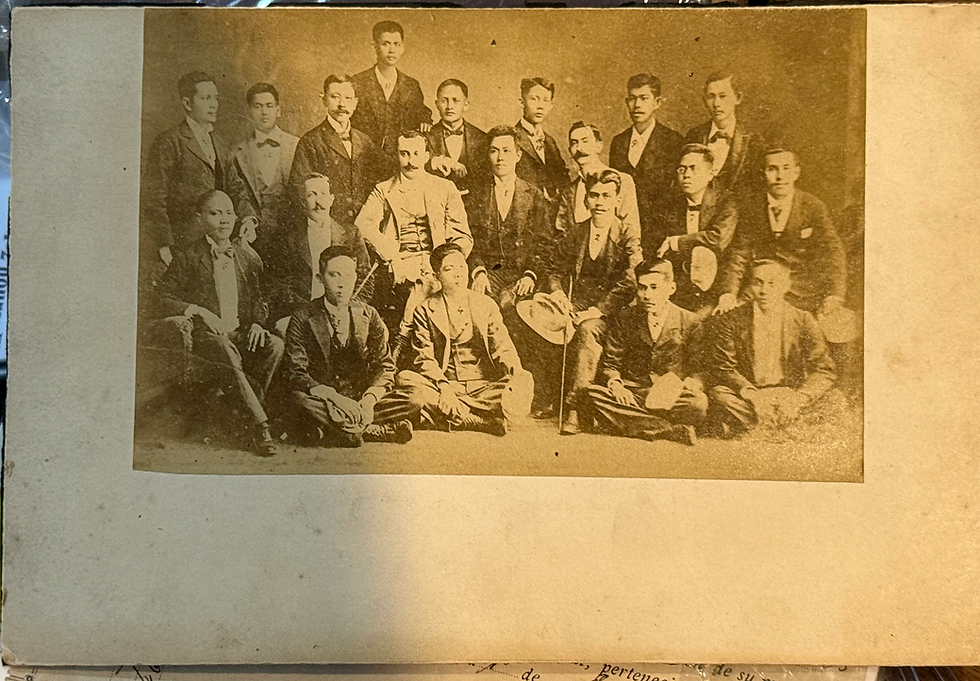
There's a particular chill to holding a photograph older than your lolo—especially one that spent over a century in someone else’s archive, half a world away from the story it was actually about. This mounted original photo, taken in Hong Kong around 1898, is one of those. It came from the famous Brown Brothers, a pioneering American stock photo agency with documented access to the Philippines in the early days of the Philippine-American War. Which means: this photo of our revolutionaries, taken in exile, ended up cataloged by an agency in the very country that would soon become their colonizer. Kind of poetic. Kind of infuriating. We’ll let you sit with that—and we’ll get into exactly how that happened further down, because the timeline holds a wrinkle worth walking through honestly rather than glossing over.
But first, the people in it (as there seems to be confusion about who these men were) — twenty men, frozen mid-exile, some of whom would go on to shape the next fifty years of Philippine history, and one who very much would not, because he wasn’t Filipino.
To understand why this group of men is posing for a photograph in a British colony rather than, for example, anywhere in the Philippines, we have to go back to December 14–15, 1897 — the signing of the Pact of Biak-na-Bato.
By late 1897, the Philippine Revolution against Spain had stalled. Governor-General Fernando Primo de Rivera, unable to crush the revolutionary forces outright, opened negotiations through an intermediary: the poet, novelist, and career political operator Pedro Paterno. The talks produced a deal — not independence, not even close, but a truce. Emilio Aguinaldo and his senior officers would accept a cash indemnity and safe passage into exile. In return, they’d lay down their arms, and Spain would, at least on paper, promise reforms. Aguinaldo took the money. By most accounts, he also took it as a down payment on round two — funds to buy the guns that round one hadn’t secured.
On December 27, 1897, Aguinaldo and roughly three dozen fellow revolutionaries boarded the steamship Uranus in Sual, Pangasinan, and sailed to Hong Kong. Under British law, the colony had sheltered Filipino political exiles since the 1872 Cavite Mutiny — a familiar refuge on unfamiliar ground. What happened next wasn’t retirement. The men who arrived in Hong Kong organized into what became known as the Hong Kong Junta — a government without territory, running correspondence networks back into the Philippines, courting foreign consuls, and quietly preparing for the moment the ceasefire would break. And it did, quickly: within months, Spain and the United States were at war, and every American consul from Hong Kong to Singapore suddenly wanted a meeting with Aguinaldo.
This photograph almost certainly comes from that window — the strange, suspended months when the revolution wasn’t over, only paused, and nobody in the frame yet knew whether they’d be going home as liberators or as those trading one empire for another.
Here's where we have to slow down, because this photograph holds a detail most retellings gloss over: not everyone in it was a revolutionary. Seated beside Aguinaldo is Lieutenant Colonel Miguel Primo de Rivera (No. 11 in the guide) — the nephew and aide-de-camp of the Spanish governor-general who’d just signed the Pact. He wasn’t posing in solidarity. He was a hostage, handed over by Spain as collateral to ensure the indemnity payments were made. History has a sense of humor about where its footnotes end up: this same Miguel Primo de Rivera would, twenty-five years later, become Spain's military dictator, and his son would found the "Falange", an extreme nationalist political group founded in Spain in 1933. A man held hostage by Filipino revolutionaries in a Hong Kong drawing room, decades later running Spain. You can’t write that kind of detail — you can only find it, sitting quietly in row two of an old group photo.
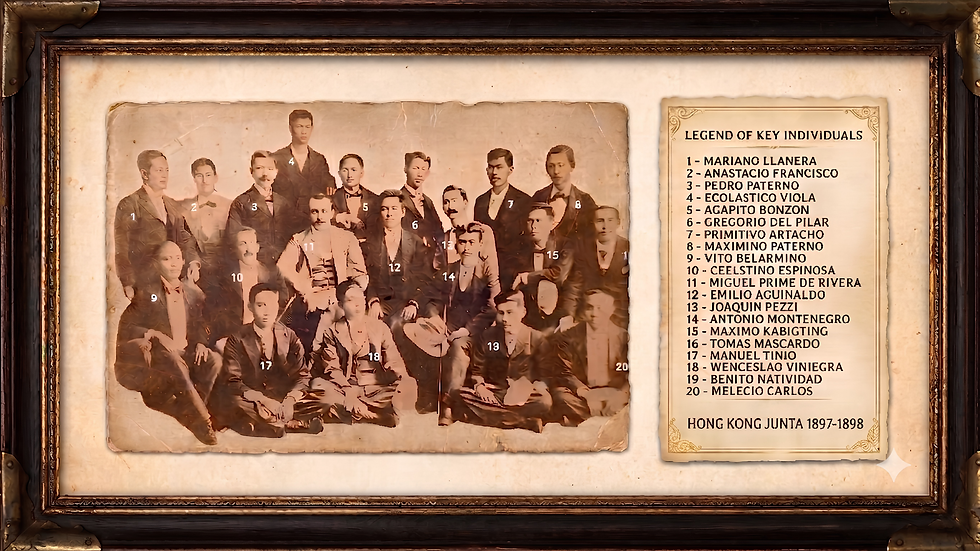
With that context set, here’s who else is standing (and sitting, and lounging on the floor, this being 1898 and formality apparently optional once the coats came off) in the frame. The number after each name corresponds to the numbered guide to the photograph, so you can look from name to face and back again as you read:
Emilio Aguinaldo (No. 12) — the reason everyone else is there. Leader of the Revolution, signatory to the Pact, and head of the Junta. Within months of this photograph, he’d be back on Philippine soil aboard a US Navy ship, and within a year, he’d be president of a republic that barely had the chance to exist before the next war began.
Pedro Paterno (No. 3) — the man who brokered the entire arrangement. A poet and novelist by trade, a negotiator by necessity, Paterno shuttled between the Spanish and the revolutionaries to produce the Pact. He’d go on to preside over the Malolos Congress and briefly serve as Prime Minister of the First Republic — proof that in this revolution, the pen genuinely opened doors the sword couldn’t.
Gregorio del Pilar (No. 6) — twenty-two years old in this photo, already a general. History remembers him as the “Boy General,” and if you know how his story ends, it’s hard not to feel a little sad when looking at this photograph. Two years later, at twenty-four, he’d die holding the rearguard at the Battle of Tirad Pass, buying time for Aguinaldo to escape north. Some of the men in this photo were building the next phase of the fight. Del Pilar was, without knowing it, sitting for one of his last quiet moments before becoming its most famous sacrifice.
Manuel Tinio (No. 17) — still younger, a commissioned general at twenty. One of the “three fathers” of the Cry of Nueva Ecija and one of the last officers standing when Aguinaldo was finally captured in 1901. He later became a provincial governor and a genuinely influential figure in early 20th-century Philippine politics.
Mariano Llanera (No. 1) — the elder statesman of this group, over forty, a veteran organizer from Nueva Ecija who fought through both the revolution and the war that followed. He outlived nearly everyone else in the photo, dying in 1942, just in time to see a third foreign flag rise over Manila.
Vito Belarmino (No. 9) — codenamed “Walang Gulat” (unshakeable, more or less) by his fellow Katipuneros, and by most accounts, he lived up to it. He commanded revolutionary forces in Albay and established a functioning provincial government there.
Tomás Mascardo (No. 16) — general at the Battle of Zapote Bridge, later governor of two provinces during his political career. A revolutionary who successfully transitioned into the machinery of civil government once the fighting eventually stopped.
Benito Natividad (No. 19) — carried a family wound into this fight: his father, Mamerto Natividad, was executed by Spanish authorities in 1896, making him one of Nueva Ecija’s first martyrs. Benito and his brothers all joined the revolution to avenge him. He fought alongside Manuel Tinio until nearly the end, among the last to surrender in 1901.
Antonio Montenegro (No. 14) — went on to serve as Secretary of Foreign Affairs once the government reconstituted itself in the Philippines — proof that some of what was planned in Hong Kong wasn’t just military.
Primitivo Artacho (No. 7) — likely connected to Isabelo Artacho, the government’s Secretary of the Interior, whose falling-out with Aguinaldo over the indemnity funds left behind at Biak-na-Bato became one of the period's uglier internal disputes. Whether Primitivo was kin or simply shared a surname common enough at the time, we can’t confirm from here — an honest gap, not a filled-in one.
Agapito “Yntong” Bonzon (No. 5) — the most contested figure in this frame. A Katipunan colonel, implicated, depending on whose account you trust, in the arrest and eventual execution of Andres and Procopio Bonifacio at Maragondon. His account and the widow Gregoria de Jesus’s don’t agree. We’re not going to pretend to settle that here — just flag that not every face in a revolutionary photograph belongs to an uncomplicated hero.
Maximo Kabigting (No. 15) — recorded as a continuing presence at Junta meetings through 1898, though the deeper record on him is thin.
And then the names history simply didn’t keep as much of: Anastacio Francisco (No. 2), Escolastico Viola (No. 4), Maximino Paterno (No. 8), Celestino Espinosa (No. 10), Joaquin Pezzi (No. 13), Wenceslao Viniegra (No. 18), and Melecio Carlos (No. 20) — all confirmed across multiple period rosters as part of this exile party and present in this photograph by caption tradition. Their names survived. Much else about them didn’t, at least not in any record we could verify. That’s worth saying honestly rather than dressing it up.
Here's the wrinkle we promised. Brown Brothers, the agency that produced this photo, wasn’t founded until 1904 — six years after this photograph was taken. Arthur and Charles Brown started the firm in New York, and it’s widely credited as the first true stock photo agency in the world, the ancestor of everything from wire services to Getty Images. So no Brown Brothers photographer stood in that Hong Kong room in 1898. Whoever took this picture, it wasn’t them.
What Brown Brothers did, and did well, was collect. The firm grew quickly in its first decades — a dozen full-time photographers on staff, plus a wide network of independents, covering everything from Ellis Island arrivals to the Triangle Shirtwaist fire to the Hindenburg going down. But alongside its own assignments, the company actively acquired older photographic collections, which is exactly why the surviving Brown Brothers archive holds material dating back to the 1860s — decades before Arthur and Charles ever opened shop. A photograph like this one, tied to events unfolding in the Philippines just as the US Navy was arriving in Manila Bay, is a plausible fit for that kind of acquisition: American interest in the Philippines spiked sharply in 1898, and any agency in the business of collecting newsworthy images would have wanted material documenting it, however it came into their hands.
The archive remained a going concern for most of a century, eventually growing to more than a million photographs and negatives, until Lelands, a sports and historical memorabilia auction house, acquired it in 2020 and has been releasing prints and negatives from the collection piece by piece ever since. That’s exactly the road this particular print traveled — out of a Hong Kong exile household, into an American commercial archive built to document exactly this kind of moment, and out again, well over a century later, into the hands of someone willing to ask who’s actually in the picture.
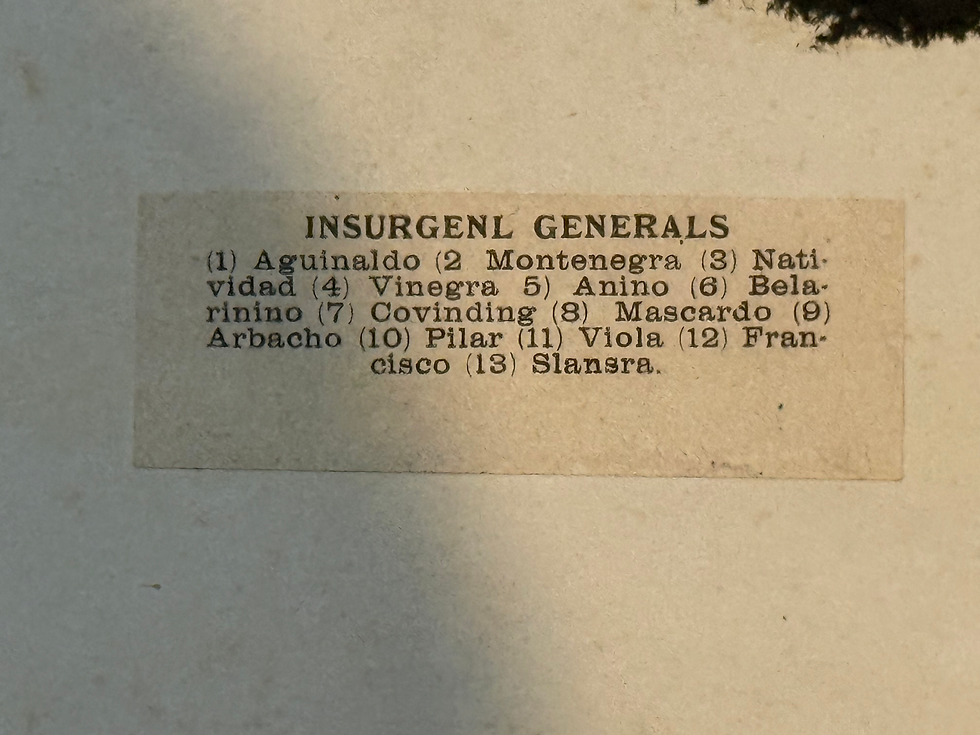
It gets more interesting once you flip the print over. The reverse carries Brown Brothers’ own printed caption slip, headed “INSURGENT GENERALS” (misspelled “INSURGENL” on the actual label) — as if every man in the frame held a military rank, though several, including the civilian negotiator Pedro Paterno, plainly did not. The numbered key beneath it identifies only thirteen of the twenty men, with several names garbled almost beyond recognition — “Montenegra,” “Vinegra,” “Belarinino,” “Arbacho” for Montenegro, Viniegra, Belarmino, and Artacho, and at least two entries, “Anino” and “Slansra,” that don’t match any name we’ve been able to confirm against the record. Pedro Paterno doesn’t appear on the list, and neither, tellingly, does Miguel Primo de Rivera — the Spanish hostage seated right beside Aguinaldo, apparently invisible to whoever typed up this label. Whoever cataloged this photograph in America clearly worked from a caption someone handed them, not from any real knowledge of who these men were. They didn’t even attempt to name seven sitters, got thirteen only approximately right, and missed one very consequential figure. It’s a small thing, a typed slip pasted to old mat board, but it says something true about how this photograph crossed the ocean: not as twenty individual stories, just as “insurgent generals,” filed and forgotten.
What makes this image more than a curiosity is the moment it’s suspended in — the hinge between two wars, two colonizers, and two versions of what “freedom” would mean. The men in this photograph left Biak-na-Bato thinking they were done fighting Spain, or at least done fighting it the old way. Within a year, several of them would be fighting a new occupying power, one that had, ironically, helped bring Aguinaldo home in the first place.
And in the middle of it all sits a Spanish hostage who’d one day rule Spain — a reminder that history rarely holds still long enough to be simple, even in a single frame, even in a photograph that took over a century to return to a conversation about the country it was actually about.
Sources:
1. 1. Aguinaldo, Emilio. True Version of the Philippine Revolution. Tarlak: 1899. Chapter II, “The Treaty of Biak-na-bató.” https://www.gutenberg.org/files/12996/12996-h/12996-h.htm
2. “Pact of Biak-na-Bato.” Wikipedia. Accessed 2026. https://en.wikipedia.org/wiki/Pact_of_Biak-na-Bato
3. “Siege of Biak-na-Bato.” Wikipedia. Accessed 2026. https://en.wikipedia.org/wiki/Siege_of_Biak-na-Bato
4. “Hong Kong Junta.” Wikipedia. Accessed 2026. https://en.wikipedia.org/wiki/Hong_Kong_Junta
5. “1897 Philippine Supreme Council Elections.” Wikipedia. Accessed 2026. https://en.wikipedia.org/wiki/1897_Philippine_Supreme_Council_elections
6. “Philippine Revolution.” Wikipedia. Accessed 2026. https://en.wikipedia.org/wiki/Philippine_Revolution
7. “What Was the Hong Kong Junta?” Boot Camp & Military Fitness Institute, May 24, 2023. https://bootcampmilitaryfitnessinstitute.com/2023/05/24/what-was-the-hong-kong-junta/
8. “May 17, 1898: Emilio Aguinaldo Boards American Ship to Return to PH.” Philippine Daily Inquirer (USA edition), May 17, 2024. https://usa.inquirer.net/149893/may-17-1898-emilio-aguinaldo-boards-american-ship-to-return-to-ph
9. “Pulong ng Hong Kong Junta, Ika-4 ng Mayo 1898” [Minutes of the Hong Kong Junta meeting, May 4, 1898]. Republika Pilipina (blog), July 2025. https://republica-filipina.blogspot.com/2025/07/pulong-ng-hong-kong-junta-ika-4-ng-mayo.html — cited for Anastacio Francisco’s and Maximo Kabigting’s attendance at Junta proceedings.
10. “From left: Gregorio del Pilar, Wenceslao Viniegra, Emilio Aguinaldo, Vito Belarmino, and Pedro Paterno.” Caption from Pictorial History of the Philippines, reproduced via Official Gazette of the Philippines (Flickr). https://www.flickr.com/photos/govph/10150709504 — cited for Wenceslao Viniegra’s presence in the exile party.
11. “Battle of Tayabas.” Wikipedia. Accessed 2026. https://en.wikipedia.org/wiki/Battle_of_Tayabas
12. “Lelands Acquires Brown Brothers and its Legendary Photo Archive.” Lelands, October 15, 2020. https://lelands.com/auction-ave/lelands-acquires-brown-brothers-and-its-legendary-photo-archive
13. “Lelands Acquires Brown Brothers Photo Archive.” Sports Collectors Daily, October 2020. https://www.sportscollectorsdaily.com/lelands-acquires-brown-brothers-photo-archive/
14. “Lelands Acquires Brown Brothers Photo Archive.” Sports Collectors Digest, October 22, 2020. https://sportscollectorsdigest.com/news/lelands-acquires-brown-brothers-photo-archive
15. “The $5-Million Brown Brothers Photo Archive.” Fine Books & Collections. https://www.finebooksmagazine.com/fine-books-news/5-million-brown-brothers-photo-archive
16. “Brown Brothers.” A New Yorker State of Mind (blog). https://newyorkerstateofmind.com/tag/brown-brothers/
17. Brown Brothers USA (company site, current operator). http://brownbrothersusa.com/
Individual roster order of Photo
No. 1 — Mariano Llanera. “Mariano Llanera.” Wikipedia. https://en.wikipedia.org/wiki/Mariano_Llanera
No. 2 — Anastacio Francisco. “Pulong ng Hong Kong Junta, Ika-4 ng Mayo 1898.” Republika Pilipina (blog). https://republica-filipina.blogspot.com/2025/07/pulong-ng-hong-kong-junta-ika-4-ng-mayo.html — the only independent confirmation found beyond the photograph’s own caption tradition; no dedicated biographical record located.
No. 3 — Pedro Paterno. “Pedro Paterno.” Wikipedia. https://en.wikipedia.org/wiki/Pedro_Paterno
No. 4 — Escolastico Viola. No independent biographical source located beyond the mounted photograph’s caption tradition and the numbered legend graphic. Unverified.
No. 5 — Agapito “Yntong” Bonzon. “Philippine Revolution.” Wikipedia. https://en.wikipedia.org/wiki/Philippine_Revolution — arrest of Andres and Procopio Bonifacio. “Col. Agapito ‘Yntong’ Bonzon, A Traitor or A Good Soldier?” Auntie Sosyal (blog), March 21, 2016. https://auntiesosyal.wordpress.com/2016/03/21/col-agapito-yntong-bonzon-a-traitor-or-a-good-soldier/ — Gregoria de Jesus’s disputed account referenced here.
No. 6 — Gregorio del Pilar. “Gregorio del Pilar.” Wikipedia. https://en.wikipedia.org/wiki/Gregorio_del_Pilar
No. 7 — Primitivo Artacho. No independent biographical source located under this name. His probable relative, Isabelo Artacho, Secretary of the Interior and party to the indemnity-funds dispute with Aguinaldo, is sourced separately: “Philippine Revolution.” Wikipedia. https://en.wikipedia.org/wiki/Philippine_Revolution and “What Was the Hong Kong Junta?” Boot Camp & Military Fitness Institute. https://bootcampmilitaryfitnessinstitute.com/2023/05/24/what-was-the-hong-kong-junta/ — the specific family relationship between Primitivo and Isabelo Artacho remains unverified.
No. 8 — Maximino Paterno. No independent biographical source located; relationship, if any, to Pedro Paterno unverified.
No. 9 — Vito Belarmino. “Vito Belarmino.” Wikipedia. https://en.wikipedia.org/wiki/Vito_Belarmino
No. 10 — Celestino Espinosa. No independent biographical source located beyond the photograph’s caption tradition. Unverified.
No. 11 — Miguel Primo de Rivera. “Pact of Biak-na-Bato.” Wikipedia. https://en.wikipedia.org/wiki/Pact_of_Biak-na-Bato — seating position and hostage status, sourced in turn to Nick Joaquin, A Question of Heroes (Manila: Ayala Museum, 1977), p. 309–310. Corroborating primary account: Aguinaldo, True Version of the Philippine Revolution, Ch. II. https://www.gutenberg.org/files/12996/12996-h/12996-h.htm
No. 12 — Emilio Aguinaldo. “Hong Kong Junta.” Wikipedia. https://en.wikipedia.org/wiki/Hong_Kong_Junta; Aguinaldo, True Version of the Philippine Revolution. https://www.gutenberg.org/files/12996/12996-h/12996-h.htm
No. 13 — Joaquin Pezzi. No independent biographical source located beyond the photograph’s caption tradition. Unverified.
No. 14 — Antonio Montenegro. “1897 Philippine Supreme Council Elections.” Wikipedia. https://en.wikipedia.org/wiki/1897_Philippine_Supreme_Council_elections; “Emilio Aguinaldo.” New World Encyclopedia. https://www.newworldencyclopedia.org/entry/Emilio_Aguinaldo — both confirm Montenegro as Secretary/Minister of Foreign Affairs.
No. 15 — Maximo Kabigting. “Pulong ng Hong Kong Junta, Ika-4 ng Mayo 1898.” Republika Pilipina (blog). https://republica-filipina.blogspot.com/2025/07/pulong-ng-hong-kong-junta-ika-4-ng-mayo.html — recorded attendee at the May 4, 1898 Junta meeting.
No. 16 — Tomás Mascardo. “Tomás Mascardo.” Wikipedia. https://en.wikipedia.org/wiki/Tom%C3%A1s_Mascardo; “Philippine Revolution.” Wikipedia. https://en.wikipedia.org/wiki/Philippine_Revolution — exile roster confirmation.
No. 17 — Manuel Tinio. “Manuel Tinio.” Wikipedia. https://en.wikipedia.org/wiki/Manuel_Tinio
No. 18 — Wenceslao Viniegra. Caption, Pictorial History of the Philippines, reproduced via Official Gazette of the Philippines (Flickr). https://www.flickr.com/photos/govph/10150709504 — the only independent confirmation located; no further biographical record found.
No. 19 — Benito Natividad. “Benito Natividad.” Wikipedia. https://en.wikipedia.org/wiki/Benito_Natividad; “Mamerto Natividad.” Wikipedia. https://en.wikipedia.org/wiki/Mamerto_Natividad — father’s execution.
No. 20 — Melecio Carlos. No independent biographical source located beyond the photograph’s caption tradition. Unverified.


Comments