


Confetti, Crowns and a Curveball from Misamis: The 1915 Philippine Carnival, Told Through Eighteen Real-Photo Postcards

Early in 1915, a fifteen-year-old girl from Masbate was carried into her coronation on a litter, shouldered by eight men dressed as Numidians. Someone played Nero.
Across the grounds, a team of schoolgirls from the far end of Mindanao was beating every province in the islands at a game barely a few years old in Philippine schools.
And over it all, a windmill lettered MERALCO sold electric light to a city that had only just started paying more for light than for streetcar rides.
Europe was at war. Manila was throwing a party.
These eighteen cards came to me as a single set. The seller would have preferred to sell them one by one; our offer was more generous than his reluctance. Each carries a hand-lettered white caption and a number at the end. Laid out together on my desk, they began to tell a story the 1915 newspapers never quite put together.
Eighteen cards, one season
These are real-photo postcards, or RPPCs: actual photographic prints on postcard stock, not mass-printed halftones. The photographer lettered each caption in reverse on the negative, so it prints white, and ended each one with a number. The numbers are the closest thing we have to a contact sheet.
Nine of the cards say 1915 outright. Most of the rest fall within the same run of numbers, 452 to 555, placing them in the same season. One card, the Corregidor champions, carries a credit: Photo by Shera. Whether Shera shot the whole set, I can’t yet say. The other cards say nothing about it.
Through the Hub Bub

The Manila Carnival was an American colonial invention. Its gates first opened on 27 February 1908 on Wallace Field, in Luneta and Bagumbayan,[2] as a showcase of the islands’ “progress” under American rule.[3] Alex D. R. Castro, whose blog Manila Carnivals 1908–1939 is the most thorough record of the event anywhere, writes that by 1915 it had firmly established itself as the country’s premier event.[4] He describes a fortnight of parades, provincial booths, masquerades and sport.[2] The 1915 edition was shorter: its own promotional artwork gives the dates as 30 January to 7 February.[1]
Card 525 shows how you got in. A long white façade, three arches, raised lettering reading Philippine Carnival, and the founding year, 1908, on the left pier. In front stands a two-story ticket kiosk with three windows marked TICKETS and a balustraded gallery on top. The queue is a cross-section of the city: white suits, pith helmets, a woman in a saya, bicycles parked along the road.
In 1908, Castro notes, the grounds were walled in with Pampanga sawali, and tickets were sold at the taquillas for 20 centavos.[2] In later years, tickets cost 50 centavos and up, and at the gate you could buy a mask, a horn, and a bag of confetti. The fair was famous for sounding like New Year’s Eve.[3]

Card 452 is the one I keep coming back to. The arch now reads 1915. Through it, you can just make out the first letters of a second arch: HUB BUB. In the foreground, a squad of Igorot men in campaign hats, uniform tunics, and wrapped skirts, several barefoot, walks among visitors in straw boaters.
Here is why it matters. In 1908, the carnival’s first organizer proposed displaying “half-naked” Igorots as a curiosity. The Governor-General turned him down.[3] Seven years later, this card shows Igorot men not as an exhibit but as visitors, taking in the fair like everyone else. That same year, Benguet crowned its own carnival queen: Eveline Chainus Guirey, thirteen, daughter of an Igorot mother. She brought her court to Manila, where the Philippine Carnival Association presented her with a silver tea set. She died of tuberculosis at eighteen. Castro tells her story in full.[5]


Past the gate, the Hub Bub arch opened onto a long white arcade. Cards 551 and 552 were taken back-to-back, probably on one late-afternoon walk; the shadows are long. In the first, a column in pith helmets crosses the lawn, some carrying rifles or tall pointed props. In the second, a band in white peaked caps marches past in single file: brass, a bass drum, cymbals. Behind the hedge, under the arches, hangs a sign that says CONFETTI.
Note the big urn in both shots. Its band is a Greek-key meander. Hold that thought. You’ll see the same pattern again on the queen.
As for where these grounds stood: the carnival began on Wallace Field, and its later home on Vito Cruz became the Rizal Memorial Sports Complex in 1934.[6] Which of the two sites these 1915 cards show is a question I’m still chasing.
The windmill that sold the light

Of all eighteen cards, this one feels most like today.
A Dutch-style windmill, its sails strung for electric lights, towers over the grounds. Across its gallery, in big letters: MERALCO. Around its base, a stall wraps with a banner reading CONFETTI CONFETTI, with price boards that appear to read 80, 40, and ₱1. The most eye-catching structure at the fair was a billboard. Electric light had been part of the spectacle from the start; Castro describes the first carnival grounds “strung with miles of brilliant electric lights.”[2]
In 1915, the name was not yet household. It stood for the Manila Electric Railroad and Light Company, founded in 1903 when Detroit businessman Charles M. Swift won the franchise as the sole bidder.[7] It ran Manila’s electric streetcars, the tranvía, and sold power on the side. Then the side became the business. By 1915, electricity had overtaken the streetcars as the company’s main source of income.[7] The windmill went up the same year the light started paying the bills.
The company dropped “Railroad” from its name in 1919. The streetcars are long gone. The light stayed.[7]
Today, Meralco is the country's largest electric distribution utility and the sole distributor in Metro Manila, with a franchise covering dozens of cities and municipalities across Luzon. It doesn’t generate most of the power it delivers; it buys it and moves it down the wires. But if your lights are on in Manila tonight, Meralco brought them.[7]
A century ago it advertised with a glowing windmill and a confetti stand. Now it sends you a monthly bill. Some brands earn their permanence.
Fifteen, Roman, and crowned


Her name was Concepcion Medina y Zurbito. Born in Binondo on 9 January 1900, she was the only daughter of a wealthy Masbate family and was crowned at 15. Most of what we know about her reign comes from Castro’s profile.[4]
1915 changed the rules of the race. Before that year, readers nominated the candidates. In 1915, the newspapers put up their own. They bought votes, either as money ballots or as coupons clipped from publications, making the contest part beauty pageant and part circulation war. Concepcion ran as the Spanish-language El Ideal candidate and finished with 46,500 votes, 9,000 ahead of the Cablenews-American candidate, with the Manila Times’ Pilar Paredes third.[4]
Look at her in these two studio portraits. A tall openwork crown on upswept hair. A draped, toga-like gown bordered with that same Greek-key meander from the urn by the Hub Bub arch. Armlets, bracelets, a white fur pelt over the throne. In 554, she stands with a bouquet and a white bird at her side, her train pooling across the floor. A newspaper of the day praised “her royal robes and wonderful crown.”[4]
The theme was Rome, and the organizers committed. The auditorium was dressed as an arena, and the coronation featured four Roman processions and ended with the queen borne on a litter by eight “Numidians,” beside an “Emperor Nero.”[4]
Her consort, the carnival king, was Joseph Manning, the American Auditor General. In her court sat Esperanza Limjap, a nineteen-year-old who would later marry Sergio Osmeña and become First Lady.[8] Governor-General Francis Burton Harrison and Mrs. Harrison came to pay their respects.[4] Harrison had been in office since October 1913 and was busy handing government posts to Filipinos.[9]
Here is my take. Picture the scene: a Filipina teenager dressed as a Roman empress, crowned under an American governor, beside an American consort, at a fair built to advertise American rule. Every layer of that costume belongs to somebody else’s empire. Yet the girl in it is ours, and so is the crowd that voted her in, 46,500 ballots at a time. The carnival was staged from above. Its meaning came from below.
And the casting of Nero? In the opening weeks of 1915, as the Western Front settled into its first winter of trenches and the Gallipoli landings were less than three months away, Manila cast a man as the emperor who fiddled while Rome burned. I don’t think anyone meant it as a joke. It lands anyway.
Concepcion married Dr. Andres F. Navarro on 4 March 1920, at the Lourdes Church in Manila.[4]
Play ball: the tournament inside the fair
A beauty contest and a windmill would be enough for most fairs. The Manila Carnival also ran a national sports championship, and it did so by design.
In 1911, the carnival hired Elwood Brown of the YMCA as its director of athletics. Brown pushed sport into the school curriculum, and in 1912 he used the carnival to launch what became the Far Eastern Championship Games, the ancestor of today’s Asian Games.[10] In 1914, Dean C. Worcester described “a general interscholastic meet held each year at the Philippine Carnival” and claimed that “in many regions baseball is emptying the cockpits.”[11] Castro calls school sport a tool for the “subtle acculturation” of Filipinos to American values.[12] The Bureau of Education’s 1915 report lists baseball and indoor baseball among the events contested at the carnival.[13]
The intent was colonial. The postcards show what the players did with it.
The girls: Misamis takes the crown

Indoor baseball, the forerunner of softball, used a large, soft ball and a lighter bat. The softball association dates its formal introduction to Philippine public schools to 1911, as the girls’ game replacing basketball,[14] though Castro finds girls already playing it at the very first Central Luzon Athletic Association meet, held in Malolos in February 1908.[15] In 1915, the carnival champions came from Misamis, then a single province on Mindanao's north coast.
Card 534 says it in white letters: Misamis Indoor Baseball Champions 1915 Carnival. Castro confirms it independently: the Misamis team “won the championship in the 1915 edition of the Carnival,” an example, he writes, of how carnival sport promoted “pride and loyalty to province and country.”[16] Twelve girls in matching dark middies with white buttons, black stockings, and bloomers; a bat laid across the front row; the big soft ball beside it. Behind them, the grandstand is packed.
Think about the distance. The best team in a Manila tournament came by sea from the far end of the colony to win.

Card 531 is the only action shot in the set: Meisic vs Misamis, taken from high in the stand. A diamond chalked on the grass, an umpire in white behind the plate, a runner sliding into third on the far left, and acacias beyond a criss-cross bamboo fence. Meisic was a Tondo barrio,[17] so this was likely a Manila public-school team against visitors from Mindanao. The card is numbered 531 and the champions’ portrait 534. It may be the final. I can’t prove it.
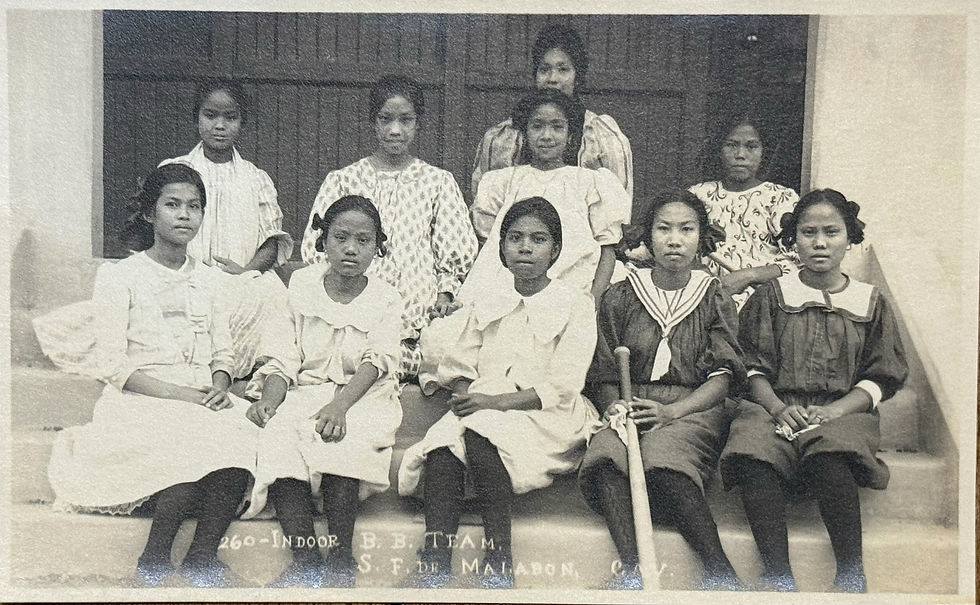
Three more girls’ teams appear in a separate, lower-numbered group, photographed at home rather than at the fair: Pampanga (captioned “Bacalod,” which I read as Bacolor), San Francisco de Malabon (now General Trias),[18] and Santa Cruz de Malabon (now Tanza),[19] both in Cavite. Both Cavite town names had officially changed in February 1914, so these cards may predate the 1915 fair. My favorite is the Malabon team: ten girls on stone steps, only two in uniform, and one of them holding the bat. A new sport, a small budget, and no shortage of nerve.


The men: provinces, a trade school, Tokyo and Corregidor


The men’s cards read like a map of the players. Cavite (505) in dark flannels with an Old English “C,” a province that had won baseball at the first Southern Tagalog meet in 1910.[20] Tarlac (510), its jerseys lettered not with the province but with a town, MONCADA, several players barefoot or in work shoes. Tarlac was a founding member of that same Central Luzon Athletic Association in 1908.[15] The Trade School, Manila (500), most likely the Philippine School of Arts and Trades, older boys training as mechanics and craftsmen, in pinstripes with TRADE arched across the chest.

Then there is card 545: Waseda University of Tokyo, sixteen men in crisp white pinstripes, the best-dressed team in the set. The photographer added a slur in parentheses after the name. I have left the card as it is, because erasing it would also erase what Americans in Manila thought of Japan in 1915.
That attitude had context. In January 1915, Japan had served China with the Twenty-One Demands, and the Pacific was nervous.[21] Waseda had toured Manila before, in 1912,[22] and sports historian Gerald Gems writes that its games in the Philippines “approximated a surrogate form of war,” with crowds of more than 5,000.[23] No written source I’ve found confirms a Waseda visit specifically in 1915. The card’s number, within the 1915 run, suggests they were here.

And the men’s champions? Not a province. Card 546 names them: the “All Stars” from Corregidor, Champions of the 1915 Carnival. Most jerseys read 42. One reads 70. One standing player’s shirt says CAC. That unlocks it. Corregidor was Fort Mills, the U.S. Army’s harbor-defense post at the mouth of Manila Bay, and the 42nd and 70th Companies of the Coast Artillery Corps were stationed there.[24] An all-star side, picked from two garrison companies. Note the woven sawali wall behind them, the same backdrop as the Cavite card. It may well be the carnival’s own perimeter, which Castro describes as walled in sawali from the very first year.[2]

Card 428, the All-Navy team of the Manila Baseball League, shows the pool those soldiers came from: American service clubs that had played in Manila since 1898.[25] Those leagues were segregated.[26] Oscar Charleston, later a Hall of Famer, pitched for the all-Black 24th Infantry in the Manila League in 1914.[27] He is not on these cards. Neither, so far as I can tell, is any future major leaguer.
So here is the 1915 scoreboard. An American garrison won the men’s title, borrowing its best players from two companies. A province at the far end of Mindanao won the girls' title. Only one of those champions was playing for home.
In May, after the carnival, the Philippines sent two girls’ teams to the Far Eastern Championship Games in Shanghai to demonstrate indoor baseball to the region.[14][28] A game barely a few years old in the schools was now an export.
Meanwhile, in 1915.....
It helps to know what else was on the calendar while Manila threw confetti.
The year opened with two signals from opposite ends of the map. On 18 January, Japan served China with the Twenty-One Demands, and the Pacific grew nervous.[21] A week later, on 25 January, Alexander Graham Bell placed the first transcontinental telephone call, from New York to San Francisco.[29] The world was getting smaller and, at the same time, more dangerous.
Then, from 30 January to 7 February, the carnival began.[1] Concepcion Medina was crowned in Roman dress, the Misamis girls took the indoor baseball title, and the Corregidor All Stars won the men’s.[4][16] On 20 February, half a world away, San Francisco opened the Panama-Pacific International Exposition, where a Philippine pavilion displayed colonial schooling and handicrafts for American eyes until the fair closed on 4 December.[30] The carnival spirit spread to the provinces too. Benguet crowned thirteen-year-old Eveline Chainus Guirey, and Cebu, holding only its second carnival, crowned Rosario Chiong Veloso Singson.[5][31]
Spring showed what the century held. On 22 April, at the Second Battle of Ypres, poison gas was used on a large scale for the first time on the Western Front.[32] On 24 April, the arrest of Armenian leaders in Constantinople marked the start of the Armenian Genocide.[33] The next day, Allied troops landed at Gallipoli.[34] On 6 May, young Red Sox pitcher Babe Ruth hit his first major-league home run.[35] The next day, a German U-boat sank the RMS Lusitania and 1,198 people died.[36]
A week later, from 15 to 22 May, Shanghai hosted the second Far Eastern Championship Games, and Filipino schoolgirls took the regional stage to demonstrate indoor baseball.[28][14]
Back home, the year’s quieter shifts went on. Governor-General Harrison kept handing the civil service over to Filipinos.[9] Electricity overtook the streetcars as Meralco’s main source of income.[7] The Jones Law, with its promise of eventual independence, was still a year away; it would pass on 29 August 1916.[37] And on 25 November, in Berlin, Albert Einstein presented the field equations of general relativity.[38]
The postcards show two carnivals side by side. One was staged from above: a Roman queen, an American consort, a corporate windmill, a sports program its designers said would empty the cockpits. The other belonged to the players: barefoot boys from Moncada, a Cavite team with two uniforms between ten girls, and a Mindanao squad that beat everyone.
That tension never left. We still crown queens in costume; Miss Universe Philippines contestants now build theirs from indigenous techniques rather than Roman drapery.[39] We still send provincial school teams to national finals at the Palarong Pambansa.[40] The sponsors still take the best real estate at every festival. And the meaning still comes from the provinces that show up.
The old grounds are now a sports complex. The windmill is gone. The light it advertised is in every room in Manila. And somewhere, a muster roll from the 42nd Company and a Misamis school register with twelve girls’ names on it wait for someone to find them.
If you know who they were, write to me.
Much of what anyone knows about the Manila Carnival survives because Alex D. R. Castro spent years documenting it, queen by queen and ticket by ticket, on Manila Carnivals 1908–1939 and Views from the Pampanga. This piece draws on that work throughout.
He has been generous in return. We recently acquired 39 of the 52 issues of Renacimiento Filipino from 1911 from a friend. When we shared a full-page photograph from one of them, Alex used it to write up the 1911 Reina de Luzon, Elisea G. Tronqued, and credited us by name.[41] That page showed not one queen but three, crowned for Luzon, the Visayas and Mindanao, at a carnival long believed to have skipped its beauty contest altogether.[41] One collector’s page, in a historian’s hands, filled a gap in the record. That is how this work is supposed to go.
Salamat, Alex. If this story leaves you wanting more, his blog is where to go next: manilacarnivals.blogspot.com
Where everything has a past… and some even have a future.
Sources
Jeffrey S. Evans & Associates. “Unique 1915 Manila, Philippines Carnival Original Illustration.” Fall Fine & Decorative Arts, Lot 3186, 19 October 2024. https://live.jeffreysevans.com/online-auctions/jeffrey-evans/unique-1915-manila-philippines-carnival-original-illustration-6682232
Castro, Alex D. R. “3. Oh, Meet Me at the Carnival.” Manila Carnivals 1908–1939, 20 July 2008. https://manilacarnivals.blogspot.com/2008/07/3-oh-meet-me-at-carnival.html
“Manila Carnival.” Wikipedia. https://en.wikipedia.org/wiki/Manila_Carnival
Castro, Alex D. R. “32. 1915, Queen of the Manila Carnival: Concepcion Zurbito Medina.” Manila Carnivals 1908–1939, 4 October 2008. https://manilacarnivals.blogspot.com/2008/10/32-1915-queen-of-manila-carnival.html
Castro, Alex D. R. “119. 1915 Queen of the Benguet Carnival, Eveline Chainus Guirey.” Manila Carnivals 1908–1939, 24 May 2010. https://manilacarnivals.blogspot.com/2010/05/119-1915-queen-of-benguet-carnival.html
“Rizal Memorial Sports Complex.” Wikipedia. https://en.wikipedia.org/wiki/Rizal_Memorial_Sports_Complex
“Meralco.” Wikipedia. https://en.wikipedia.org/wiki/Meralco
Castro, Alex D. R. “168. Esperanza Escolar Limjap-Osmeña: From a Carnival Princess to the Country’s First Lady.” Manila Carnivals 1908–1939, 10 April 2011. https://manilacarnivals.blogspot.com/2011/04/168-esperanza-escolar-limjap-osmena.html
“Francis Burton Harrison.” Wikipedia. https://en.wikipedia.org/wiki/Francis_Burton_Harrison
“Elwood Brown.” Wikipedia. https://en.wikipedia.org/wiki/Elwood_Brown
Worcester, Dean C. The Philippines Past and Present (1914). Project Gutenberg. https://www.gutenberg.org/files/41918/41918-h/41918-h.htm
Castro, Alex D. R. “97. Advancing an American Agenda: Sports and Physical Education.” Manila Carnivals 1908–1939, 3 January 2010. https://manilacarnivals.blogspot.com/2010/01/97advancing-american-agenda-sports-and.html
Bureau of Education. Sixteenth Annual Report of the Director of Education (1915), as quoted on Naquem, June 2010. http://naquem.blogspot.com/2010/06/
Amateur Softball Association of the Philippines. “A Brief History of Softball.” https://asaphil.com.ph/about-us/
Castro, Alex D. R. “299. History in Sports: Central Luzon Athletic Association Meets.” Views from the Pampang, 24 June 2012. https://viewsfromthepampang.blogspot.com/2012/06/299-history-in-sports-central-luzon.html
Castro, Alex D. R. “31. Let’s Get the Ball Rolling!” Views from the Pampang, posted May 2007 (written 18 January 2003). https://viewsfromthepampang.blogspot.com/2007/05/31-lets-get-ball-rolling.html
“En el Barrio de Meisic del Pueblo de Tondo.” Flickr (Biblioteca Nacional de España image). https://www.flickr.com/photos/bren/7962610268
“General Trias.” Wikipedia. https://en.wikipedia.org/wiki/General_Trias
“Tanza.” Wikipedia. https://en.wikipedia.org/wiki/Tanza
“History of the RAAM CALABARZON (formerly STAA).” Batangas History. https://www.batangashistory.date/2019/05/stcaa-tracing-athletic-associations.html
“Twenty-One Demands.” Wikipedia. https://en.wikipedia.org/wiki/Twenty-One_Demands
Waseda University USA Office. “The DNA of a Waseda trailblazer,” 13 October 2015. https://www.waseda.jp/inst/us-office/news-en/2015/10/13/340/
Gems, Gerald R. “Race, Sport, and the American Occupation of the Philippines.” https://www.researchgate.net/publication/324877788_Race_Sport_and_the_American_Occupation_of_the_Philippines
Smith, Bolling W. “Coast Artillery Corps Unit Histories: Companies and Regiments.” Coast Defense Study Group. https://cdsg.org/wp-content/uploads/2025/12/CAC-Comp-WWI-Reg-Histories.pdf
“Club of USS Olympia v Army and Navy teams in May 1898.” Protoball. https://protoball.org/Club_of_USS_Olympia_v_Army_and_Navy_teams_in_May_1898
26. Hallock, Jennifer. “Baseball in the Philippines,” 30 September 2017. http://www.jenniferhallock.com/2017/09/30/baseball-in-the-philippines/
“Oscar Charleston.” Wikipedia. https://en.wikipedia.org/wiki/Oscar_Charleston
“1915 Far Eastern Championship Games.” Wikipedia. https://en.wikipedia.org/wiki/1915_Far_Eastern_Championship_Games
“First transcontinental telephone call.” Wikipedia. https://en.wikipedia.org/wiki/First_transcontinental_telephone_call
“The 1915 Panama-Pacific International Exposition and the Colonial Exhibition of Philippine Education.” Tala Kasaysayan. https://www.talakasaysayan.org/index.php/talakasaysayan/article/view/257
Manguerra-Brainard, Cecilia. “All Hail Cebu’s Carnival Queens 1914–1941.” Positively Filipino, 9 February 2022. https://www.positivelyfilipino.com/magazine/all-hail-cebus-carnival-queens-1914-1941
“Second Battle of Ypres.” Wikipedia. https://en.wikipedia.org/wiki/Second_Battle_of_Ypres
“Armenian genocide.” Wikipedia. https://en.wikipedia.org/wiki/Armenian_genocide
“Gallipoli campaign.” Wikipedia. https://en.wikipedia.org/wiki/Gallipoli_campaign
SABR Games Project. “May 6, 1915: Red Sox pitcher Babe Ruth hits first major-league homer.” https://sabr.org/gamesproj/game/may-6-1915-red-sox-pitcher-babe-ruth-hits-first-major-league-homer
Royal Museums Greenwich. “The Sinking of the Lusitania.” https://www.rmg.co.uk/stories/maritime-history/sinking-lusitania
“Jones Law (Philippines).” Wikipedia. https://en.wikipedia.org/wiki/Jones_Law_(Philippines)
“Einstein field equations.” Wikipedia. https://en.wikipedia.org/wiki/Einstein_field_equations
“20 Standouts at Miss Universe Philippines 2026 National Costume Competition.” PEP, April 2026. https://www.pep.ph/lifestyle/fashion/191803/miss-universe-philippines-national-costume-a721-20260417-lfrm
“Palarong Pambansa.” Wikipedia. https://en.wikipedia.org/wiki/Palarong_Pambansa
Castro, Alex D. R. “276. 1911, Reina de Luzon, Elisea G. Tronqued, Manila.” Manila Carnivals 1908–1939, 13 March 2024. https://manilacarnivals.blogspot.com/2024/03/276-1911-reina-de-luzon-elisea-g.html
Postcards: author’s collection.


Comments