


The Elephant, the Quill, and the Ghost in the Room
Updated: 2 days ago
How I stopped yawning at José Rizal's silver quill, and why it took a postcard from Hong Kong to wake me up.
Confession first. For over a year, I walked past José Rizal's silver quill the way you walk past the old portrait in your lola's sala. You know it matters. You just stopped looking.
It debuted at the first Plumaluma exhibit at the Ortigas Library in 2025. Then it came back. And back again. A pen met here, another pen met there. By my count, four, maybe five appearances, each time carried in by its owner, Melvin Lam. Yes, that Melvin: the quiet man with the plastic bins and the silver spoons ( https://www.nineteenkopongkopong.com/post/the-enigma-of-the-silver-spoon-a-tale-of-passion-provenance-and-plastic-bins) .
Let me be clear about who the problem was. Not Melvin. A man who keeps Rizal's prize pen has every right to show it, and every reason to. The problem was me. Somewhere around the third showing, the quill turned into furniture. Over-displayed, I told myself. Seen it.
So when we put together Whispers of the Nib: The Pens That Wrote Our History this July, and the Ortigas Library insisted the quill come back yet again, I'll admit I sighed. There it was, the elephant in the room. Everyone would expect it. I had seen it.
But Melvin had a twist up his sleeve. The exhibit already had other old postcards on display, because our whole idea was to bring people back to handwriting: to writing notes and letters again. So Melvin suggested the quill should not sit alone this time. Beside it would lie a postcard, written and signed by Rizal himself.
The day I actually looked
One quiet afternoon at the exhibit, I hung around the case longer than I needed to. I picked up the pen. Then I picked up the card, and for the first time in a year, I paid attention.
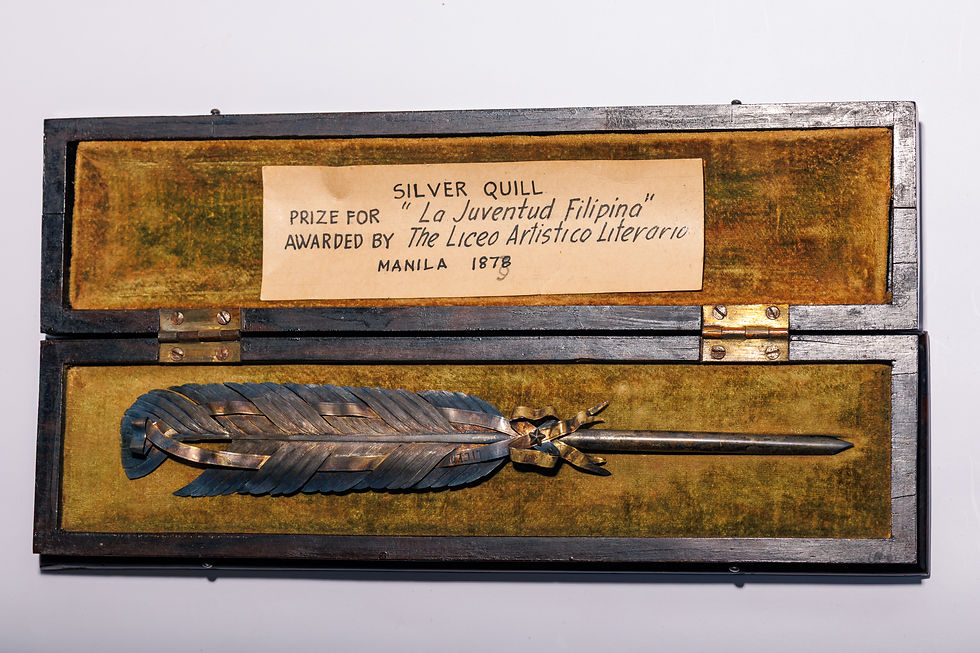
Let me walk you through it the way I finally looked at it: tip to nib, one part at a time. The pen splits into two unequal halves. About two-thirds is the decorative feather, the vane. The last third is the working end, a plain barrel and a nib.

01 Rolled curl. Start at the very tip. The woven band that runs the length of the feather finishes here in a tight little curl, like the end of a ribbon someone forgot to trim. It's the most playful touch on the whole piece.

02 Vane. The feather is not cast in one piece. It is built up from separately cut silver plates, each chased with dense parallel lines for barbs, then overlapped in a herringbone on both sides of the spine. The edges are notched to imitate a real feather's split barbs. Look at the left contour, and you'll see gaps. The National Museum's catalog notes three feathers missing, and the gaps fit.
03 Woven band. A thin silver strip runs over and under the plates along the vane, threaded through the feather like a ribbon. Austin Craig described Rizal's prize as having a gold ribbon running through it. Today the strip reads silver-toned. Whatever gold it carried is gone, or hiding under tarnish.
04 Central shaft. A raised rib runs down the middle, standing in for the feather's spine. Everything else hangs off it.
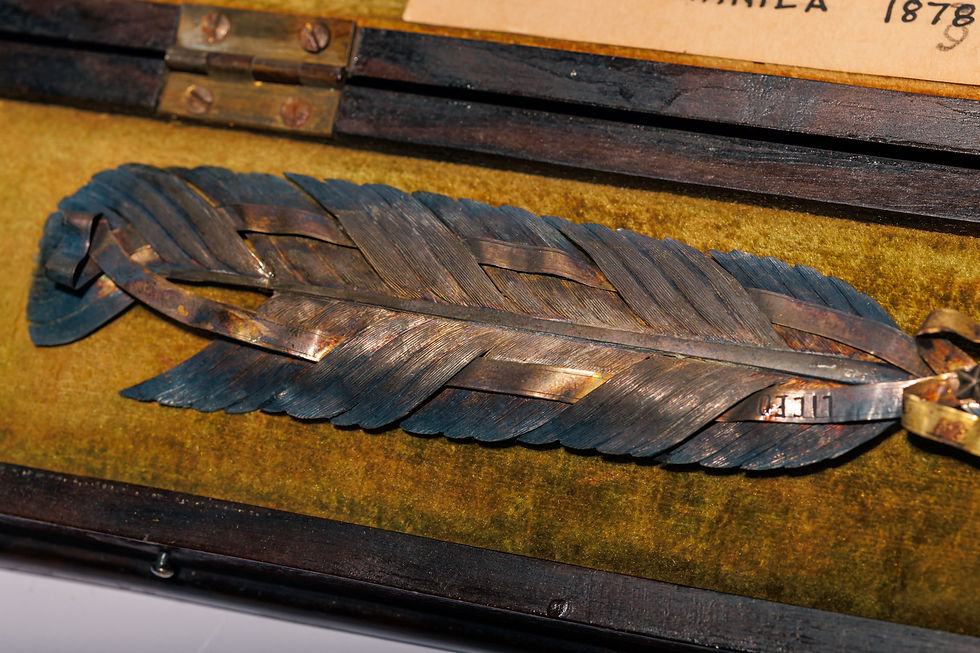
05 Liceo stamp. Near the base of the vane, struck into the band in small capitals: LICEO. That's the Liceo Artístico-Literario de Manila signing its prize. It is the closest thing this object has to a hallmark, and the single most important detail on it.
06 Star rosette. Where feather meets barrel, a tiny five-pointed star pins the bow at its knot. At first glance, you'd miss it. Once you see it, you can't stop seeing it.
07 Gilt bow. The bow is a loose gilt ribbon, with two looped wings and forked swallowtail ends. The gilding is worn through in places and spotted with red-brown corrosion. Still, it's the only warm color on the pen, and it catches the light first.
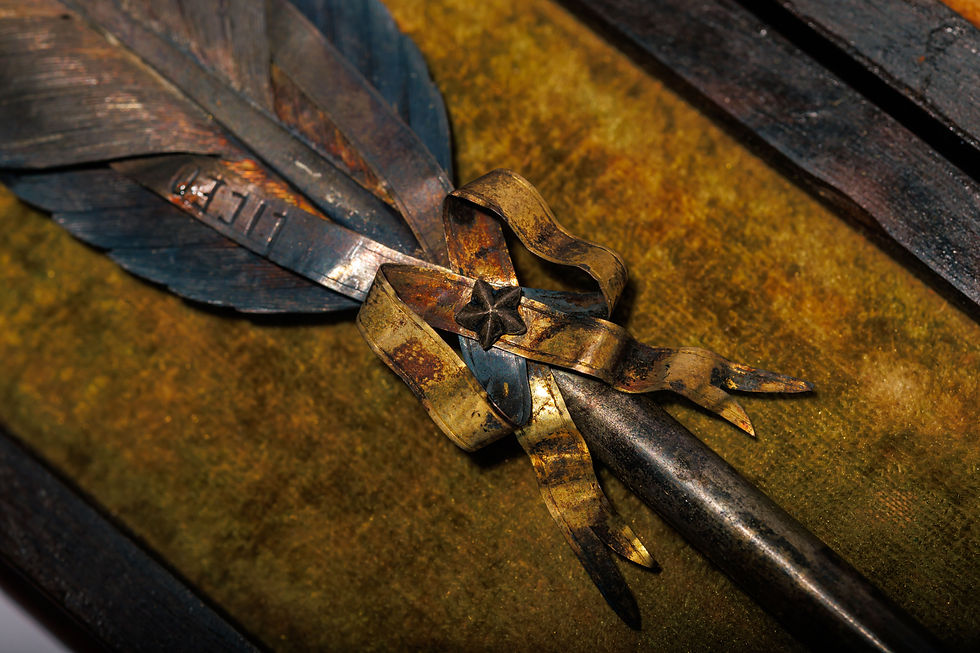
08 Barrel. Then the business end. A plain tapered silver tube, darkened with patches of black tarnish. No decoration at all, as if the silversmith spent everything on the feather and remembered at the last minute that this was supposed to be a pen.
09 Nib. It ends in a faceted, pointed tip, shaped like a dip-pen nib. That detail matters. The quill was made to be usable, dipped in ink and written with, not only admired in a box.

The surface. The whole piece has gone blue-black and violet, with rainbow colors on the high points, the way old silver does when it's left alone for a century or so. Nobody polished it off, thank goodness. A few bright, raised spots show where hands have touched it over the years. Mine, now, among them.
The case. The quill lies diagonally in a shallow box of dark hardwood, kamagong according to the National Museum, with a hinged lid on two brass butt hinges held by slotted screws. The lining is green velvet, faded to olive and ochre. The mitered corners have opened slightly as the wood shrank.
The label. Glued inside the lid is a paper card, hand-lettered in English: SILVER QUILL, Prize for "La Juventud Filipina", awarded by the Liceo Artistico Literario, Manila 1878. The English wording points to a 20th-century collector's or curator's label, not an 1879 original. Someone, at some point, caught the date error and penciled a 9 over the final 8.
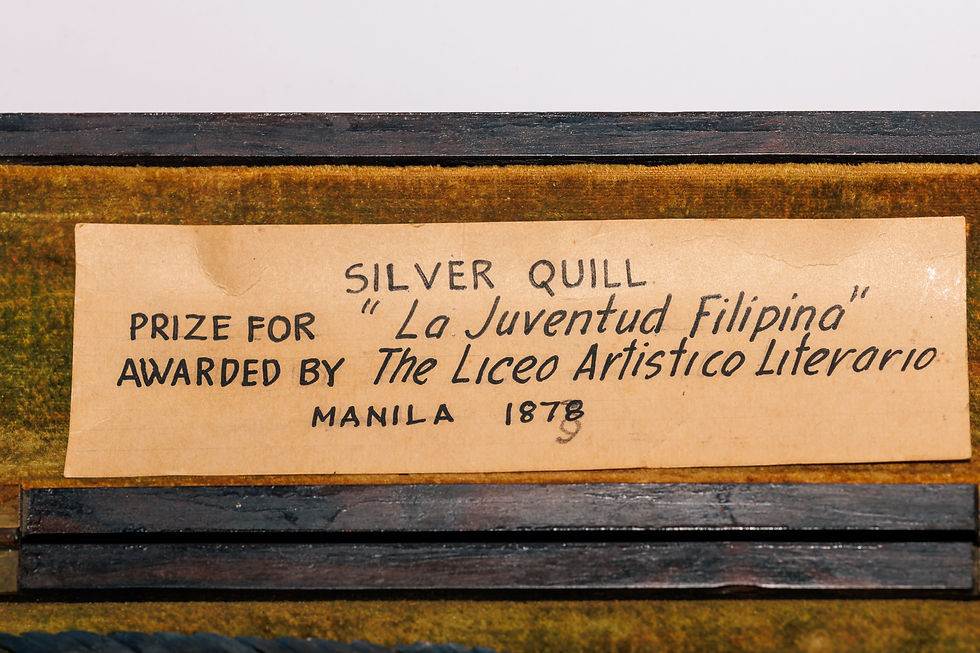
That penciled 9 was the first thing that hooked me. Somebody before me had cared enough to correct the record. Who? When? I still don't know.
In 1879, the Liceo Artístico-Literario de Manila held a literary contest with a section open only to indios and mestizos. Rizal, eighteen and a medical student at Santo Tomás, entered an ode called A la Juventud Filipina, To the Filipino Youth. He won first prize: a diploma of honor and a feather-shaped silver pen. His early biographer Austin Craig described it as a silver pen, feather-shaped, with a gold ribbon running through it. The object in my hands matched, ribbon and all, even if the ribbon has since lost its gold.
The poem's most famous line calls the Filipino youth bella esperanza de la patria mía, the beautiful hope of my homeland. It survives today as the saying every Filipino schoolchild knows: Ang kabataan ang pag-asa ng bayan. The National Museum's essay on the poem notes that critics read it as an act of nerve, because Rizal named the Philippines, not Spain, as his patria. It also cites historian Fidel Villaroel, who read it more modestly, as joy that Filipinos were finally allowed into a Spanish-judged contest at all. One stanza even praises Spain's "pious and wise hand." Both readings fit. That's what makes it interesting.
Then came the sting. The following year, Rizal's El Consejo de los Dioses topped an open contest, Filipinos and Spaniards together. According to Craig, he was bumped to second place after objections that a native had beaten the Spanish entrants. So the quill is the prize from the contest he was allowed to win. Hold that thought, and look at the nib again.
Nine years later, a card from Hong Kong
Now the postcard. It is headed Hong Kong, Victoria Hotel, 9 February 1888. Stained, torn at the edges, sealed in a clear sleeve, with a circular datestamp sitting right on top of the text.

Context makes it land. Noli Me Tángere had come out in 1887. By year's end, Rizal was helping Calamba's tenants answer a government inquiry into their Dominican landlords, and the Governor-General himself advised him to leave the country for his own safety. On 3 February 1888, he sailed on the Zafiro. He reached Hong Kong on the 8th. He wrote this card the very next day, the first full day of his second exile. A Spaniard named José Sainz de Varanda, a former secretary of the Governor-General, reportedly shadowed his movements there.
Here is the part that undid me. The card is not in proper Spanish. It is in Cavite Chabacano, the Manila Bay creole, with a bit of Tagalog thrown in. Line by line, as best as I could read it:
Ñol: Aquí está nisós con ñol Yriarte. Yo di andá na Londres, y pasá Japón, Estados Unidos. Pronto di escribí con vos. Ta mandá mío expresiones con el mga capatid y otro pa suyo. Adiós, ñol…
Sir: Here we are with Mr. Yriarte. I'm off to London, passing through Japan and the United States. I'll write you soon. My regards to the brothers, and to the rest of yours. Goodbye, sir…
Then the signature, Rizal, with that long confident underline.

The details check out. Manuel Yriarte was one of the Filipino residents who welcomed Rizal in Hong Kong, along with José María Basa and Balbino Mauricio. And the route he announces is exactly the route he took: the Oceanic out of Hong Kong on 22 February, Yokohama on the 28th, across America in the spring, and London by late May, where he would sit in the British Museum and annotate Morga's history of the Philippines.
One small mystery I can't let go of. Ambeth Ocampo, reading Rizal's original 1888 travel diary, found that Rizal wrote he stayed at the Victoria School and only had dinner at the Victoria Hotel for one dollar. On our card, a word is squeezed between "Victoria" and "Hotel" that the stains refuse to give up. I would love to know what it says. Fellow history nerds with raking lights and infrared cameras, you know where to find me.
Your handwriting was you
Some of you know we've been spending a lot of time lately reading the messages on old private mailing cards. Werner and his breathless note about the new postcard craze. Walter, the German sailor, scribbling a goodbye from Manila Bay in 1898.
We made a short video about their two cards, and how they found their way back to Manila: https://youtu.be/STTwPJDYj5Y.
One of the display tables at Whispers of the Nib carries a line I keep repeating: The original selfie: your handwriting was you.
So why not read one written by our own national hero?
Reading Rizal's card the same way changed everything for me. This is not the Rizal of bronze monuments and textbook portraits. This is a 26-year-old man, days into exile, watched by a Spanish informer, joking with a friend in Chabacano. Ñol. Nisós. Mga capatid. The national hero, sounding like a barkada from Cavite.
I should be careful here, because I'm a stickler and you'd call me out anyway. No record shows Rizal wrote this card with this quill. Nine years separate them. By 1888, he was almost certainly writing with an ordinary steel nib, like everyone else in Hong Kong.
But the imagination doesn't need footnotes. Standing there with the quill in one hand and the card in the other, I could almost see him: a young man bent over a desk in a Hong Kong hotel room, the same hand that took that silver feather from Spanish judges at eighteen now writing to a friend that he was leaving, that he would write soon, that he was going to London. It felt like watching his ghost write the card in front of me.
That was the moment the furniture stopped being furniture. I wasn't holding a pen that had been to too many pen meets. I was holding history, and history was holding back.
People will ask what it's worth. Melvin did tell me once, if I recall correctly, what he paid for it in a private sale. I'll keep that between us. This is, after all, the same man I once described as allergic to the very idea of price. Publicly, I couldn't find a single auction record for the quill or the card. When Rizal letters do come up at auction, León Gallery has opened them at a million pesos each. But price shouldn't be the issue here, because this is priceless, and not in the auction sense. Silver quills like this one were not unique. Emilio Jacinto's poetry-prize quill once turned up in a junk shop, about to be sold by weight for the silver. Objects get price tags, and appraisers can argue over them.
What no one can price is the moment itself: a silver feather in one hand, Rizal's handwriting in the other, and 138 years folding down to nothing. That experience is the priceless part. Everything else is paperwork.
A Halloween dinner
This is what has kept me busy all day: reading, transcribing, comparing hands, dates, and creole verb forms. Tonight I finally took a break and had dinner with some very nice people who were also part of the exhibit. Good food, good company, and a lot of stories, mostly from me. I guess it's my outlet after spending the whole day reading and researching Rizal and his pen and postcard, and yet every few minutes during the dinner my mind wandered back to that kamagong case, that penciled 9, that Aquí está nisós. I couldn't wait to get home and write this down.
It's Halloween night, and I only noticed the date when I sat down to research and write. Fitting, I think, that I spent Halloween chasing a ghost.
For a year, an elephant in the room showed up every time that quill came out of its case. Tonight the elephant is gone. A ghost chased it off: a young man with a silver feather in one hand and a postcard from Hong Kong in the other, leaning over my shoulder, whispering the first line of his card.
Aquí está nisós. Here we are.
The quill and the postcard are still on display at the Ortigas Library. Whispers of the Nib seems to be in its final month, maybe even its final weeks. So don't wait. Go and see them for yourself. Who knows, the ghost may be there to show you around.

Happy Halloween, fellow history nerds.
Sources
Ambeth R. Ocampo, "Footnotes to PH history in Hong Kong," Philippine Daily Inquirer — https://plus.inquirer.net/?p=347267
Also drawn from: National Museum of the Philippines, "Pluma · Silver Quill" object page and M. C. Calanno, "An Ode to the Filipino Youth"; Austin Craig (ed.), Rizal's Own Story of His Life (1918); joserizal.com, A la Juventud Filipina; Inquirer Lifestyle, "Up for historic auction: the letters of Rizal" (2017); Inquirer Opinion, "One person's trash, another one's treasure."


Comments