


Two Blades, One Oath

A dagger doesn’t just cut. Sometimes it keeps a promise.
Some auctions sell objects. This one, if you let it, sells you a conversation between two men who never met — or may have, we’ll never fully know — separated by rank and region, perhaps by a few birthdays, yet united by the same impossible ambition: a free Philippines.
Lot 101 and Lot 105 are both daggers. Both are dated to the same violent, hopeful stretch of years that witnessed the Katipunan uprising against Spain, which flowed directly into the Philippine-American War that followed, with barely a breath between one occupier and the next. Both, cut or cast in silver, bear the same solar face and the same three stars that would end up on a flag. And both, in their different ways, are trying to tell you the same thing: “I held rank in a nation that did not yet legally exist.”
That’s the trick of it. The Philippine Revolutionary Army fighting Spain and the Ejército Filipino fighting the United States were not two armies. They were the same institution, wearing two different uniforms of crisis, forced to reinvent itself faster than its enemies could be replaced. An officer who commissioned a dagger like Lot 101 in 1897 could very plausibly have been the same man commanding troops under the Republic in 1899 — the Katipunero become general, the underground cell become government. If these two blades never crossed paths in a single skirmish, they very nearly did in spirit: same chain of command, same cause, twelve months and one new enemy apart.
Lot 101: the officer who wanted to be seen
This one belongs to the field. Its owner was not a rank-and-file Katipunero swinging a bolo, the
tool-turned-weapon of the masses, but a company- or battalion-level officer, a man of some

standing, possibly a municipal leader who set aside his ledger to take command. The construction points to the Tagalog heartland: Cavite, Batangas, and the towns ringing Manila Bay, where the Katipunan organized and the Ejército Libertador drew its officer corps. The hand-forged blade, the deliberately European-styled crossguard borrowed from hunting hangers and naval dirks, and the faceted kamagong grip are not mere decoration. It is a man-made object, crafted from local materials and borrowed grammar, the uniform of a command structure that Spain refused to recognize as legitimate.
The silver triangle sunk into the pommel does the real talking. That anthropomorphic sun first
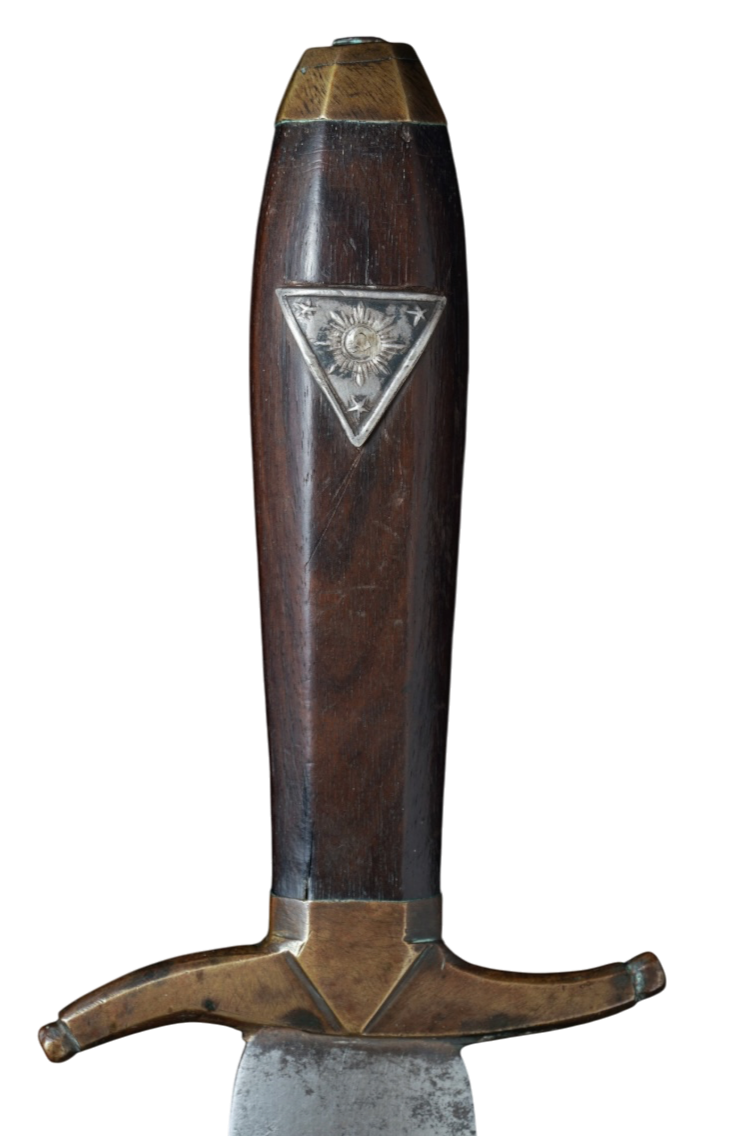
appeared on the banner Aguinaldo raised at the Naic Assembly on March 17, 1897; the triangle-and-three-star framework belongs to the flag sewn in Hong Kong and unfurled at Kawit on June 12, 1898. Lot 101 fuses both moments into one inch of silver—meaning whoever wore it either commissioned it after Kawit or updated an old blade to keep pace with the new republic’s iconography. Either way, this was a man watching the revolution’s symbols evolve in real time and insisting that his sidearm evolve with them.
Lot 105: the general who wrote it himself
If Lot 101 is a field officer’s declaration, Lot 105 is a general’s confession. This one belongs to the Ejército Filipino of the First Philippine Republic -- the

army that inherited the Katipunan’s cause and then had to fight a new, better-armed occupier for it, through 1899 and into 1900. The silver-and-carabao-horn hilt, the clover-topped crossguard, and the hand-cast orb crowning the scabbard’s tip — these are the trappings of a general who, by necessity, was also his own quartermaster and iconographer, designing the ceremonial vocabulary of a republic that had existed for less than a year.
But it’s the scabbard that sets this dagger apart from every other militaria lot in the room: scratched by hand into the silver casing, in what reads as the owner’s own script, is the word “Livertad.” Not engraved by a silversmith working from a template — scratched, personally, imperfectly, the way a man

writes a word he means rather than one he’s been told to display. Beside it, the same sun and three stars that Lot 101 carries in miniature. Whoever owned this blade did not need a jeweler to tell him what he was fighting for. He carved it into his own scabbard so he would not forget, or so anyone who saw it would not mistake him for someone still fighting for Spain’s approval rather than for his own country’s existence.
Put the two side by side, and the chronology moves quietly. One is the sidearm of a man proving himself an officer against Spain, in the years when “the Philippines” was still a Katipunan cell structure and a triangle passed hand to hand in secret. The other is the sidearm of a man who had already won that argument, now commanding a standing army of a republic the world had not yet recognized, fighting a second colonial power for the exact same right to exist. Different rank, quite possibly different regional origin, almost certainly different battlefields in any given week, but the same three stars, the same solar face, the same word underneath it all, whether cast in silver or scratched by an anxious hand: "Livertad."
We can’t identify either owner. Auction catalogs are honest about that, and so should we be. Without stretching the record, we can say that these two men belonged to the same unbroken chain of command—the officer corps that Lot 101 served in the Katipunan years is the same institution, wearing a different name, that Lot 105’s general served in during the war that followed. They may never have stood in the same trench. They almost certainly stood against the same idea: that Filipinos did not get to choose who governed them.
Two daggers. One oath, spoken twice, to two different enemies, by two men who never doubted it was the same fight.
Both daggers go to auction on September 12 at The Magnificent September Auction at the Leon Gallery


Comments