


The Gilded Bloom: How the Kikumon Turns Luxury into Legend
Updated: Aug 21

In the high-stakes world of luxury markets, we often discuss "Veblen goods"—items whose demand rises as they get more expensive. But what happens when the price doesn’t matter because selling the item is technically illegal? Enter the “Kikumon,” or the Sixteen-Petal Chrysanthemum crest. In Japanese history, this isn't just a floral symbol; it is the intellectual property of the Sun Goddess’s direct descendants. To put it on an object is to go beyond "premium" and "limited edition" and directly into the realm of “Goshakuhin” (or “Imperial Gifts”). It is the ultimate market disruptor: a branding exercise in which the "brand" has ruled since the 12th century. These three items, once simple, now stand for something much more significant.
I am confident that fountain pen enthusiasts and collectors agree that, according to standard market logic, a Sailor Professional Gear fountain pen is already a mid to top-tier writing instrument. With its 21k gold nib, it’s one of the leading brands in capillary action, being a very

reliable writer. However, when the Imperial Household commissions a batch, they add a small, stamped chrysanthemum to the nib, the cap, and the top of the ink bottle. Suddenly, this isn't a pen you use to sign a lease or doodle during a Zoom call. Nestled in its Paulownia wood box, it becomes a relic of political history. These are never available in a Ginza department store; they are given to diplomats and high-ranking officials. In economic terms, the rarity is absolute. You can't buy your way into this club; you have to be "useful to the State" to get in. Imagine giving someone a pen so exclusive that the ink itself probably refuses to write grocery lists, lest it be sullied by mundane tasks. Even the cap might feel slightly offended at the idea of being twisted off for anything less than a treaty signing. It's luxury at its most dramatic—if pens could roll their eyes, these would surely do so whenever you reach for them to jot down "milk, eggs, bread."

Then you have the "Imperial Seiko": The V.F.A. Unicorn. The watch that represents and symbolizes a "flex" of sovereign proportions -- the Seiko Ref. 4580-7020. On another level, this Seiko is a true example of exceptional value. In the late 1960s, Seiko’s "Very Fine Adjusted"
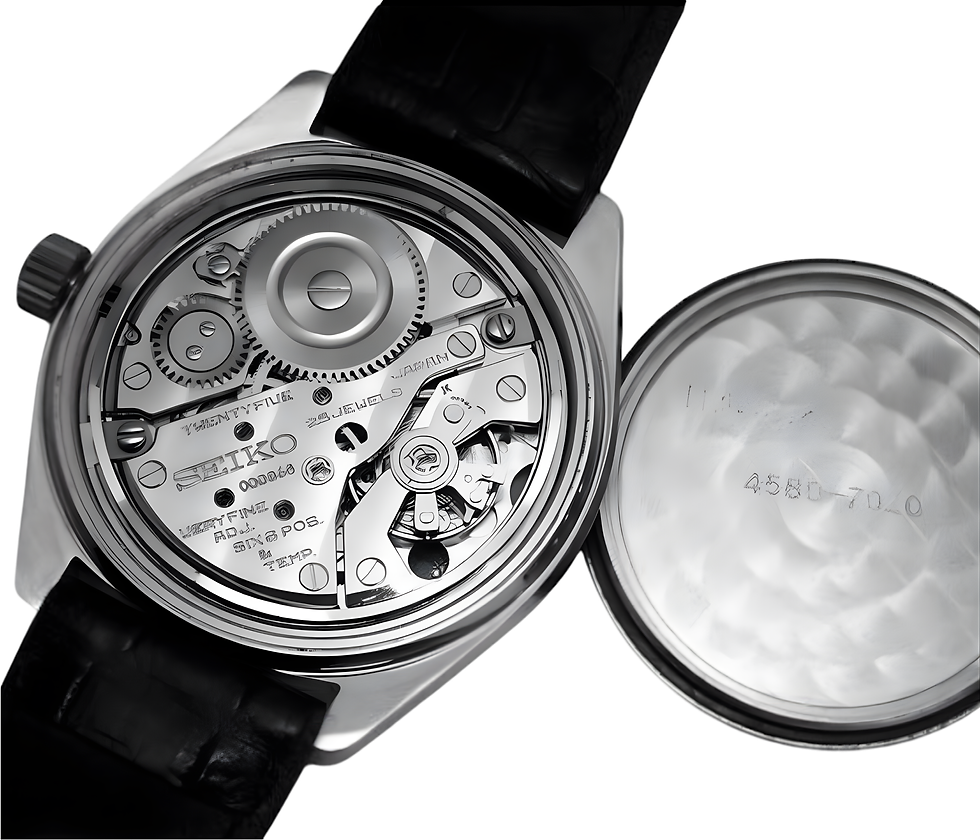
(V.F.A.) movements were already at the top of the Japanese horological hierarchy, adjusted to six positions and different temperatures with meticulous care. But the Imperial version doesn’t just stop at excellence—it elevates minimalism to such a divine level that even Marie Kondo would blush. The "Seiko" and "GS" logos are scrubbed from the dial; in their place, at the 12 o’clock position, sits the gold Chrysanthemum crest, so regal it looks like it might start issuing decrees if you stare too long. This transforms the watch into a silent, steely symbol of Emperor Hirohito’s 1971 European tour—a tour so important that even the second hand might have felt underdressed. It served as a diplomatic peace offering, proving that Japan had traded its military ambitions for world-leading precision (and possibly the world’s most intimidating punctuality). It is important to note that a commercially available model of the Grand Seiko VFA 4580-7020 sold for $48,000 in 2021. But the Imperial Seiko, due to their extreme rarity and "private provenance" can probably command upward of $100,000. For collectors, it is the ultimate "Unicorn": not only rare, but also mysterious—Seiko kept no official records of these, making the hunt for one a blend of high-end horology and Indiana Jones-style archaeology, minus the hat but with just as much dramatic theme music every time a clue turns up. (I can hear the music now https://www.youtube.com/watch?v=-bTpp8PQSog&list=RD-bTpp8PQSog&start_radio=1)
Finally, we have the understated gold watch—with its dignified sub-second hand and an impressively engraved case back. The inscription commemorates the 60th Anniversary of the

Showa Emperor’s ascension in 1986. While the V.F.A. Seiko highlights technical skill, this gold piece is all about celebrating history with style. It’s a wearable tribute to the Showa era and, honestly, might be the only anniversary watch that can command your entire jewelry box just by being nearby. Honestly, if you wore it to a casual dinner, the cutlery might suddenly straighten up and give a respectful bow. And as far as the market is concerned, its "value" comes from a double factor—gold, the universal symbol of status and a stable asset, combined with Imperial history, an utterly irreplaceable treasure. In the world of commemorative gifts, this isn’t just any "years of service" gold watch; it’s the kind of masterpiece that makes those plastic participation trophies look like they were handed out at a school science fair.
I believe the lesson here for the modern collector or historian is simple: “Context is the ultimate luxury.” When the Sixteen-Petal Chrysanthemum is used on an object, it stops being just a tool and becomes a symbol of imperial sovereignty. It elevates world-class Japanese craftsmanship to a level of rarity that modern marketing departments can only dream of.
Using an Imperial Gift to tell time or to write a grocery list is, frankly, like using a royal scepter to flip pancakes. It’s technically functional and undeniably impressive, but you might be overqualified for the task. In the end, even with all this regal grandeur, history reminds us: Emperor Hirohito himself was famously fond of a humble Mickey Mouse watch. It seems that even when you have the power to command the rarest "Unicorns" of the watch world and turn a simple fountain pen into a treasure, sometimes you just want a cartoon to tell you it’s lunchtime.
Note: The Pen and the gold watch are mine, the Seiko VFA is only a dream........................and will remain

YOUTUBE VIDEO
Sources:
1. Imperial Household Agency (Kunaichō).Goshakuhin: The Tradition of Imperial Conferment and Gift-Giving. Tokyo: Records of the Showa Era. (https://www.kunaicho.go.jp/en/index.html)
2. Meiji Government Registry (1871). Decree on the Exclusive Use of the Sixteen-Petal Chrysanthemum (Kikumon) by the Imperial House. National Archives of Japan. (https://www.jacar.archives.go.jp/das/meta-en/C09090288700)
3. Seiko Watch Corporation.The History of V.F.A. (Very Fine Adjusted) Movements: Precision and Diplomacy. Seiko Museum Ginza Archive, Ref. 4580-7020. (https://watchesbysjx.com/2020/09/imperial-vfa-seiko-4580-7020-emperor-hirohito.html)
4. Sailor Pen Co., Ltd. Special Commissions for the Imperial Household: A Study of 21k Gold Nib Stamping and Kiri-Box Presentation. Hiroshima, Japan.
5. Bix, Herbert P. Hirohito and the Making of Modern Japan. New York: HarperCollins, 2000. (Context regarding the 1971 European Tour and the shift from militarism to industrial excellence).
6. Sano, T. "The Kikumon as National Branding: From the 12th Century to the Modern Luxury Market." Journal of Japanese Cultural Heritage, Vol. 42, 2018.
7. A Quick Note on "The Unicorns”: Because Seiko and the Imperial Household notoriously kept "off-the-book" records for these diplomatic gifts, much of the data regarding the Ref. 4580-7020 comes from private collector registries and auction provenance rather than a public retail catalog. In the world of high-end horology, these are often referred to as "Ghost References."


a riveting read haha