


The Fountain Pen of Escolta: A Heacock’s Tale
Updated: Apr 6

In Philippine history, we often highlight treaties, revolutions, and national heroes, but we tend to overlook and ignore the "lifestyle upgrade" that arrived in Manila around the beginning of the 20th century. An upgrade brought by our American friends who came for a quick visit, only to overstay for nearly half a century, influencing both our lifestyle and ways of thinking. One such “upgrade” began in 1900, when H.E. Heacock and B.W. Freer sold Elgin watches from a small shop. After moving to Escolta, they weren't just selling jewelry anymore; they were selling the future. In 1909, they installed Manila's first glass-sheet facade, effectively creating "window shopping" for a dazzled audience. By 1919, led by the legendary Samuel F. Gaches, Heacock’s had expanded into a seven-story giant—the largest department store in the islands, comparable to the finest emporiums in New York or Chicago. It was the retail hub of the nation, a place where you could find anything from a Frigidaire to a Remington typewriter.

Amid the gleaming silver and International Silver Co. flatware sat a modest yet impressive
“Heacock Special” Fountain Pen. This 5 1/4" black ebonite piece exemplified the peak of early 20th-century craftsmanship. Legend has it that a young, dapper Manuel L. Quezon, perhaps
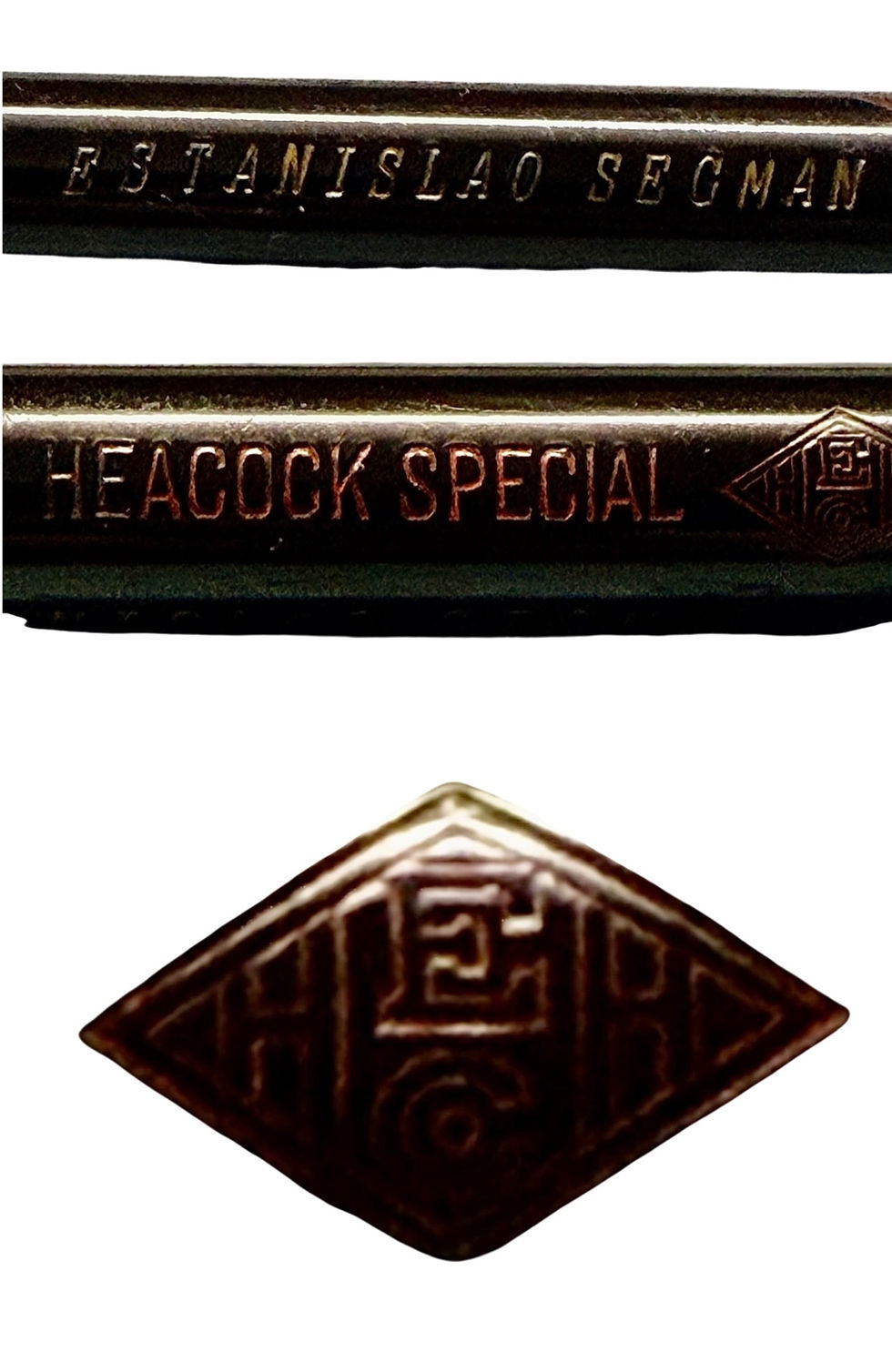
taking a break from debating the Jones Act, once strolled past the display at the David Street corner. He might have even picked up this very pen, feeling the balance of its slip cap and the smooth texture of the black hard rubber, contemplating it for his next fiery memorandum. Ultimately, however, the pen found its way into the pocket of Estanislao Segman, whose name remains professionally engraved on the barrel—making him, in academic terms, the luckiest guy of the 1910s.
This pen is a true survivor, almost like something out of the "Final Destination" movie. It endured the disastrous August 1937 earthquake that famously toppled the Heacock building. Although the store was rebuilt in a sleek Art Deco style in 1938, the pen had already faced an even bigger threat: World War II. During the Japanese occupation, luxury items were often "requisitioned." Our friend Estanislao probably had to play some risky hide-and-seek, maybe hiding this black ebonite treasure behind a loose wallboard to prevent it from being taken by an occupying soldier. Surviving the Battle of Manila in 1945, where much of Escolta was reduced to ash, is nothing short of a stationery miracle.
The question is: how did I end up with a 116-year-old time machine that also writes? It all starts with a friend, an eBay link, and a Jedi Master who shares these links to keep his status as our Jedi Master, “Budolero.” Let’s be honest: usually, when a Jedi Master of Vintage Fountain Pens shares an eBay link in your group chat while you’re stuck in traffic, you end up feeling like you missed out — 'The One That Got Away.' That’s exactly what happened when Butch posted a link to a "Buy It Now" auction. I was behind the wheel, helpless, while Dino—who clearly has the fastest thumbs in the East—snapped up the listed Heacock Special for just $75. After some heavy prodding, a bit of begging, and a friendship display that deserves its own monument, Dino kindly agreed to pass it to me at his cost.

Upon receiving the pen this morning, I was amazed by its condition, making it a true “survivor.”
This Heacock Special Fountain Pen is a 5 1/4" black ebonite marvel that proves history can write itself—sometimes literally. With a warm, grippy, hard rubber body and cap, this pen feels extremely comfortable in your hand thanks to its smooth texture. Although I find it thin, as I am a “fat Duofold” fan, you might mistake it for a tiny baton and start conducting your own symphony of signatures. Its eyedropper filling system allows you to fill the entire barrel with a glass dropper, a task best attempted with steady hands (or at least a stable table). Sporting a “Regal” 14kt gold-plated Fine nib, it writes like a dream as it will cater to the flex lovers, given its semi-flex nib; and its crisp, red-filled “HEACOCK SPECIAL” logo and “Dandy” nickel clip add enough patina and character to whisper, “I’ve seen things you wouldn’t believe.”

And that’s what truly amazes me about this pen—the history behind it. That’s why I had to get it at all costs, even if it meant looking foolish to the person with the quickest thumb in this part of the world. This pen was sold in a department store once known as a top pre-war luxury store that defined the "Pearl of the Orient." This store was so upscale that it had branches in Iloilo, Cebu, and Baguio before most people even knew what a department store was. The pen survived the Great Earthquake of 1937 and risked playing a game of "Don't Find Me" with Japanese soldiers during the occupation.
In the world of fountain pen collecting, we naturally pursue the pens we love—those that look eye-catching with all the bells and whistles, pens that write smoothly with nice flex, and perhaps the most expensive ones with beautiful Maki-e artwork. But this Heacock Special stands out as the "Unicorn" of Southeast Asian stationery history. While a modern Montblanc, featuring a lovely snowcap emblem at the tip and calling itself a “Starwalker,” might seem flashy to many, or a vintage Parker Duofold with impressive flex that creates eye-catching calligraphy, or a Namiki Emperor with an incredible Goldfish design in Maki-e, they still can’t tell the story of surviving the collapse of a colonial empire, the fires of a World War, or witnessing the birth of a new society built on American values. For just $75, my friend didn't just purchase a pen; he rescued a piece of the Philippine soul and entrusted it to me for safekeeping. This pen will be kept for future generations to enjoy and learn from, preserving a part of history. In a hobby where choices are endless, this clipless ebonite marvel, named after the store where it was first sold, serves as a humble reminder: the most valuable pens aren't always the most expensive ones, but those that refuse to retire, and endure a century of drama and history.
Source:


Comments