


The Byron Milstead "Spotlight" Exhibit: A Strategic Guide in Collecting Philippine Counterstamps and Countermarks
- sandylichauco
- Mar 22
- 9 min read
Updated: Mar 23

Last March 14 to 15, the Westin Manila in Mandaluyong City served as a temporary sanctuary for some of the rarest treasures in the collecting world. While the Minted MNL Spotlight event featured a variety of displays, one exhibit stood out as a beacon for history buffs and serious numismatic hobbyists alike. It was the brainchild of Mr. Byron Milstead, a good friend and a collector with a deep passion for the "damaged" yet divine. His exhibit, a masterclass in historical preservation, was titled:
"PHILIPPINE COUNTERSTAMPS AND COUNTERMARKS (1828-1837): POTENTIAL COLLECTING APPROACHES FOR THE BEGINNER OR THE ADVANCED,"
But first, a brief history lesson is in order. As we explore Byron’s strategies, let’s start by understanding the economic context of the early 19th century. Imagine it’s the early 1800s, a time when South America is rife with fervent independence movements seeking to break free
from colonial rule. At the same time, the Philippines, a Spanish colony, is experiencing an influx

of foreign coins, predominantly the Mexican and Peruvian 8 Reales. These coins, known for their silver content and wide acceptance, are flooding into the archipelago, creating both opportunities and challenges for the local economy. To maintain economic stability and prevent the local populace from entertaining thoughts of independence, the Spanish colonial authorities implemented a series of royal decrees. These decrees mandated that all foreign coins circulating within the Philippines must bear specific marks. For instance, coins were stamped with identifiers such as "F.7.o," representing King Ferdinand VII, or "Y.II." for Queen Ysabel II. These marks, though they may appear as mere defacements or damage to the untrained eye, were in fact critical symbols of legitimacy. They served as a form of royal

endorsement, effectively validating these foreign currencies for local transactions. The
introduction of these stamps was a strategic maneuver by the Spanish authorities to exert control over the economy and suppress any burgeoning nationalist sentiment among the Filipino people. By regulating currency and ensuring that foreign coins were accepted, Spain aimed to strengthen its grip on a colony that, at the time, served as a crucial component of the empire’s wealth, largely due to the lucrative galleon trade linking Asia and the Americas. In this context, what might be perceived by modern collectors as a mere stamp or an indication of damage was, in reality, a vital mark of approval that conferred greater value and authenticity to the coins of that era. In the eyes of the local populace, these stamps served as VIP passes, allowing the coins to circulate freely and reinforcing the colonial authority’s narrative of stability and legitimacy. Thus, the economic policies of the Spanish crown were not just about currency; they were intricately linked to the broader strategies of governance and control over a colony that was essential to the empire’s financial success.
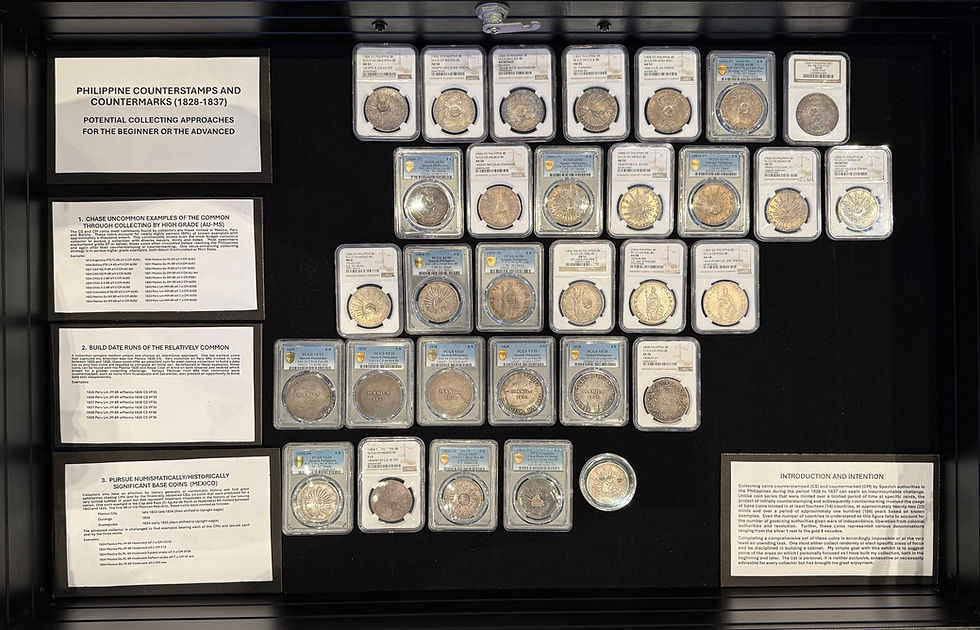

Byron’s collection proves you don't need to find every single coin to build a world-class cabinet. Since these marks appear on coins from over 14 countries and 22 mints, a "complete" collection is an endless pursuit. Instead, Byron shares seven "words of wisdom" on how to focus your collecting energy.
1. The Pursuit of Perfection: High-Grade Commons
Most countermarked coins seen today come from Mexico, Peru, or Bolivia, and because they circulated widely, they are usually found in rough condition—EF grade or lower. Byron’s first collecting tip is to pursue "Uncommon Examples of the Common." He suggests that by searching for coins in About Uncirculated (AU) or Mint State (MS), collectors can turn a common coin into a rare prize, like his 1832 Mexico Zs OM 8R (MS61). In other words, although most countermarked coins are worn from use, finding a standard host coin (from Mexico or Peru) in exceptional condition is truly special and highly valued among numismatists.

These are common host coins from Mexico, Peru, and Bolivia, but they are preserved in exceptional condition.
1815 Argentina PTS FL 8S w/ Y.ii CM (AU53)
1834 Bolivia PTS LM 8S w/ Y.ii CM (AU58)
1827 CAR (Central American Republic) NG M 8R w/ Y.ii CM (AU det)
1829 CAR (Central American Republic) NG M 8R w/ Y.ii CM (AU55)
1834 Chile S JJ 8R w/ Y.ii CM (AU55)
1834 Chile S JJ 8R w/ Y.ii CM (AU53)
1834 Chile S JJ 8R w/ Y.ii CM (AU50)
1835 Colombia B RS 8R w/ Y.ii CM (AU55)
1832 Mexico Do RM 8R w/ Y.ii CM (AU50)
1833 Mexico Do RM 8R w/ Y.ii CM (AU53)
1830 Mexico Go MJ 8R w/ Y.ii CM (AU53)
1831 Mexico Go MJ 8R w/ Y.ii CM (AU53)
1834 Mexico Go PJ 8R w/ Y.ii CM (AU55)
1831 Mexico Zs OM 8R w/ Y.ii CM (AU det)
1832 Mexico Zs OM 8R w/ Y.ii CM (MS61)
1834 Mexico Zs OM 8R w/ Y.ii CM (AU50)
1833 Peru Lm MM 8R w/ F.7.o CM (AU58)
1833 Peru Lm MM 8R w/ F.7.o CM (AU58)
1833 Peru Lm MM 8R w/ F.7.o CM (AU53)
1833 Peru Lm MM 8R w/ F.7.o CM (AU50)
2. The Logical Path: Building Date Runs
If you dislike randomness, try a Date Run. For beginners, the Manila 1828 counterstamped on Peru 8 Reales is an ideal starting point. You only need four specific years to complete an initial set. It turns a chaotic hobby into a structured mission. Focusing on the Manila 1828 Counterstamp (CS) on Peruvian 8 Reales, collectors seek coins from key years such as 1825, 1826, 1827, and 1828, with various grades available. This approach provides a clear path for collecting and makes it easier for newcomers to get started.

Focusing on the Manila 1828 Counterstamp (CS) on Peruvian 8 Reales.
1825 Peru Lm JM 8R w/ Manila 1828 CS (VF25)
1826 Peru Lm JM 8R w/ Manila 1828 CS (VF35)
1827 Peru Lm JM 8R w/ Manila 1828 CS (VF35)
1827 Peru Lm JM 8R w/ Manila 1828 CS (VF35)
1828 Peru Lm JM 8R w/ Manila 1828 CS (XF40)
1828 Peru Lm JM 8R w/ Manila 1828 CS (VF30)
3. For the History Buffs: Historically Significant Base Coins

Some collectors prioritize the "host" coin over the stamp. Byron highlights the Mexican "Hookneck" 8 Reales (1823-1825), which were the first coins of the Mexican Republic. Finding one that survived long enough to reach Manila and be stamped by the Spanish authorities is truly the height of historical irony and reveals a fascinating overlap of eras.
The "El Aguila de Perfil" or Hookneck 8R, the first of the Mexican Republic.
1824 Mexico Mo JM 8R Hookneck w/ F.7.o CM (VG10)
1824 Mexico Mo JM 8R Hookneck w/ Y.ii CM (F15)
1824 Mexico Do RL 8R Hookneck (Folded snake) w/ F.7.o CM (VF35)
1824 Mexico Do RL 8R Hookneck (Defiant snake) w/ F.7.o CM (VF det)
1824 Mexico Go JM 8R Hookneck w/ Y.ii CM (Raw)
4. The "Peru Libre" and the Royalist Struggle
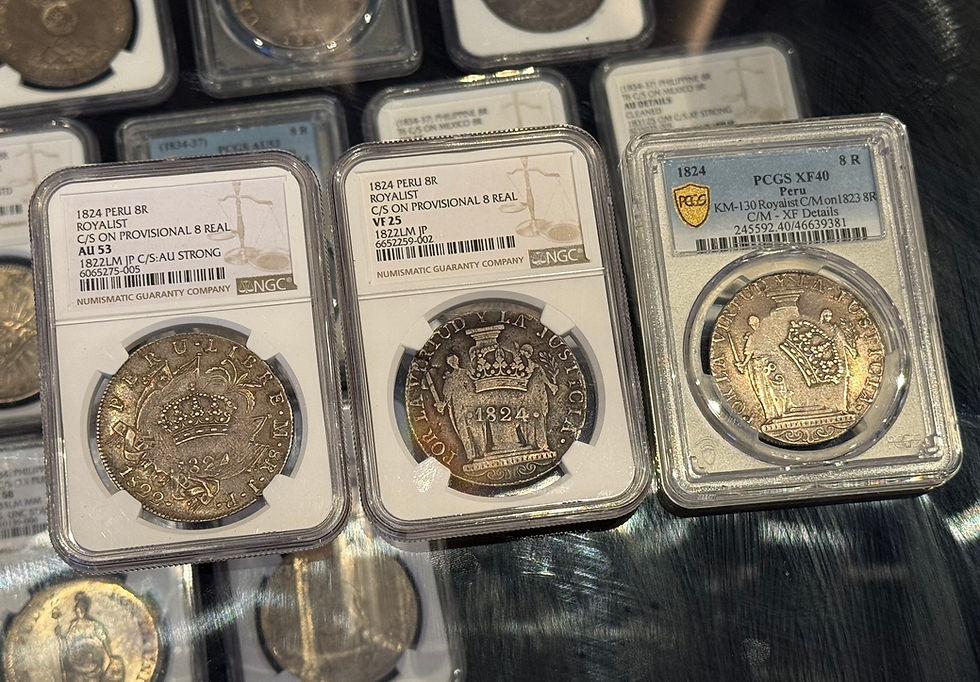
Peru offers the "Wedding Coin" or "Peru Libre" (1822-1823). These coins are fascinating because they often tell a story of a political tug-of-war. Some were stamped with a Royalist Crown when Spain briefly retook Lima in 1824, then later received a Philippine countermark. It’s a layered history of political upheaval and struggle.
The "Provisional Government" or "Wedding Coin" series.
1822 Peru Lm JP 8R w/ Royalist Crown CM (AU53)
1822 Peru Lm JP 8R w/ Royalist Crown CM (VF25)
1823 Peru Lm JP 8R w/ Royalist Crown CM (XF40)
1822 Peru Lm JP 8R w/ Royalist Crown CM & F.7.o CM (VF35)
1822 Peru Lm JP 8R w/ F.7.o CM (VF30)
1822 Peru Lm JP 8R w/ F.7.o CM (VF25)
1823 Peru Lm JP 8R w/ F.7.o CM (AU55)
1822 Peru Lm JP 8R w/ Y.ii CM (AU det)
1823 Peru Lm JP 8R w/ Y.ii CM (VF35)

5. Royals on Royals
This is a favorite niche. Collectors seek Philippine CMs featured on coins that already display
Spanish royalty. Byron’s personal favorite comes from this category—coins where layers of imperial history are pressed into a single piece of silver.
Philippine CMs on earlier Spanish colonial coinage featuring royal portraits.
1806 Lima Lm JP 8R w/ F.7.o CM (VF det)
1807 Mexico Mo TH 8R w/ F.7.o CM (VF det)
1818 Mexico Zs AG 8R w/ Y.ii CM (VF20)
1821 Mexico Zs RG 8R w/ F.7.o CM (XF det)


6. The "Holy" Grail: Perforated Coins
In 1834, a decree stated that holed or perforated coins could be considered legal tender only if a

CM was punched over the hole. These coins are extremely rare—fewer than 80 are known to exist. Finding a "Father and Daughter" pair (bearing both F.7.o and Y.II. marks) on a holed coin remains the ultimate challenge. Coincidentally, this is the same coin, with the same grade that sold for $116,000 in the last Minted MNL auction last November.
Coins with holes covered by CMs to regain legal tender status.
1798 Mexico Mo FM 8R w/ Y.ii CMs (Double CM) (F det)
1817 Mexico Zs AG 8R w/ Y.ii CMs (Double CM) (VF20)
1827 Peru Lm JM 8R w/ Y.ii CMs (Double CM) (VF25)
1827 Peru Lm JM 8R w/ F.7.o (1) & Y.ii (2) CMs (Triple CM) (VF30)
1834 Peru Lm MM 8R w/ Y.ii CM (Single CM) (XF det)
1835 Peru Lm MM 8R w/ Y.ii CM (Single CM) (F15)

7. Chasing Unicorns
For those with deep pockets and nerves of steel, there’s the hunt for the Unicorns. These are

coins with process errors, rare mints, or unique origins, which are really for the advanced investor. Like this Somberete which is my personal favorite.
Investment-quality pieces based on extreme scarcity of the host or the mark.
1828 Manila over 1815 Argentina PTS JM 8S (VF20) – Only 2-3 known.
1828 Manila over 1287 (1827) Mexico Ga FS 8R (VG10) – The only known 1828 Manila CS on this error.
1830 Manila over 1829 Bolivia PTS JM 8S (MS63) – Finest graded.
1767 France B K Ecu w/ F.7.o CM (F15) – Only 2 known.
1812 Mexico Sombrerete 8R w/ Y.ii CM (XF40) – Legarda provenance.
1825 Mexico Mo JM 8E w/ Y.ii CM (XF45) – Only known 1825 with CM.
1832 Mexico Zs OM 1R w/ Y.ii CM (VF25) – Only known 1832 Zs.
1830 Peru Lm JM 2R w/ Y.ii CM (VF20) – Only 1 known for this date.
1832 Mexico Zs OM 4R w/ Y.ii CM (VF20) – Legarda provenance.
1833 Mexico Zs OM 4R w/ Y.ii CM (VF30) – Only 4 known.
1833 Peru Lm MM 8R w/ Y.ii CMs (Double CM Obv/Rev) – Very scarce.
1836 Peru Lm MM 8R w/ Y.ii CMs (Double CM Obv/Rev) – Very scarce.

The Byron’s Exhibit showcases a curated selection of numismatic rarities that define the Philippines' role in 19th-century global commerce. These "crown jewels" represent the intersection of international trade, colonial administration, and rare minting anomalies.
Key Specimens or Showstoppers of the Collection:
I. 1830 Manila over 1829 Bolivia PTS JM 8S (MS63): Recognized as the finest graded example of its kind, in my opinion, this coin is the centerpiece of the exhibit. It serves as a premier artifact of the Manila minting process, in which foreign silver was officially restamped for local circulation and yet maintained it's uncirculated state.

II. 1832 Mexico 1 Real (Zacatecas Mint): Minor denomination coins bearing a Philippine countermark are difficult as it is, from the 1R to the 4R. It proves that even small-value currency was strictly regulated by the colonial government. This is the only known 1832 1R with a Philippine countermark.

III. 1828 Manila over 1815 Argentina 8 Soles: With only two or three specimens in existence, this coin illustrates the flow of wealth from South American independence movements to the markets of Manila. Only 2 or 3 known, plus coin came from a good friend and a collector from London.

IV. 1767 French Ecu (with "F.7.o" mark): A historical anomaly, this coin suggests unconventional trade routes. Since France was not a primary partner, its presence likely indicates arrival via British merchant vessels or military activity. Only two known French coins with mark and this one is the finest graded.

V. 1825 Mexico 8 Escudos: A unique gold specimen. Gold was rarely counterstamped because of its high intrinsic value; this single known survivor offers a rare glimpse into elite, high-net-worth transactions and colonial metal controls. Any gold coin with a CM is like "hen's teeth," only four known on a Mexican gold coin, and only known on a 1828.

VI. The "1287" Date Error (1827 Mexico 8 Reales): A "rarity within a rarity," this coin features a reversed date strike. It is the only known example of this specific manufacturing mistake bearing the 1828 Manila counterstamp. A date error that has become a "legend."

The Bottom Line
Walking through Byron’s exhibit is a humbling experience. When asked about the estimated value of the coins in this exhibit, which he was discreetly bringing around in his knapsack, he mentioned the cost was in the seven-figure USD range or higher, eight figures in Pesos, with a market value that could easily swing into the nine-figure range in Pesos at a high-end auction.
However, beyond the staggering price tag, the true value lies in the story. These coins are tiny, metallic witnesses to revolutions, royal decrees, and the birth of nations. As Byron’s exhibit demonstrates, the best way to collect isn’t just about the price but about 'getting down on the ground" and understanding the story engraved in the metal. This collecting approach is best summarized by his own words: "The list is personal... it has brought me great enjoyment." In the end, whether you are chasing a gold coin with a countermark or a common silver piece, the fundamental rule of collecting remains: pursue what brings joy and makes you happy or, as we say in the local community, "walang basagan ng trip."


the expertise and work that went into this blog entry is unbelievable!