


Iligan Was Discovered on October 7th, ’05
Imagine a trooper standing at the bow of a launch called the Annie. Arms folded. One boot up on the gunwale. Chin raised, like Balboa sighting the Pacific. Across the water, a row of nipa huts flies little pennants. The hand-lettered caption reads: “Iligan was discovered on October 7th ’05.”
Iligan, of course, had been discovered long before. The Spanish had kept a garrison there for generations. The Americans had been in town since 1900. The trooper is the joke. That is the whole point.
This is the first of fourteen pen-and-ink postcards we recently won at auction from the Ortigas Library. Every card is printed “Camp Overton, Mind. P.I.” Every card is drawn by the same hand. And in all our digging, we have not found another example of the series anywhere. Not in a dealer’s stock, not in a sale record, not in a museum.

A joke book in fourteen pages
The cards are printed on cream stock, with black line drawings and the camp imprint along the bottom. Thirteen are signed with an interlaced “HG” monogram followed by “ill.” One, the only card drawn as a solid black silhouette, is signed simply “H.G.” Two name the unit outright: “1st Sqdn. 4th Cav’y.” Two carry dates, “October 7th ’05” and “1905–07.”
That pins them down. The First Squadron of the U.S. 4th Cavalry served in the Philippines from 1905 to 1907. These cards are its private joke book.
Look at the corners. Each card has a pale diagonal ghost where an album mounting corner once sat. Nobody mailed these. Someone bought the set, slipped it into an album, and kept it together. For roughly 120 years, someone kept deciding it was worth keeping.
Camp Overton sat on Mindanao's north coast, a few kilometers south of Iligan town and about three kilometers from Maria Cristina Falls. On a map it looks like a minor coastal post. On the ground, it was a door.
Iligan was the northern entrance to Maranao country. Everything the Americans sent into Lanao first came ashore at Overton. Troops, mules, rations, ammunition, mail. From the camp a road climbed to Camp Keithley at Marawi on the lake’s north shore. From Keithley, boats crossed Lake Lanao to Camp Vicars on the south shore. A telephone line strung on poles ran from Overton all the way up to Keithley. Whoever held Iligan held the supply line, and whoever held the supply line could stay at the lake.
The camp grew in stages. Iligan historian Patrocenia Acut records a small American detachment set up a few kilometers south of town soon after the troops arrived in 1900. Lieutenant Parker Hitt of the 22nd Infantry, who knew the place well, credited the 14th Cavalry with building Camp Overton proper around 1903. The North American Forts register lists it as active until 1918.
And the name? Army posts in Lanao were usually named for officers, and the most likely namesake is Clough Overton, a West Point graduate of the class of 1888. We say “likely” on purpose. We have not found a document that ties him to the camp, or one that tells us how he died. Until one surfaces, the dedication stays an open question.
Not the war you think
Cards like these often get filed under “Spanish-American War.” They don’t belong there, and it is worth being precise about why.
Spain’s war with the United States was over by the end of 1898. The Philippine-American War was fought mainly on Luzon and the Visayas from 1899 to 1902. Camp Overton belongs to the third chapter: the Moro campaigns in Mindanao and Sulu, which ran from 1902 to 1913. In 1899, the Americans signed the Bates Agreement with the Sultan of Sulu precisely to keep out of Moro affairs while they fought in the north. Once the northern resistance broke, they turned south.
A thread ties the chapters together, though, and it runs straight through these cards. The 4th Cavalry was one of the first American units sent to the Philippines in 1898. Its troopers landed in August, just after Manila fell, and fought in some 119 engagements against Filipino forces before rotating home in 1901. When the regiment returned in 1905, it found itself in a different war, on a different island. A few of its older sergeants may well have been on their second tour. Card 02, about a man re-enlisting over and over, reads differently in light of that.

Who came through
For a small post, Camp Overton saw a remarkable cast.
John J. Pershing worked out of Iligan in 1901 and 1902, years before anyone called him “Black Jack” in a newspaper. From there, he walked unarmed to Marawi to talk with the Lanao datus. His key ally on the north shore was Amai-Manabilang, the retired Sultan of Madaya and the most influential leader on that side of the lake. In 1906, Pershing would be promoted straight from captain to brigadier general, over the heads of more than 800 senior officers.
Robert Lee Bullard’s men cut the supply road from Iligan up to the lake. Parker Hitt, later a famous Army cryptologist, ran the lake’s improvised “fleet” and left behind the best stories. In April 1904, his men dragged a condemned 28-foot steam launch up the road from Overton on a makeshift rig pulled by eight mules. Hitt nicknamed her “the little hussy” for her temperamental boiler and her coal appetite. His men also salvaged the gunboats the Spanish had scuttled in the lake in 1898. In one cabin, they found six champagne glasses and an empty bottle. Hitt kept five of the glasses for the rest of his life.
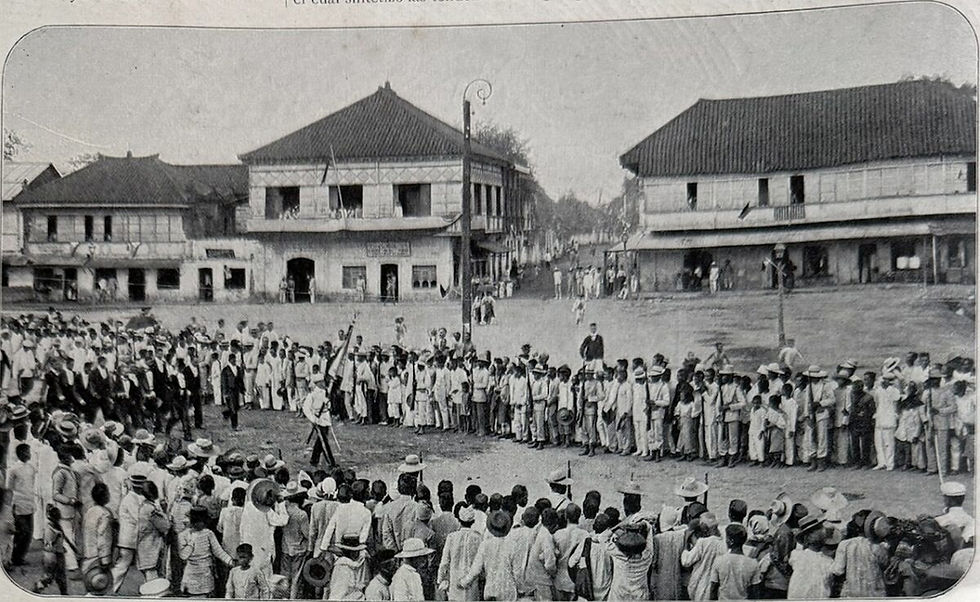
In April 1905, Major Abner Pickering’s battalion of the 22nd Infantry came down from Keithley, gathered at Overton, and sailed the same day on the steamer Romulus for the Third Sulu Expedition. That August, William Howard Taft crossed Mindanao overland with a congressional party and the President’s daughter, Alice Roosevelt. They came down from Keithley to Camp Overton, where photographer Burr McIntosh caught them. A few days earlier in Jolo, Alice called her official welcome “sheer comic opera.”
Two months later, Colonel Joseph Garrard’s 14th Cavalry marched out. Our cartoonist’s squadron marched in.
The fourteen
Here is the first thing you notice: the enemy barely appears. Thirteen of the fourteen cards aim their jokes inward, at the troopers themselves, their horses, their sergeants, their thirst and their laziness. Only one card looks out at the war. We will come to that one.
The horses. A cavalry squadron lives and dies by its mounts, and remounts in the tropics were at best half-broken. Three cards get the message across.

Troopers called “Monkey drill” vaulting and trick riding. Card 04 shows a sergeant, chevrons on his sleeve, squatting on a rock with an unmistakably simian face. The caption says the drill comes naturally to some men. That is a joke you can only make about someone everyone in the squadron knows. One suspects he saw it.


Cards 05 and 06 are a pair. In the first, a trooper in full field kit sails head-first over the neck of a bucking horse under the caption “Prepare to dismount,” the cavalry command given just before “Dismount!” Underneath: “Not necessary.” In the second, a horse rears straight up while its rider clings to the neck, hat flying. “Not yet,” the caption says. “But soon.”
The Army. The longest-running joke in any army is the army itself.

Card 02 shows a lanky recruit taking the enlistment oath before a smiling officer. “Hands up,” the caption says. “Up again, down again, ‘sold’ again.” “Hands up” is what a robber says. “Sold” was slang for being cheated. This man raised his hand, lowered it, signed on again, and was taken in every time. Below the drawing is a dotted line for a signature. A man made it home to explain to his mother why he had re-enlisted.

At guard mount, the sharpest-turned-out man was picked as the commanding officer’s orderly and excused from guard duty. Card 03 shows him: spotless uniform, polished shoes, hands in pockets, eyes shut, cigarette angled upward. The caption calls him the “Aristocracy of the ranks,” but it's misprinted. Every troop had one.

Card 08 is our favorite. Back home, every family knew the Pears’ Soap advertisement of a howling baby reaching out of its bath for a bar of soap: “He won’t be happy till he gets it.” Gill redraws the baby as a blubbering private spilling out of a washtub, tears flying, reaching for a corporal’s chevron on the floor. The scramble for promotion, told through a soap ad. “Apologies to Pears Soap,” he adds, politely.


Card 09 takes the camp's loudest order literally. A slow trooper is booted down a flight of steps by a leg from above. He has fallen in. Card 14 is a double pun: a shabby man in patched fatigues leans on a hoe. Fatigue duty, the endless clearing, ditching and digging, is the real general in charge, and the hoe is his staff.
The drink.

“Up the pole” meant drunk, and Card 07 leaves no room for doubt. Troopers climb, dangle from, and tumble off a pole. One lies across the top with a bottle. At the bottom, one man sprawls beside a jug marked “Beno,” and another is upended head-first into a crate of lager. “Beno” is almost certainly the soldiers’ spelling of bino, the local palm or nipa liquor. It is the first Filipino word in the series.

Card 13 is the most beautiful card in the set. Three troopers sit on the grass, silhouetted against a stippled night sky. One smokes. One blows smoke rings. One tips back a bottle. A man in the moon looks on. The title comes from Thomas Moore’s sentimental parlor song “Oft, in the Stilly Night,” about fond memories of loved ones gone. Gill’s version of a quiet night is quieter still: three men, out of the sergeant's sight, quietly getting drunk. It is funny. If you sit with it, it is also a little sad.
The sea.

Overton was a port, and the boat was the squadron’s link to everything, mail included. Card 11 shows the Annie again, this time pitching in heavy seas under a crescent moon. One man has climbed the mast. Another hangs over the bow, seasick. A fish leaps from a wave and asks, “Porque?” Why? The caption gives the squadron its only battle honor: “The Battle of Iligan Bay, fought and refought 1905–07.”
Home.

Card 12 may be the most human card of all. A trooper sleeps on a cot under a mosquito bar, one boot up. Cobwebs run from his foot to the floor. A spider has moved in. The rail reads “1st Sqdn 4th Cav’y · Bunk Fatigue · Camp Overton P.I.” Below it is a printed letter with blanks to fill in: “My dear …… I haven't had time to write; I'm just rushing. Yours truly ……”
Think about who bought this card. A young man half a world from home, with weeks between mail boats, who could not find the words for a proper letter. So he sent a joke that said: I’m fine, I’m lazy, don’t worry. The cobwebs told his family he was safe. The joke said what he couldn’t.
The card we have to talk about

Card 10 is the only one that turns to the war. A trooper, revolver drawn and a cartridge belt slung, creeps forward in an exaggerated stalking stride. The “enemy” is a small, solid-black silhouette of a Moro drinking from a bottle of beno. A lizard on the right says something we still can’t make out: “Oh, tac on you.” Our best guess is that it renders the call of the tuko, the gecko every soldier in Mindanao heard all night, but that is a guess.
The quotation marks around “hostile” carry the joke. The squadron’s first expedition into the interior finds nothing more dangerous than a man having a drink. Plenty of patrols out of Iligan ended exactly that way. The joke targets the trooper’s own bravado.
But the joke only works because of the drawing, and the drawing is a racial caricature. It plainly shows how the men who drew and bought these cards saw the people whose land they patrolled. We won't crop it out or explain it away. A Filipino collection that keeps this card should keep it with its eyes open. It is evidence, too.
Who was H. Gill?
We wish we could give you a name, a hometown, and a photograph. We can’t, yet. “H. Gill” does not appear in any catalog, sale record, or museum collection we searched. What the cards themselves tell us is still a great deal.
He was inside the squadron. Nobody outside the 1st Squadron would know the sergeant’s face, the launch’s name, or the running jokes about the horses. No publisher’s name appears on the fronts. The drawing is confident and economical, the work of someone who had studied the newspaper cartoonists of the day. The simplest explanation is a trooper with a gift, whose drawings were printed in a short local run and sold at the post exchange, or by the artist himself, to men who wanted something more personal to send home than a view of the pier.
If it survives, the answer is in Washington. The 4th Cavalry’s muster rolls and returns for 1905–07 at the U.S. National Archives list every man in the squadron. There may be only one Gill with an H. The backs of the cards may help too; we will report back on what the printer’s marks tell us.
Why a soldier draws jokes in a war zone
Lanao was not a quiet posting. Men died at Bayang, on the trails around the lake, and of fever in the barracks. The cards don’t mention any of it. That silence is part of what they say.
Humor in a garrison does specific work. It turns shared misery into shared property. The bucking horse, the sergeant, fatigue duty, and the bad crossing stop being things that happen to you and become things you are in on. A joke only the squadron can understand binds the squadron. Gill drew the grievances every enlisted man knew and, in doing so, told them they weren't alone in knowing them.
He also reached for home. The Pears’ Soap baby and Thomas Moore’s song were familiar to every family in America. A soldier could mail one of these cards to a mother in Ohio, and she would get the joke at once. Humor became a bridge across the Pacific, carried on a 3.5x5 inch card.
And it was the one thing the Army couldn’t issue or confiscate. A trooper at Overton didn’t control his rations, his posting, his horse, or his discharge date. He could control what he laughed at. For men a month at sea from their families, in heat, rain, and fever, that wasn't a small thing. It may have been what got some of them through.
Why fourteen matters
From a deltiologist’s point of view, every reason these cards might be rare points the same way.
A tiny print run. One squadron, at most a few hundred men, and a two-year window. This was never a commercial series.
A hostile climate. Paper in Mindanao fights humidity, mould, silverfish and termites. Then came typhoons, the burning of the camp in 1942, and a war that leveled much of the country.
No paper trail. We found no example of the series on WorthPoint, eBay or HipPostcard, and none in the Smithsonian or Harvard’s Peabody Museum. Camp Overton photo postcards, by contrast, turn up regularly for around US$12–13.
A set, not a stray. The album-corner ghosts show these fourteen were kept together from the start. A single card is a curiosity. Fourteen, with a signed artist, a named unit and a dated span, is a document.
They have also survived remarkably well: crisp ink, clean stock, only light toning and a stain or two. We won’t put a price on them. No recorded sale exists to anchor one. What we can say is that we haven't seen another, and we have looked.
Camp Overton today
The name survives. A locality in Iligan still answers to Camp Overton, and a steel manufacturer now occupies the old site. You can drive past without knowing what stood there.
Its last chapter as a military post was its darkest. In 1942, Colonel Robert Vessey made Camp Overton the headquarters of the 73rd Infantry, Philippine Army. When the Lanao defense collapsed in May, retreating USAFFE troops set fire to the camp, the pier, and parts of the town. Then, on the Fourth of July 1942, the Japanese marched 46 American prisoners, wired together four abreast, and some 300 barefoot Filipino soldiers about 36 kilometers down the old Camp Overton road from Dansalan to Iligan, without food or water. Men who fell were shot.
Sergeant Herbert Zincke half-carried his weakened friend Richard Beck for much of the way. “Had it not been for him,” Beck said later, “I would not have made it.” That night, in the upper floor of St. Michael’s Academy in Iligan, a young finance officer, Lieutenant Robert Pratt, died in the arms of the camp cook. His comrades buried him under a wooden cross hung with his dog tags.
It is the same road. The one Pershing walked unarmed toward Marawi, and Hitt’s mules dragged a steam launch up, and Gill’s squadron rode for two years, cursing their horses.
A glimpse, not a mirror
Why should a Filipino collector care about an American cavalry squadron’s joke book?
Because the history happened here, and it happened to us. These cards were drawn in Iligan, around Iligan Bay, bino and nipa huts, and the long road to the lake. They are among the very few enlisted voices we have from Camp Overton. Most surviving memoirs talk about the lake posts, the road, or the sea crossing. Almost nobody wrote about Overton itself. Gill drew it.
They don’t show us the whole picture. The Maranao, whose country this was, appear only as a silhouette in Card 10. The Iliganons, who by Acut’s account saw the soldiers as protection from raids, don’t appear at all. These cards are a narrow window, cut from one side of the wall.
Through that window, though, you see something you rarely see in an official report: young men, bored and homesick and seasick, laughing at their horses, their sergeants, and themselves, because nobody could order them to stop laughing. They were occupiers. They were also somebody’s sons, writing home on a card with a spider on it to say they were fine.
We discovered Iligan on October 7th, 1905. We rediscovered it about 120 years later, in an auction lot from the Bayanihan Collector's Club Auction with the Ortigas Library. We’re still learning what it has to say.
Where everything has a past… and some even have a future.
Sources
Camp Overton historical research report (compiled 26 Sep 2026, revised 20 Oct 2026), including transcriptions of Cards 01–14.
Parker Hitt, “Amphibious Infantry—A Fleet on Lake Lanao,” U.S. Naval Institute Proceedings, February 1938.
Patrocenia Acut, “Iligan During the American Period,” via All About Iligan City.
Maggioni, “Hearts and Minds in Mindanao,” HistoryNet (2017).
American Battlefield Trust, “The 4th U.S. Cavalry.”
Spanish American War Centennial Website, “4th U.S. Cavalry.”
North American Forts, “Philippine Forts.”
1st Battalion, 22nd Infantry history pages: “Third Sulu Expedition, 1905” and “The Datu Ali Expedition.”
Smithsonian Institution, Alice Roosevelt Longworth collection: Camp Overton, 1905; “Alice in Asia.”
Cullum’s Biographical Register: Joseph Garrard (no. 2478); Grote Hutcheson (no. 3045).
Wikidata: Clough Overton (USMA 1888, Cullum no. 3258).
Wikipedia: Moro Rebellion; Battle of Bayang; 73rd Infantry Regiment (Philippines).
Donesa, “The Mindanao Death March” (2020), drawing on Mapes, Zincke, Beck and Fullerton.
Richard P. Beck interview, Library of Congress Veterans History Project, AFC/2001/001/54751.
Victor L. Mapes, The Butchers, the Baker (McFarland, 2000).
VERA Files, “Greetings from P.I.” (2025); Mapcarta, Camp Overton, Iligan.
Ortigas Foundation Library image bank: Camp Overton views; military caricature postcards.

Comments