


The Weight of History: The Year 1898 Through the Pages of Harper’s Weekly
- sandylichauco
- Feb 10
- 3 min read

If history is a story, then the year 1898 is the chapter where the plot goes off the rails. It was the year the United States stepped out of its own backyard and onto the world stage as a budding empire. For those of us fascinated by the tangled roots of American and Philippine history, there is perhaps no better "time machine" than a complete, bound set of Harper’s Weekly, Volume 42.
This isn't just a book; it’s a 10-kilogram slice of the past. Holding it feels like holding the year 1898 itself—all 52 issues, from the first hopeful January sparks to the heavy December embers. As you turn its oversized pages, you are struck not only by images of war and diplomacy but also by the everyday humanity that emerges between the headlines. Political cartoons, portraits of Filipino revolutionaries, and maps shaded with uncertainty combine to offer a vivid, sometimes uncomfortable window into how Americans and Filipinos saw each other in that transformative year. The illustrations serve as both evidence and artifact, capturing fleeting emotions and perspectives that official documents often miss.
In 1898, the world watched as the Spanish Empire crumbled and the Americans arrived in the Philippines. We often hear about the Battle of Manila Bay, where Commodore George Dewey

supposedly "liberated" the islands, and the entry of General Emilio Aguinaldo into the realm of the sometimes weird Philippine-US relationships. But history buffs know the nuance—the "mock battle" that allowed Spain to surrender gracefully to the Americans while keeping Filipino revolutionaries at arm's length. Harper’s Weekly captured this drama in real time. Because it was the "Journal of Civilization," it didn't just report facts; it set the mood. In these pages, you can see the shift in the American psyche: Throughout Harper’s Weekly’s coverage of 1898, several recurring themes stand out. Early sketches depicted Commodore Dewey as a conquering Caesar, reflecting the hero worship that swept across America after his victory. At the same time, editorials revealed widespread confusion, with writers questioning what the United States should do with an archipelago thousands of miles away. The magazine also chronicled a pivotal shift: the slow, awkward transition in official language, as Filipinos were first portrayed as "allies" against Spain and later recast as "insurgents" under American rule. These snapshots capture the evolving attitudes and uncertainties that defined this transformative year.
For Philippine collectors and historians, this volume is a goldmine for one reason: the visuals. Before the internet or television, Harper’s used high-quality sketches and early photographs to
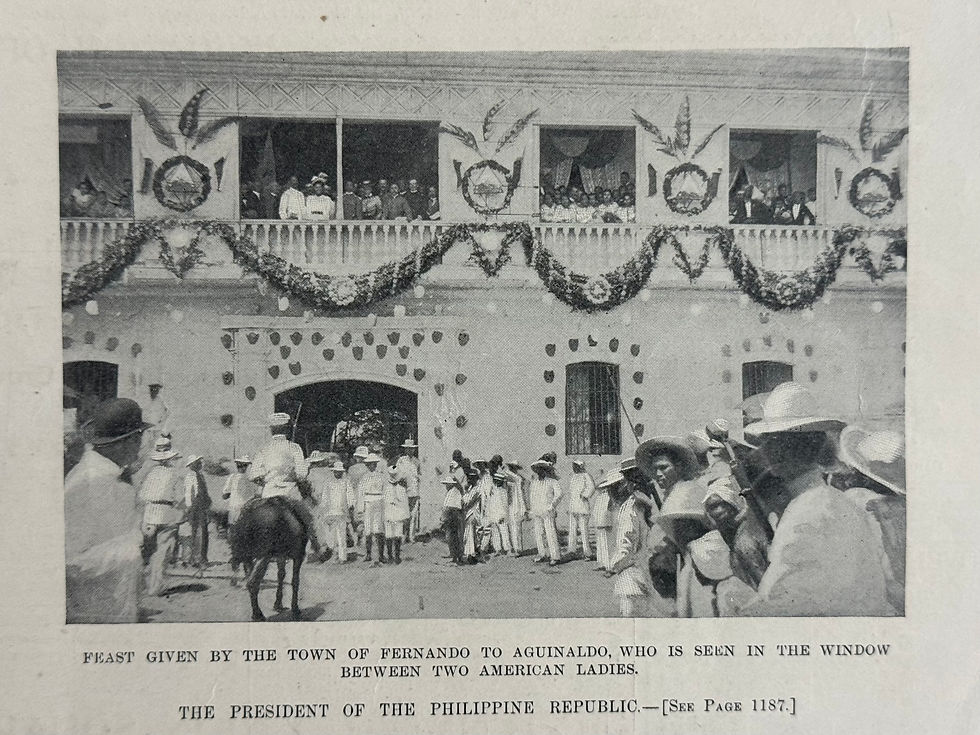
show the world what was happening. This volume contains rare, original photographs of the Filipino intelligentsia and military leaders. Seeing the faces of the Malolos Congress or the signatories of the Pact of Biak-na-Bato in a New York publication is surreal. It reminds us that while the U.S. media was busy framing the "Philippine Question," our ancestors were building the first Republic in Asia. These pages document a sophisticated struggle for sovereignty that many at the time dismissed as a minor scuffle.
You can't talk about 1898 without addressing the era's "vibe": Manifest Destiny. The political cartoons in Volume 42 are masterclasses in 19th-century spin. Historians can use these cartoons to deconstruct how "Benevolent Assimilation" was sold to the American public. You see the "Propaganda Factor" in full swing—portraying the Philippines as a child in need of a tutor and justifying a war of conquest as a civilizing mission. It’s gritty, uncomfortable, and essential to understanding our national identity today.

Owning this massive, bound volume—which, fair warning, weighs nearly 10 kilos—is a true triumph for any collector. It is a physical manifestation of the birth of modern American journalism and a foundational artifact of Philippine-American relations.
In a world of digital snippets and 280-character history lessons, there is something deeply grounding about flipping through the actual paper that a citizen in 1898 would have held. Looking through this collection, it’s easy to see how it blends news and memory. Every issue tells stories through battlefield updates, candid letters, and editorial opinions that reveal what people were feeling and hoping for at the time. Flipping through the pages, you learn not just what happened but how Americans and Filipinos changed their views over time. The magazine covers more than fighting; it includes arguments in Congress, voices of those who didn’t want an empire, and how ordinary Americans dealt with becoming a colonial power. It’s not just a bibliographic rarity; it’s a bridge to a world in flux.
The complete 1898 bound set of Harper's Weekly will be offered at auction as Lot 119 on February 14 at the Leon Gallery during the Asian Cultural Council Auction 2026.


Comments