


The Million-Peso Scrapbook: Unearthing the Visual History of Lot 575
Updated: 12 hours ago

In the exciting, dust-filled world of historiography and collecting—where the most thrilling moments often involve squinting at old paper—the true treasures are frequently hidden behind the dullest descriptions imaginable. Imagine this: It’s last October. It’s a week before my birthday, and I am casually browsing an online auction, indulging in my usual everyday habit of doom-scrolling through listings from auctions all around the world. Then an auction listing just popped up. Tucked away towards the end of the auction's catalog, like the kid picked last for dodgeball, was Lot 575. The description was a masterclass in understatement: “A Fifty Five Piece Collection of Antique Photographs From the Turn of the Century.”

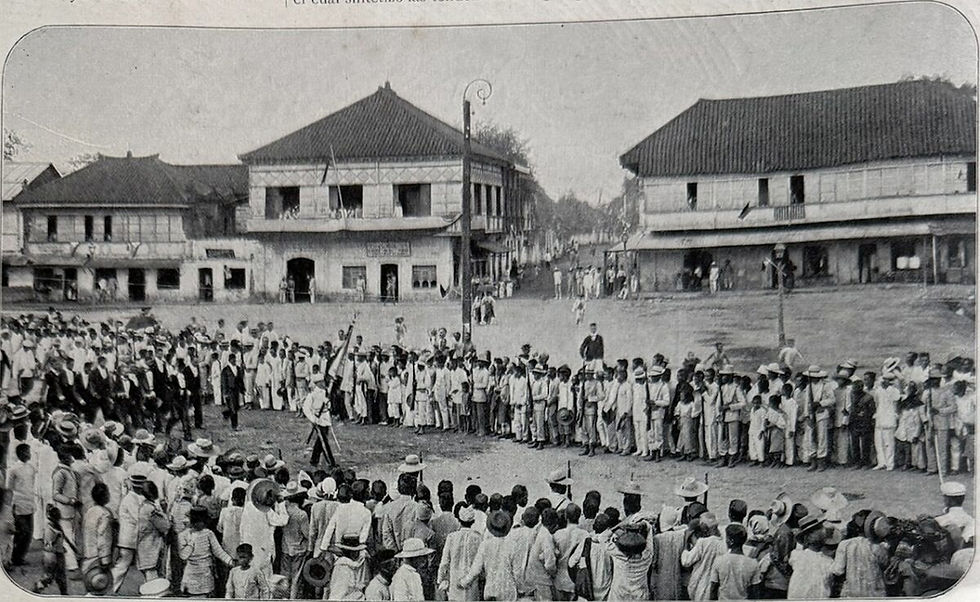
To the untrained eye, or perhaps someone with an active social life, this appeared to be a random pile of old album prints—grandpa’s vacation photos from 1899. But a careful look revealed that this album was more than just a collection of pictures; it was a solid primary source illustrating the key transition between the Spanish and American colonial periods in the Philippines. What seemed like a tourist’s scrapbook was actually a photo archive of the Philippine Revolution and the subsequent Philippine-American War. This modest collection truly reflects a transformative period in Philippine history. The photographs, seemingly ordinary, are layered with stories of bravery, change, resistance, beauty, and adaptation. Each image provides unique evidence of how Filipinos navigated the turbulent years around the start of the twentieth century, revealing subtle shifts in dress, posture, and setting that hint at larger changes across the archipelago.
Upon close examination of the album, a clear division emerged between the visual images and the written captions provided by the original owner. The captions reveal the perspective of an

outsider—likely an American serviceman or administrator—who is unfamiliar with the seriousness of the subjects he documented or the photos he collected at that time. This act of viewing—documenting and labeling—raises important questions about authorship, intent, and perspective in colonial-era photography. Who owned this collection and documented these photographs, and what motivated them? The album’s captions, often written in English and reflecting the language of occupation, reveal the complex filters through which these images have been shaped. Therefore, interpreting Lot 575 requires not only a careful analysis of the visual content but also an examination of the biases embedded in its presentation.
The difference between the label and the subject was striking. Interpreting the album becomes

a layered, yet exciting task—shifting between surface details and the deeper stories hidden within both photograph and caption. The wear on the delicate pages, along with uneven handwriting, all speak to the album’s long journey through time and different hands, with each layer adding to its story. Looking at these details helps viewers today connect not only with the people pictured but also with how these images have been interpreted and changed over generations. In this way, Lot 575 is not just a record of what was seen but also of how history was viewed, shaped, and kept alive by those who came before us.
Some examples from our own images show these photos and the mismatch with their handwritten labels, as seen firsthand through our own phone camera lens:
The "Insurgent": One photo was casually labeled “Insurgent Soldiers.” But in reality, it showed the famous image of General Gregorio Del Pilar, the Boy General himself, on his horse, looking every bit the hero of the First Republic. To our American photographer or “photo-documenter,” he was just some "insurgent." Using the term "Insurgent" reflects the American military’s naming of the time, downplaying the revolutionary general’s role as a defender of the First Republic. Talk about a failure to recognize.

The "Moutiny": The caption “Portion of wall at Cavite – Men watching for the Moutiny” suggests our photographer was not winning any spelling bees back in the States; it clearly shows the foreigner’s struggle to understand the local geography and the area’s sociopolitical tensions.

The Walled City: A photo titled “Gate To Walled City” depicts the defenses of Intramuros, symbolizing centuries of Spanish rule.

The caption "Lunetta": Ah, yes, the famous park of "Lunetta." Close, but no cigar for you.

Included were images of General Emilio Aguinaldo in uniform and various photos depicting strategic locations in Cavite, the center of revolutionary activity. These images act as a visual

record of the conflict zones, capturing moments of calm before the era's inevitable violence. These examples highlight a larger issue in interpreting colonial photographs: the tension between viewing the image as an objective record and recognizing the subjectivity of its labeling. The captions, influenced by the author's limited understanding and dominant colonial attitudes, often obscure the true identities and experiences of the Filipino subjects depicted. As modern viewers, we are responsible for peeling back these layers of interpretation, questioning the narratives imposed by outsiders, and uncovering the authentic voices and stories within each frame. By doing so, we not only respect the lived realities of those in these photographs but also reclaim the power to tell our own history.
The Crown Jewel: The Arias Mic Drop
Buried among pictures of "Comm. Phelps" and "Capt. Case" (whoever they were) was the pièce

de résistance—the photo that made my heart skip a beat. Labeled simply “Execution of Dr. Rizal,” this was not just a snapshot; it is attributed to the legendary Colonel Manuel Arias. In the pantheon of Philippine photography, images of the December 30, 1896 execution are rarer than a quiet day on EDSA. If my memory is correct, only about three or four such images exist—one at the GBR Museum, another at the National Museum, and maybe one or two collecting dust in private collections. This album likely holds the fifth publicly known example of this image. It’s a silver gelatin shadow of the moment our history changed forever. The photograph captures the exact instant of martyrdom—a visual record of the event that fueled the nationalist movement. Its presence in this otherwise simple album elevates the collection from a curiosity to a national treasure.

Market Valuation Versus Historical Worth
We identified the album as a sleeper and hoped to acquire it for a "reasonable price" (a term that means nothing in the auction world). The bidding was intense, with our own bids stopping at PHP 500,000. The lot finally sold for PHP 905,000, pushing the total cost over PHP 1,000,000. Note that the album was listed with a starting bid of only PHP 10,000, so you can imagine how far it had travelled to get to its final hammer price.
Now, we can debate "break-up value" versus "intrinsic value" all day. Sure, if you sold the photos individually, you might make a profit. But how do you assign a price to a time machine? What is the numeric value of standing in front of Rizal at Bagumbayan? The market says 1 million pesos. My historian's heart says it's priceless.
Ultimately, the hammer price indicates strong local interest in historic preservation. The winning bidder, likely a Filipino collector, has served the country and done us all a favor by keeping these artifacts in the Philippines. We sincerely hope that this privatization of heritage is only temporary. We pray these images will eventually move from a private collector’s vault to a public museum, so all Filipinos can enjoy them (and laugh at the spelling of "Moutiny"). Until then, we find comfort in knowing that history, quite literally, has come home.


one of my top 3 fave entries on this blog. and i have many faves!